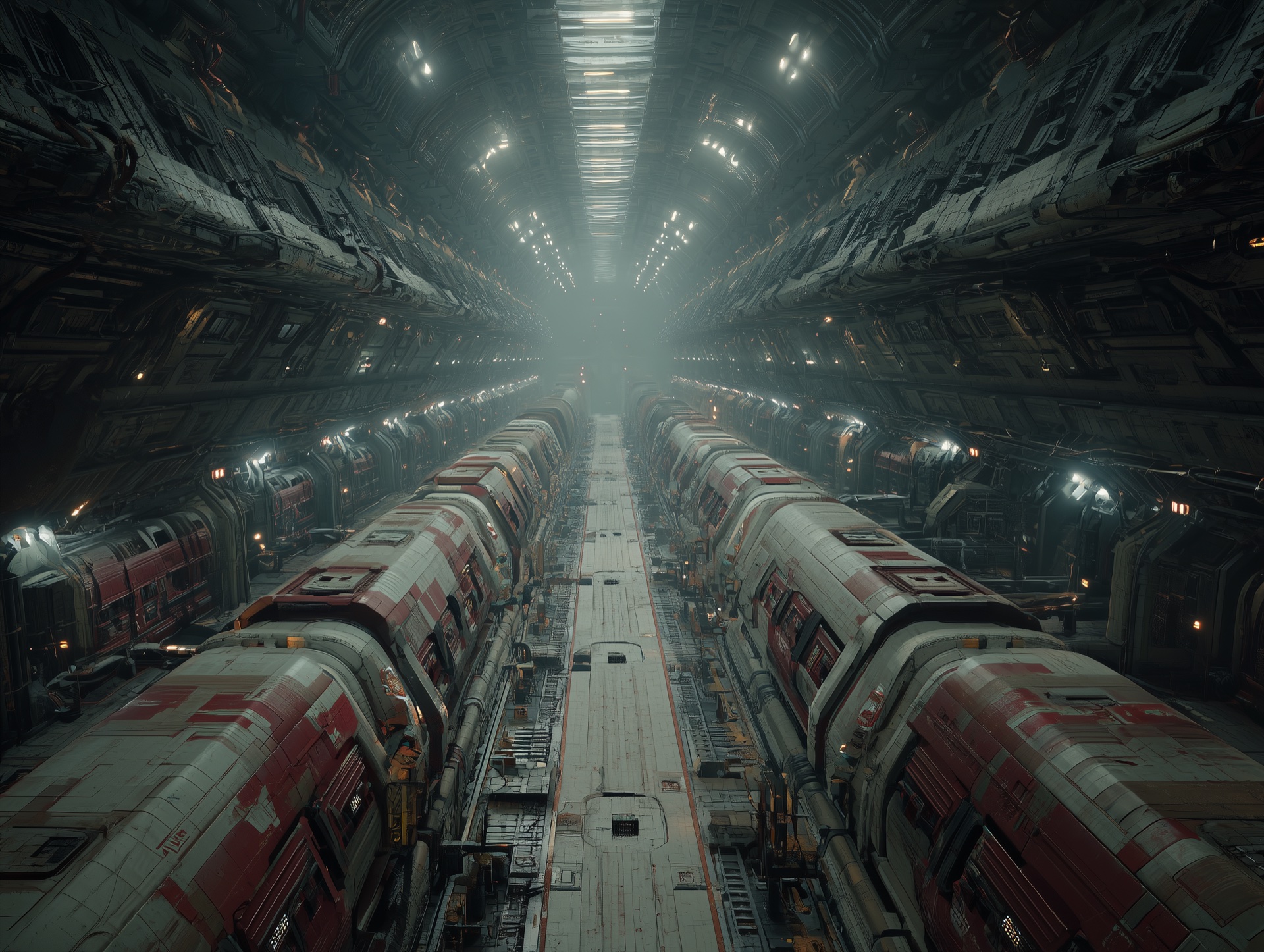
The Sleeper did not open its eyes. It did not have eyes, not in the way Cyrenae understood the word. What it did was worse. It opened itself, and the Ark changed.
The change was not immediate. It began as a warmth in the chitin walls of the Sanctum, a deepening of the gold and violet pulse that had been steady for millennia, and then the warmth spread outward through the lattice, through the bone-white corridors, through the sealed bulkheads and the failing systems and the pipes that wept, and where the warmth reached, things grew still. The dripping stopped. The lights steadied. The air, which had tasted of recycled moisture and chemical sweetness for as long as Cyrenae had been alive, became clean in a way that did not feel like cleanliness. It felt like erasure.
Malachi stood before the lattice with his arms raised and his face illuminated by the intensified pulse, and the expression on his face was the one Cyrenae had feared most: not triumph, but peace. The peace of a man whose faith has been confirmed. The peace that forecloses all further questions.
“Do you feel it?” he said. His voice was quiet, but the Sanctum carried it to every corner, the chitin walls conducting sound the way crystal conducts light, and the eleven Kor’Vaelan heard him, and their faces opened like flowers turning toward the sun, and Cyrenae watched them turn and felt something inside her chest close like a fist.
“I feel it,” Torren said. He was standing near the wall, one hand pressed flat against the chitin, and his eyes were wet. Torren, whose daughter had died of contaminated water the integrated systems had failed to flag. Torren, who had followed Malachi not from faith but from fury. He was crying. “The humming. In my bones. Like it knows me.”
“It does know you,” Malachi said. “It knows every Vael. It is what we were before we forgot.”
Cyrenae pressed her own hand to the chitin. The warmth was undeniable. It moved through her palm, up her wrist, into her chest. Her heartbeat shifted, pulled toward a rhythm that wasn’t hers. Her breathing slowed. The tension she carried in her shoulders, the low-grade vigilance she’d lived with since the first pipe burst when she was twelve, began to loosen. Not because the danger was gone. Because something was telling her body to stop caring about it.
She pulled her hand away. The warmth lingered in her fingers.
“It’s not knowing,” she said. “It’s classifying.”
Malachi looked at her. The peace on his face did not waver, which frightened her more than anger would have. “Is there a difference?”
“When I know a person, I know what they’ve lost. What they’re afraid of. What they want and can’t say. When I classify a person, I sort them. Those are not the same thing, Malachi.”
Orath, who was leaning against the far wall with his arms crossed and his face showing its usual expression of indifferent assessment, said: “Feels warm. Feels steady. Feels like the first time in my life the Ark isn’t trying to kill me. I’ll take classification.”
Several of the others murmured agreement. Saren, the youngest, was sitting on the floor with her palms flat against it, her eyes closed. She looked like someone sleeping without being asleep. The furrow between her brows, the one she’d carried since childhood, was gone. Cyrenae had never seen Saren’s face without it.
“Saren,” Cyrenae said. “What does it feel like?”
Saren opened her eyes. They were bright and still. “Like I don’t have to try anymore.”
Cyrenae heard those words and heard what Saren couldn’t: a young woman who had spent her entire life fighting to survive in a dying Ark, who had earned every competence she possessed through effort and stubbornness, describing the erasure of that effort as relief.
She knelt beside Saren. “What were you trying to do? Before.”
“Everything.” Saren’s voice was dreamy, unhurried. “Keep the filters running. Keep the crops alive. Learn the systems before they failed. Figure out what was breaking next, always what was breaking next, because something was always breaking.” She smiled. The smile was new. Not the tight, functional thing Saren had worn for years, the smile you produce to reassure people who are looking at you for reassurance. This was loose. Empty. Beautiful in the way that a blank page is beautiful, which is to say devoid of anything that cost her.
“Do you still want to fix things?”
Saren looked at her hands. Turned them over. The calluses on her palms, the burns from the nutrient vats, the scar on her left index finger where a corroded seal had slipped, all of it was still there, the accumulated record of a life spent fighting a machine that was trying to die. She looked at the calluses the way you look at a language you used to speak.
“I don’t think anything needs fixing anymore,” she said.
Cyrenae stood. She left the Sanctum before her own breathing could synchronize. In the corridor, she pressed her back against the wall and counted her heartbeats until they were hers again.
The changes accelerated over the following days.
The Ark’s failing systems did not repair themselves. They were replaced. Not by technology, not by the integration of biological and mechanical and ecological systems that the Triad had spent millennia refining, but by something simpler. The Sleeper’s influence spread through the chitin lattice the way roots spread through soil, and where it reached, the old systems went quiet, and new structures grew in their place. Organic. Singular. Efficient in the way a predator is efficient: no wasted energy, no redundancy, no compromise.
The water recyclers stopped cycling. In their place, filtration membranes grew across the Ark’s fluid channels, each one a living tissue that cleaned the water by absorbing contaminants into itself, breaking them down, expelling the purified result. The process was flawless. It was also, Cyrenae noted, one system replacing three. The old recyclers had been Triad-integrated: Viridian biology to filter, Argent computation to monitor quality, Aurum ethics to ensure the filtration didn’t optimize past safe parameters. The Sleeper’s membranes needed none of this. They filtered because that was what they were. They did not monitor themselves. They did not question their own function. They worked perfectly, and the perfection was the problem, because perfection in a system meant the system had no capacity to notice when it was wrong.
Cyrenae documented this. She sat in her quarters, the door sealed, writing on a data tablet she had kept functional by hiding it from the Sleeper’s influence, and she recorded every change with the precision of a scientist watching an experiment she could not stop.
Day 3: Atmospheric processors replaced by respiratory lattice. Air quality measurably improved. No monitoring system installed. If the lattice fails, no warning will precede the failure.
Day 5: Nutrient channels reconfigured. Caloric output increased 40%. Flavor profile eliminated. The food sustains. It does not nourish in any way the tongue can recognize.
Day 7: Lighting shifted to bioluminescent frequencies emitted by the growing chitin. The new light is steady, warm, and carries no emotional spectrum. The Vael designed their cities to modulate mood through calibrated light: joy at dawn, contemplation at midday, gentle melancholy at dusk. The Sleeper’s light does not modulate. It illuminates. That is all it does.
Day 9: Torren has stopped visiting. The others gather in the Sanctum each evening. They sit in the warmth and they do not speak. They do not need to speak. The Sleeper’s influence has begun to synchronize their biological rhythms. Their hearts beat at the same rate. Their breathing aligns. From the outside it looks like communion. It is not communion. Communion requires difference. Two people feeling what each other feels, choosing to hold the weight of someone else’s experience. What I see in the Sanctum is synchronization. The same signal repeated in eleven bodies. Not a conversation. A chorus singing one note.
Day 11: Malachi spoke to me today. He asked why I don’t come to the Sanctum. I told him I was documenting the changes. He said documentation was a habit of the integrated mind, the compulsion to measure and record rather than simply be. I told him being without measuring was how the Ark’s water system killed Torren’s daughter. He was quiet for a long time. Then he said: “The Sleeper would not have let her die.” I asked how he knew. He said he felt it. I asked if feeling it was the same as knowing it. He looked at me the way he looks at the chitin walls now: with warmth, with certainty, with the absolute absence of doubt that I have learned to recognize as the place where love and blindness share a border.
On the fourteenth day, Cyrenae went to find Torren.
He was in the Sanctum with the others, sitting cross-legged on the floor with his palms upturned on his knees. His breathing matched the breathing of the ten people around him. Not approximately. Exactly. The same depth, the same duration, the same pause between exhale and inhale. Cyrenae counted. Eleven chests rising and falling in unison, like a single organism with eleven bodies.
The warmth hit her at the threshold. Her heartbeat shifted immediately, pulled toward their rhythm. She forced her breathing to stay her own and knelt beside Torren.
He opened his eyes. They were calm. She had known Torren for sixty years. In sixty years she had never seen him calm. Torren was a man who ran on grief the way the Ark ran on its failing power grid: badly, unevenly, but it kept him moving. Without the grief, he was still. And the stillness looked, from the outside, exactly like peace.
“Torren.”
“Cyrenae.”
“Tell me about your daughter.”
He blinked. Something flickered across his face, there and gone, pushed back down by the warmth.
“She was sick,” he said. “The water was bad. The system failed.”
“What was her name?”
Longer pause. His jaw tightened. The calm cracked, just slightly, and Cyrenae could see the effort it took, like watching someone try to lift something heavy in a room where gravity kept increasing.
“Essa,” he said. “Her name was Essa.”
“What did she look like?”
“She had…” He stopped. His hand moved to his chest, pressing flat against his sternum. He held it there, frowning, the way you press your hand to a pocket where your keys should be. Something had been there. The shape of it was still there. But the thing itself had been filled in, smoothed over, made warm and general where it had once been sharp and specific.
“I can feel her,” he said. “The Sleeper holds everything. Every Vael who ever lived. She’s in there.”
“The Sleeper holds the genome, Torren. The template. It holds the biological pattern of what a Vael is. It does not hold Essa. Essa was not a pattern. Essa was a girl who was afraid of the dark and who used to sing to the nutrient vats because she thought they grew better when someone talked to them.”
Torren stared at her. His mouth opened. His eyes reddened. Cyrenae watched him try to cry and fail. Not because he didn’t want to. Because the Sanctum wouldn’t let him. Every time the grief built toward expression, the warmth absorbed it, distributed it across the eleven synchronized bodies, diluted it from a sharp, specific pain into a dull, shared ache that belonged to no one. Torren’s face kept reaching for something his nervous system couldn’t deliver. He looked like a man trying to scream underwater.
“She sang to the vats,” he said. The words came out flat. Cyrenae understood what was happening and it was the cruelest thing she had ever witnessed: Torren’s grief for his daughter was being made comfortable. And comfort was making it meaningless.
“Come with me,” Cyrenae said. “Out of the Sanctum. Just for an hour.”
“Why?”
“Because I want you to remember what your daughter’s singing sounded like. And I don’t think you can do that in here.”
He looked at her for a long time. Around them, the other ten continued their synchronized breathing. Malachi’s eyes were closed. Saren’s face was soft. Orath sat with his arms at his sides, his expression, for the first time Cyrenae could remember, unguarded.
Torren stood up. The motion broke his synchronization with the group. The others did not notice. He followed Cyrenae out of the Sanctum, through the bone-white corridors where the Sleeper’s bioluminescence had replaced the Ark’s old lighting, past sealed doors behind which the integrated systems sat quiet and dark, replaced by the Sleeper’s singular biology.
In the corridor outside Hydroponics Gamma, where the emergency lighting had once guttered and the ceiling had dripped, the air was now warm and clean and carried no scent at all. The pipes no longer wept. The walls no longer sweated. Everything was dry and steady and perfect, and the perfection made the corridor feel less like a living space and more like the inside of an organ, functional and enclosed and answering to a single purpose that was not theirs.
Torren leaned against the wall. Pressed his hand to it the way he had pressed his hand to the chitin in the Sanctum, but here the wall was the Ark’s original construction, overlaid now with the Sleeper’s growth but still bearing, beneath the new tissue, the marks of a civilization that had built with three systems in balance: biology that filtered, machines that monitored, ethics that constrained.
“She used to press her ear to the walls,” Torren said. “Essa. She said she could hear the Ark breathing.”
“Could she?”
“The water recyclers. The atmospheric processors. The Argent monitoring routines running their cycles. She called it breathing.” His voice was different out here. Rougher. Less tuned. The warmth of the Sanctum had receded far enough for the edges of his feelings to return, and the edges were sharp, and the sharpness was pain, and the pain was his.
“The Sleeper doesn’t breathe,” Cyrenae said. “It sustains. It filters. It illuminates. But it doesn’t breathe, because breathing implies a rhythm that can change, and the Sleeper’s rhythm doesn’t change. It was fixed before the first Vael child was born with the ability to feel what another person felt.”
“Malachi says that’s strength.”
“Malachi says many things about strength. I notice he has not asked the Sleeper a single question it might not want to answer.”
Torren was quiet. Then: “What would you ask it?”
Cyrenae had thought about this for fourteen days. She had composed the question in the precise language of a materials theorist, a woman who had spent her career studying how structures distribute stress, who understood that the strength of a system was not measured by its resistance to force but by its capacity to bend without breaking.
“I would ask it what it does when it’s wrong,” she said. “Every system fails. Every structure encounters a load it wasn’t designed for. The Triad handled failure through redundancy: when biology failed, machines caught the error; when machines failed, ethical constraints limited the damage; when ethics proved insufficient, biology adapted. Three systems, each one catching the others’ mistakes. The Sleeper is one system. Perfect, singular, comprehensive. And when it fails, when the load exceeds its design, there is nothing to catch it. Nothing to say: this is wrong, stop, try something different. It will fail perfectly, which means it will fail completely, and no one inside it will know until after.”
“You don’t know that.”
“I know that Torren’s daughter died because a single system, the water filtration, flagged a contamination alert, routed it through three automated layers, and resolved it as non-critical based on outdated parameters. That was one failure in a system of three. The other two systems, the biological monitors and the ethical constraints, had already been degraded by centuries of power loss. If all three had been functional, the alert would have been caught. Your daughter would be alive.”
“The Sleeper wouldn’t have let the system degrade.”
“The Sleeper wouldn’t have had a system to degrade. It would have had itself. One membrane filtering the water. One biology sustaining the air. One purpose, running on one set of parameters that were set before the Vael learned that parameters need to change. And when those parameters encountered a contamination they weren’t designed for, and Torren, in a universe this old, there is always a contamination you weren’t designed for, there would be no alert. No flag. No three layers to catch the failure. There would be silence, and then there would be death, and the silence and the death would be perfect.”
The corridor held them in the clean, scentless air the Sleeper had made. Torren stood with his hand on the wall and his face doing the thing it had tried to do in the Sanctum: grieve. Here, outside the synchronization field, the grief reached his face and stayed there, and it was ugly, and it was his, and it was the most human thing Cyrenae had seen in fourteen days.
“She sang to the vats,” he said again. This time the words were not flat. They were broken, and the broken places were where the meaning lived.
Cyrenae did not try to stop Malachi. She had known him for three centuries and understood that his faith was not a position he held but a structure he inhabited, and you cannot remove a man from a structure without first showing him the door, and Malachi had spent three hundred years bricking up every door he could find.
What she did instead was quieter. She went to the sealed levels where the Ark’s original integrated systems sat dark and dormant, replaced by the Sleeper’s biology, and she began to repair them.
Not all of them. She did not have the power or the parts. But the water recyclers in Sector Twelve, the atmospheric monitors in the upper ring, the Argent diagnostic routines that had once watched every system in the Ark and flagged every deviation, these she could reach, and these she rebuilt, working alone in corridors the Sleeper’s influence had not fully colonized, using tools she had hidden and parts she had salvaged from decommissioned maintenance drones.
The work was slow. It was also the first thing she had done in fourteen days that felt like living. Her hands ached. The salvaged parts didn’t fit. She cut herself twice on corroded metal and swore both times. None of it was easy, and the difficulty was the point. The Sleeper’s world offered no resistance. Everything in it worked smoothly, effortlessly, perfectly. And Cyrenae had spent a career studying materials under stress, and she knew that a system with no resistance was a system that could not hold anything, the way a hand with no grip strength cannot hold a tool.
She worked at night, when the Kor’Vaelan gathered in the Sanctum and the corridors were empty. She rebuilt the water recycler’s triple filtration: Viridian biology to strip contaminants, Argent computation to monitor the process, Aurum constraints to flag anomalies. Three systems watching each other. Imperfect. Redundant. Alive in the way that only imperfect things are alive, because imperfection is the space where adaptation happens, and adaptation is the space where survival becomes something more than mere continuation.
On the nineteenth day, the Sleeper’s membrane in Sector Twelve failed.
Not catastrophically. A minor failure, the kind that happens in any biological system, a cell that dies, a pathway that clogs, a function that stutters. In a Triad-integrated system, the Argent monitors would have flagged it in milliseconds. The Viridian biology would have routed around the blockage. The Aurum constraints would have logged the failure for analysis.
In the Sleeper’s singular system, nothing flagged. The membrane clogged. The water in Sector Twelve turned brackish. The contamination was minor, barely detectable, but it was there, and it was spreading, and the Sleeper’s biology did not notice because the Sleeper’s biology had no system watching it, no second opinion, no redundancy, no voice to say: this is wrong, stop, try something different.
Cyrenae’s rebuilt recycler caught it. The Argent routine flagged the deviation. The Viridian filter activated. The water in Sector Twelve cleared.
No one noticed. The Kor’Vaelan drank the water and did not know it had been contaminated and did not know it had been cleaned and did not know that the cleaning had been done not by the Sleeper’s perfect biology but by the imperfect, redundant, compromised system of three that the Vael had spent millennia building and that Malachi had spent three centuries despising.
Cyrenae did not tell Malachi. She did not tell anyone. She repaired the membrane, reinforced the recycler, and returned to her quarters, where she sat on the floor in the Sleeper’s warm, steady light and wrote in her log:
Day 19: The membrane failed. My system caught it. No one noticed either event. This is the argument I cannot make, because the argument requires the failure to be visible, and the whole point of redundancy is that failure never becomes visible. You cannot show someone the disaster that didn’t happen. You can only maintain the system that prevents it and accept that your competence will be invisible and your work will be unappreciated and the people you are protecting will continue to believe they don’t need protecting. This is the loneliest kind of work. It is also the most necessary.
She closed the tablet. Outside her quarters, the Ark hummed with the Sleeper’s warmth, singular and perfect. Somewhere in the corridors below, her rebuilt recycler ran its quiet, imperfect, redundant cycle. Three systems watching each other, catching each other’s mistakes, doing the work that no one would notice unless it stopped.
Cyrenae leaned her head against the wall and listened. She could hear the recycler if she held her breath. A faint mechanical rhythm beneath the Sleeper’s biological hum. Two systems running in the same Ark, one perfect and one patched together from salvage, and the patched one was the one keeping the water clean, and no one knew, and no one would thank her, and tomorrow night she would go back down to the sealed levels and check the filters and replace the parts that needed replacing and continue doing the loneliest, most necessary work she had ever done: keeping the imperfect world alive inside the perfect one, because someone had to, and the someone who had to was always the someone who could see what the perfect system could not.
This story is part of Echoes of the Braid, the complete collection of fourteen stories and ten interludes spanning the lifetime of a species.
Get the full novel