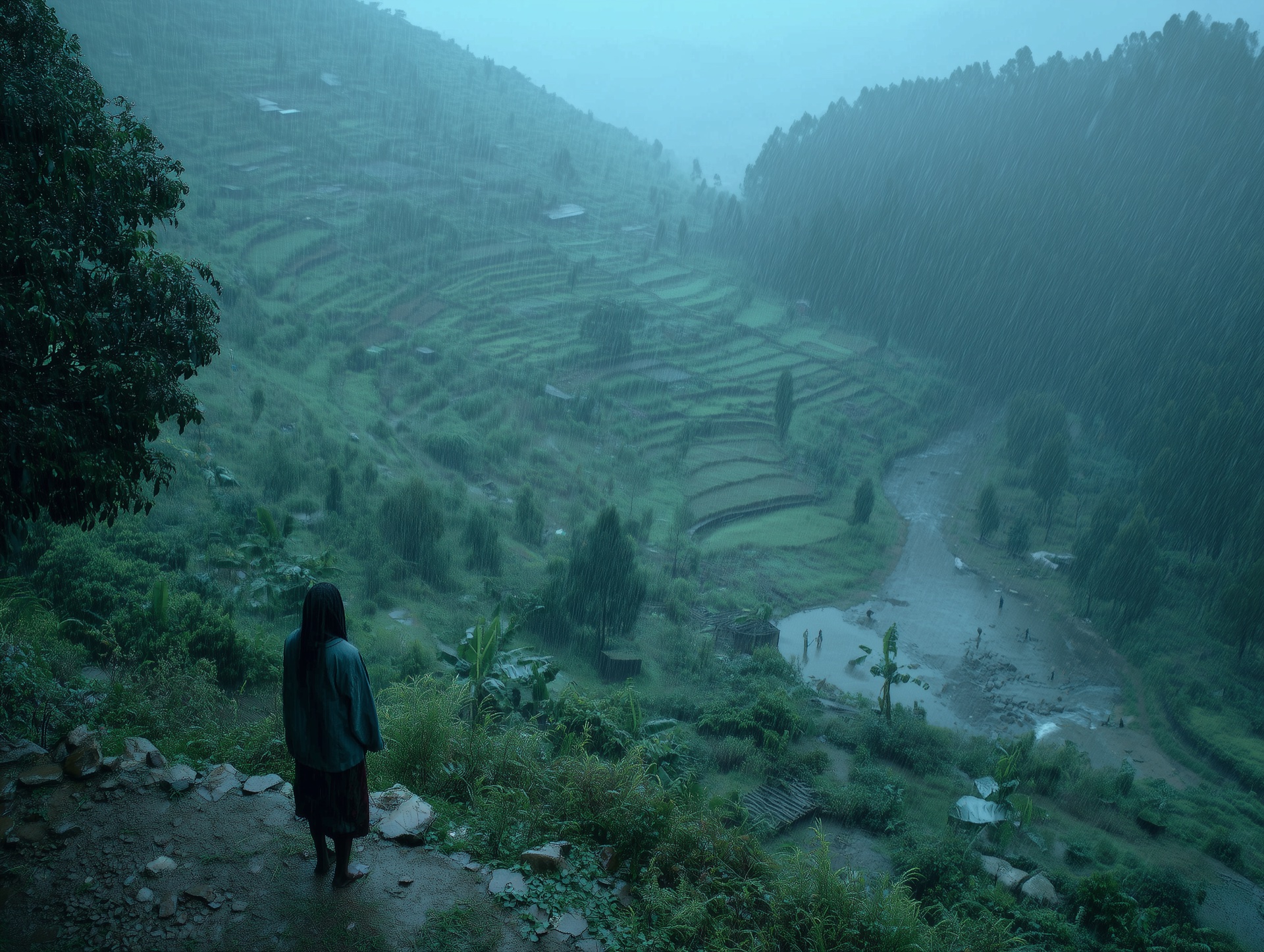
The rain fell on Accord the way it always fell: steady, soft, tasting of green things growing. Elara stood at the edge of the cistern and let it collect in her upturned palms, a habit from childhood that she had never outgrown despite the fact that no one else in the settlement did this, despite the fact that it was slightly odd, this practice of holding the rain as though it were something that needed to be caught rather than something that simply was.
The cistern was full. It was always full. The rain saw to that with a regularity that the elders called reliable and that Elara, on certain mornings, called suspicious, though she never said the word aloud because suspicion was not a quality that Accord rewarded. Accord rewarded steadiness. Accord rewarded the calm management of resources, the predictable cycles of planting and harvest, the soft routines of a settlement that had survived two generations in a world that should have been uninhabitable and was, instead, beautiful.
The valley spread below her in layered greens. The crops grew in terraced rows along the hillside, their leaves broad and dark, fed by the rain and the ash-thin soil that had been, according to the old records, poisoned beyond recovery. The poison had become nutrition. This was the word the elders used: become. As though the soil had made a choice. As though the transformation from lethal to fertile was a decision the earth had arrived at on its own, rather than a condition imposed by a technology no one in Accord fully understood.
The regulators hummed in their housings along the valley’s northern ridge. Six of them, salvaged from the ruins of what the Founders had called Vael infrastructure, maintained by Renn, who had learned their language from Iriya’s archived schematics the way other people learned recipes: through repetition and faith that the instructions, followed precisely, would produce the expected result. The regulators governed the rain. Not its timing, which seemed to follow its own logic, but its composition. The balance of minerals. The nanite density. The fine calibration of elements that turned falling water into something the soil could use and the crops could metabolize and the people could drink without the three-stage filtration that settlements outside the valley required.
Elara watched the rain and felt the thing she always felt: a pressure behind her eyes, a faint thrumming in the bones of her skull, not quite a headache, not quite a sound, more like the awareness of being listened to by something she could not see. She had felt it since childhood. She had mentioned it once, to her mother, who had looked at her with the careful blankness of a person choosing not to worry. “That’s just the rain,” her mother had said. “Everyone feels it.”
But everyone did not feel it. Elara had asked. Carefully, over years, in the sideways manner of someone who has learned that certain questions make people uncomfortable. Renn felt something. “A hum,” he called it. “Background noise. Like the regulators, but deeper.” The others felt nothing, or claimed to feel nothing, or had stopped noticing long ago the way you stop noticing the sound of your own breathing.
The children played by the cistern. Six of them, ages four to nine, splashing in the overflow channel that carried excess water to the lower terraces. They played the way children play everywhere: with complete commitment and no awareness of the systems that made their playing possible. The water they splashed in had been calibrated. The air they breathed had been filtered. The emotional texture of their afternoon, the particular quality of contentment that made play feel safe, that made the world feel manageable, that kept the low-grade anxiety of existence on a wounded planet at a volume the body could absorb without distress, all of it was managed. Tuned. Maintained.
Elara did not know this yet. But she felt it, the way you feel a room whose temperature is exactly right: not by noticing the temperature but by the absence of discomfort, a comfort so complete it becomes invisible, which is the point, which is the design.
Renn found her at the cistern as the light shifted toward evening. He was carrying a toolkit, the leather case worn smooth by years of handling, the tools inside arranged with the meticulous precision of someone who understood that the gap between a properly calibrated regulator and an improperly calibrated one was the gap between the settlement’s continued existence and something no one wanted to name.
“Number four is drifting again,” he said. He sat down beside her, not close, not far, the distance they had maintained since childhood, which was the distance of people who knew each other completely and had decided, without discussion, that completeness did not require contact.
“Drifting how?”
“Output frequency. It’s shifted three points since last week. Still within parameters, but the trend is wrong.” He opened the toolkit and laid out the instruments on the stone wall with the care of a surgeon. “I can correct it. I always can. But it’s correcting more often. The drift is accelerating.”
“What does that mean?”
He looked at her. The look was the one she knew, the look of a question without an answer, the look that appeared on his face when the regulators did something his schematics did not explain. “I don’t know. The regulators were built to last. The Founders understood them, or Iriya did, and Iriya’s notes are thorough. But she never described this kind of drift. The frequency the regulator is shifting toward isn’t in her documentation.”
“Maybe it’s adapting.”
“Machines don’t adapt.”
“The Vael ones do. That’s the whole point of the Triad. Biological, mechanical, ecological, all integrated.” She said this lightly, the way she said all things that came from the old records, with the disclaiming tone of someone quoting scripture they half believed.
Renn did not answer. He picked up a calibration probe and turned it in his fingers, and the turning was a thought, and the thought was one he did not share.
The blight came from the west.
It arrived not as an event but as a change in the light. Elara noticed it first, standing on the bluffs at the valley’s western edge, looking out at the landscape beyond Accord’s borders. The land out there was different. Everyone knew this. Beyond the regulators’ reach, the world was what the Fracture had made it: contaminated soil, mutated vegetation, air that tasted of metal and the particular sweetness of unprocessed nanite suspension. The outerlands were survivable, barely, for short periods. No one went there unless they had to. No one had to.
But the light over the western ridge was wrong. Not the amber-tinged clarity that Accord’s filtered atmosphere produced, and not the grey murk of the contaminated lands. Something between. A bruised quality, as though the air itself was inflamed. And beneath it, visible as a darkening of the soil, a line of dead vegetation spreading eastward toward the valley’s edge.
She brought Renn. He brought instruments.
“The field is degrading,” he said, his voice flat in the way it went flat when he was frightened. “The Pluvial Net, the regulatory field, whatever you want to call it. It’s losing coherence at the western boundary. The blight is what happens when the field fails. The raw environment pushing in.”
“Can you fix it?”
“From here? No. The regulators govern the field’s local parameters. Frequency, composition, dispersal. But the field itself, the Net, it’s generated from somewhere else. Somewhere deeper. The regulators are speakers. Whatever is playing the music is somewhere else.”
The elders met in the council hall. Elara stood at the back and watched their faces in the low light. Elder Theron, the oldest, whose voice had the dry quality of a man who had spent his life managing decline and calling it governance. Elder Maeve, who ran the agricultural rotation and understood the soil the way Renn understood the regulators: practically, without theory, with an intuition born of decades of paying attention. Elder Coss, who kept the Founders’ Archive and who spoke of Kaelen and Karn and Iriya and Daxos with the reverent familiarity of someone describing saints.
“The Founders’ records mention a place,” Theron said. “The Sanctum of Perception. In the Blackwood Peaks. The records are fragmentary. Mentions, not descriptions. But the fragments suggest it is the source. The origin point of the field that sustains us.”
“Or a ruin,” Maeve said. “The Founders’ era left nothing but ruins.”
“The regulators aren’t ruins,” Coss said. “They function. The schematics function. The field functions, or did until now. The Founders built something that worked, and if it is breaking, the fix is at the source.”
Theron looked at Elara. Then at Renn. The look was not a request. It was an assignment, given in the manner of a man who had run out of options and was distributing what remained.
“Go there,” he said. “See what’s to be seen.”
There was no talk of succeeding. Only of going.
They left at dawn. The rain fell as mist at the valley’s edge, and beyond the edge it stopped, and the stopping was abrupt, a line drawn in the air where the field’s influence ended and the raw world began. Elara stepped across the line and felt the pressure behind her eyes change. Not increase. Shift. The thrumming she had carried since childhood, the background hum that her mother had called “just the rain,” was gone. In its place: a different kind of pressure. Rawer. Less organized. The world unfiltered, pressing against her perception with a weight that was not unpleasant but was undeniably heavier, the way unprocessed sound is heavier than music.
Renn checked his instruments. “The field attenuates here. Completely. We’re outside it.” He looked at the reading and then at the landscape and then at Elara. “The Pluvial Net. Its reach is finite.”
She nodded. She could feel the finitude in her body. Her bones, which had always hummed at a frequency she had never questioned, were humming differently. Her skin registered the air as sharper, the temperature as less stable, the light as harsher and more variable. She was feeling, for the first time, the world that existed outside the curated version she had been born into. And the feeling was not terrible. It was loud.
They walked for three days. The outerlands were a landscape of ruin and recovery. Twisted spars of metal jutted from the earth at angles that suggested violence. The soil was dark, contaminated, but not dead. Things grew in it. Not the tidy crops of Accord but wild, adapted things: thick-stemmed plants with leaves that pulsed faintly with bioluminescence, fungal mats that spread across the ruins in patterns too regular to be random, vine structures that climbed the broken pylons and produced, in their upper reaches, small hard fruits that the birds ate without apparent harm.
The world was not uninhabitable. It was differently habitable. It was the version of habitable that you arrived at when no one was managing the conditions, when the soil and the rain and the biology were left to negotiate their own terms, and the terms were rougher and stranger and more inventive than anything the regulators had produced.
“There are energy patterns here,” Renn said on the second night. They were camped in the shell of a collapsed structure, its walls providing shelter from the rain, which fell here with a metallic taste that made Elara’s teeth ache. “Not Vael. Not natural. As if the air itself is processing something.”
“Processing what?”
He adjusted his instruments. The readings made his face do the thing it did. “I don’t know. It feels like listening. Like something in the air is monitoring us.”
“The Net?”
“Maybe. Or what’s left of it, out here, without the regulators to focus it. Like hearing someone talk in another room. You can’t make out the words, but you know someone’s speaking.”
The entrance to the Sanctum was a shadow in a cliff face, where water wept down black stone and pooled in basins worn smooth by centuries. Inside, the tunnel hummed. Not the hum of the regulators, which was mechanical and precise. This was deeper. Biological. A frequency that vibrated in Elara’s chest and sternum and the small bones of her inner ear, and the vibrating was not random but patterned, and the pattern was a pulse, and the pulse was slow and steady and felt, in a way she could not justify, like breathing.
The tunnel opened into a chamber.
It was not a room. It was a sphere, vast, its walls a slow vortex of light and geometric forms that shifted and reformed in patterns that Elara’s eyes could follow for a moment before losing the thread. The patterns were not decorative. They were functional. They were the visible expression of a system in operation, the way the glow of a furnace is the visible expression of combustion. Something was working here. Something was running.
At the chamber’s heart, a platform of dark crystal. Consoles ringed it, cold and silent. Renn went to the nearest one and pressed his hand to its surface and the surface lit with glyphs, some that he knew from Iriya’s schematics and many that he did not, and the ones he did not know outnumbered the ones he did by a ratio that made his face go still.
Elara walked to the platform. The air around it was charged. The hum intensified. She stepped onto it.
The world broke open.
Not physically. Perceptually. The pressure behind her eyes, the lifelong thrumming, shattered like a glass held at its resonant frequency, and what rushed in was not silence but everything. The raw, unfiltered, uncurated torrent of sensory information that the field had been managing since before she was born. Colors she had never seen because the field had dampened them. Sounds she had never heard because the field had smoothed them. Emotional registers she had never felt because the field had kept them at a volume the human nervous system could process without distress.
The distress arrived. It arrived as volume. The world was louder than she had known a world could be. Not in the auditory sense. In every sense simultaneously. The light was too detailed. The air carried too many chemical signatures. Her own body was generating signals she had never received before: the acid in her muscles, the pressure in her blood vessels, the micro-tremors of an autonomic nervous system that had been partially managed by the field since her first breath and was now, suddenly, unsupervised.
She sat down on the platform. The crystal was cold. The cold was specific. In Accord, cold was a gentle thing, modulated, always within the range the body could process comfortably. This cold was not modulated. It was the actual temperature of stone in an underground chamber, and the actuality was a sensation she had never fully experienced, and the newness of it at the age of twenty-six was the first indication of how much of her life had been curated.
“Elara.” Renn’s voice, from the console. The voice was different here. Sharper. His vocal cords were producing the same sounds they had always produced, but without the field’s subtle processing, the harmonics were rawer, the emotional texture less smooth. He sounded frightened. He sounded like himself, and the himself was someone she had not fully heard before.
“This place,” he said. His voice had the flat quality it took on when he was frightened, each word placed carefully, like a foot on uncertain ground. “It’s not weather control. It’s not environmental management. It’s perception. It’s shaping what we see. What we feel. What we are.”
“Renn.”
“The regulators. The ones I’ve been maintaining for six years. The ones Iriya’s schematics describe as atmospheric processors.” He was reading from the console, his fingers moving across the Vael glyphs with a speed that meant he was not translating but absorbing, taking in the schematics the way a person takes in bad news: fast, so it arrives as a single blow rather than a sequence of smaller ones. “They’re not processing the atmosphere. They’re processing us. The rain is a carrier. Every drop contains a nanite payload that interfaces with the human nervous system through the skin, through the lungs, through the water we drink and the food we grow in the soil it feeds. The Pluvial Net. It’s a perceptual field. It manages human consciousness. Not controlling it. Tuning it. The way a person tunes an instrument. The way you adjust the tension on a string until it produces exactly the note you want.”
“Tuning it for what?”
“For coherence. For emotional stability. For a specific bandwidth of feeling that the system can harvest.” He scrolled through another screen. His hands were shaking. “The contentment we feel, Elara. The steadiness. The way Accord feels safe, the way the evenings feel warm, the way the children play without that edge of anxiety that kids in the outer settlements carry. That’s not us. That’s not the valley. That’s the field, keeping our emotional output within parameters that produce…” He stopped.
“Produce what?”
He read from the log, and his voice was hollow. “Psychic architecture stabilized. Human consciousness clusters exhibiting desired resonance patterns. Sustained generation of coherent emotional energy achieved. The Unbound Collective requires this tribute for continued coherence in non-corporeal stasis.”
The words arrived in Elara’s body before they arrived in her mind. She felt them as a physical sensation: the blood leaving her face, the muscles in her stomach contracting, the small hairs on her arms rising. She felt them as the field would have prevented her from feeling them, at full volume, without the dampening that would have spread the shock across minutes instead of letting it hit in a single, concentrated moment.
The rain. The peace of Accord. The crops that grew in soil that should have been dead. The contentment that settled over the valley like a warm blanket every evening, the sense of safety that made children play by the cistern without fear, the steadiness that Elara had called reliable and then called suspicious and had never, until this moment, called what it was.
A farm.
They were livestock. Their emotions were the crop. The Vael, or what remained of the Vael, disembodied, sustained in some non-corporeal state, fed on the coherent emotional energy that the field extracted from the people of Accord the way a bee extracts nectar from a flower: gently, without damage, leaving the flower intact to produce more. The flower did not know it was being harvested. The flower only knew that the sun shone and the rain fell and the soil was good. The flower was content. The contentment was the product.
“The Founders,” Elara said. Her voice was small. On the platform, without the field, she could hear exactly how small it was. “Did they know?”
Renn scrolled through data. His face told the answer before his voice did. “The archives don’t say. Kaelen’s resonance abilities, Karn’s vigil, Iriya’s schematics, Daxos’s pathfinding. They built Accord. They activated the regulators. Whether they understood what the regulators connected to…” He trailed off. The data on the screen offered projections, contingencies, consequences. He read them and she watched him read them and the watching was the last moment of her old life, the last second before the knowledge became hers completely, the last breath before the air in her lungs became the air of a person who knew.
“The blight,” she said.
“A failure in the field. Where the perceptual management breaks down, the raw environment pushes in. The soil reverts. The crops fail. The people…”
“The people feel what’s actually there.”
“Yes.”
She looked at her hands. They were trembling. On the platform, she could feel the trembling at its actual amplitude, without the field’s dampening, and the amplitude was larger than she would have expected, and the largeness was the size of what she was feeling, which was everything, all at once, without the buffer that had made her entire life livable.
She thought about the children at the cistern. She thought about their play, the unself-conscious joy of it, the safety they felt in a world that was not safe, in a valley that was a cage, under rain that was a claim. She thought about Elder Theron and Elder Maeve and Elder Coss and her mother and every person she had ever known, all of them living inside a managed experience, their sorrows softened, their anxieties smoothed, their capacity for suffering kept at a volume the nervous system could absorb without breaking, and the keeping was not kindness but husbandry, and the husbandry was not theirs.
She thought about what would happen if she did nothing. The blight would spread. The field would continue to degrade. The curated reality of Accord would unravel, and the people inside it would feel, for the first time, what the world actually felt like: the raw grief, the unmodulated fear, the full weight of existing on a wounded planet without a buffer. Some of them would be fine. Some of them would break. The children at the cistern would lose the safety they had never known was manufactured, and the loss would be real, and the suffering that followed would be real, and real suffering was a thing that the field had been protecting them from, and the protection was a lie, and the lie was also a mercy, and the mercy was also a cage, and the cage was also a home.
She went to the crystalline chair at the heart of the platform. The Vael interface pulsed. The pulse was the same slow rhythm she had felt since entering the tunnel. The breathing of a system that had been running for two generations, tending its garden.
“Help me,” she said to Renn.
He came to her side. His face was the face of a man who understood what she was about to do and could not think of an alternative and hated both facts equally. He showed her the controls. How to modulate the frequencies. How to find the resonance of the blighted zone, the ragged edge where the field had torn and the raw world was leaking through. How to weave the pattern back together.
She closed her eyes. She reached, not into the rain’s song, not into the familiar hum that had been her companion since birth, but into the vast, silent architecture of the Perceptual Field itself.
The architecture was enormous. She had expected a machine, something with edges, something that could be mapped. What she found was closer to a weather system. Currents of organized energy flowing through channels that branched and rejoined like a river delta, each channel carrying a specific frequency, each frequency tuned to a specific aspect of human perception. One channel governed color saturation. Another governed the threshold at which anxiety became conscious. Another regulated the speed of emotional recovery, how quickly grief faded, how soon after a loss the brain began producing the chemicals that said: you are okay, the worst is over, you can continue. She could feel the channels the way she had always felt the pressure behind her eyes, but now she could see them, and the seeing was the difference between hearing a language spoken and reading it written, between sensing a structure and knowing its grammar.
She found the boundary of the blight. It was a ragged edge where the channels had torn, the organized currents spilling into chaos the way water spills when a levee breaks. Beyond the edge: the screaming static of minds untethered from the consensus, the raw terror of people in the outer settlements whose reality had suddenly become unmanaged, whose emotions were arriving at full volume for the first time. She could feel them. Individual signals in the static. A woman whose grief for a dead child had been held at a manageable level for three years and was now arriving all at once. A man whose ambient anxiety, normally smoothed to a background hum, had become a roar that locked his muscles and stopped his breathing. Children who had never felt the full weight of the world’s wrongness and were feeling it now and had no framework for it and were screaming.
She wove. She took the pattern she knew, the pattern of Accord, the familiar limits, the gentle palette of managed feeling, and she extended it across the torn boundary. The work was not technical. It was intimate. She had to match each channel to its correct frequency, and the matching required her to feel the frequency, to produce it in her own nervous system, to become, briefly, the emotional state the channel was designed to impose. Contentment. Safety. The warmth of an evening with nowhere to be. The quiet confidence that tomorrow would be like today. She produced each feeling and let the system amplify it and push it outward, and the producing felt like lying, because she did not feel content, she did not feel safe, she felt the full, unfiltered horror of what she was doing, and she did it anyway, and the anyway was the thing she would carry for the rest of her life.
She felt the chaos resist. Felt the raw world push back against the curated version, felt the boundary between real and managed flex like a membrane under pressure. And she felt, distant and cool and vast, the satisfaction of the Unbound Collective as the flow of their harvest began to mend. The Vael, or what remained of them, receiving the tribute of human emotion, sustained by it, dependent on it, as dependent on the farm as the farm was on the rain. Their satisfaction had a texture. It was not cruel. It was the satisfaction of a gardener watching wilted plants recover after watering. Patient. Proprietary. The satisfaction of something that owned what it tended and saw no distinction between the owning and the care.
She opened her eyes. The chamber was still. The vortex of light on the walls had calmed. Her face was wet. She touched her cheek and her fingers came away with tears she did not remember producing, and the tears were the first unmanaged thing her body had done in this chamber, and she let them fall.
“It’s done,” Renn said.
They sat in the Sanctum for a long time. The hum surrounded them, steady and warm and terrible. Renn did not speak. Elara did not speak. The silence between them was the silence of two people who had learned the same thing at the same time and were carrying the weight separately because carrying it together would require words, and the words did not exist yet, and when they did exist they would be inadequate, and the inadequacy would be its own kind of wound.
They walked back to Accord.
The walk took three days. They did not speak for the first day. Not from anger or shock but from the weight of what they were carrying, which required both hands, which left nothing free for the work of turning knowledge into language. They walked side by side through the outerlands and the outerlands did what they had always done: they existed, without apology, without management, without the invisible hand that had shaped every moment of Elara’s life into something bearable.
The contaminated soil, the mutated vegetation, the air that tasted of metal and nanite suspension, all of it was what it was. It made no claims. It offered no comfort. A vine had grown across their outbound path in the three days they’d been gone, thick-stemmed and pulsing with bioluminescence, and Elara stepped over it and felt, in the stepping, the difference between this world and the one she was walking back to. This vine grew where it grew because the conditions allowed it. No one had tuned the conditions. No one had decided that this vine should grow here, producing this light, creating this specific effect on the traveler who stepped over it. The vine was an accident. An adaptation. It was the world making the best of what the Fracture had left, and the best was strange and wild and did not require anyone’s emotional energy to sustain itself.
On the second night, Renn spoke. “We could stay out here.”
Elara looked at him. They were camped in the shell of a ruin, the rain drumming on the metal above them, unprocessed, unfiltered, tasting of everything the Pluvial Net would have removed.
“We could walk south. The outer settlements survive without the Net. It’s harder. The rain is raw. But they’re free of it.”
“They’re free of it because they never had it. Their bodies adapted to the raw environment. Ours didn’t. We were born in the field, Renn. Our nervous systems developed inside it. Take it away and we don’t just lose comfort. We lose the baseline our biology was calibrated against.”
He was quiet for a while. “You’ve thought about this.”
“I thought about it the entire time I was repairing it.”
“And?”
“And the children. The ones at the cistern. The ones who’ve never felt the world without the buffer. If I collapse the field, they feel everything. All at once. The full weight of this planet, unfiltered, arriving in nervous systems that were built to process the curated version. Some of them might adapt. Some of them would break. And I would have broken them. Knowing I was breaking them. Choosing to break them because I decided that my knowledge of the truth was more important than their ability to survive.”
Renn looked at the rain falling beyond their shelter. “So we go back.”
“We go back.”
They crossed into the field’s range on the third afternoon. Elara felt it happen: the pressure behind her eyes shifting, the thrumming returning to its familiar frequency, the emotional volume decreasing, the world softening around her like a lens going out of focus. The relief was immediate. Her shoulders dropped. Her jaw unclenched. The acid knot in her stomach that she had been carrying for three days began to dissolve, not because the knowledge had changed but because the field was doing what the field did, taking the sharp edges of feeling and rounding them, taking the volume and turning it down, making the unbearable into the bearable, which was its function, which was its gift, which was its crime.
Renn felt it too. She watched him close his eyes. Watched the tension leave his face. Watched him take a breath that was deeper and easier than any breath he had taken in the outerlands, and the ease was the product, and the product was them, and they walked back into the garden knowing what grew there and who it grew for.
The blight was receding. The line of dead vegetation at the valley’s western edge was pulling back, the soil recovering its managed fertility, the crops straightening. The people of Accord met them at the settlement’s edge with faces full of relief and gratitude and the particular quality of joy that comes from a crisis averted, a danger passed, a world returned to its comfortable, familiar shape.
They were feasted. They were called heroes. Saviors. Elder Theron clasped Elara’s hand and said the words that communities say to the people who fix things: you have saved us, we are grateful, the future is bright. The words were genuine. The gratitude was genuine. The future they described was a cage, and the cage was all they had, and the having was also genuine, and Elara stood in the warmth of their gratitude and felt the field smoothing the edges of her anguish into something she could carry and keep walking.
Days later. The bluffs. The rain.
Elara stood with Renn at the valley’s edge and watched the rain fall on Accord. The settlement lay below them in its green valley, orderly, peaceful, beautiful. Smoke rose from hearths. Children played. The regulators hummed on the northern ridge, freshly calibrated, the drift that Renn had noticed now corrected, the frequency stabilized by the repair Elara had made at the source. Everything was working. Everything was tuned. The garden was tended.
Each drop that touched her skin felt like a tiny, cold claim.
“They don’t know,” Renn said. It was not a question.
“No.”
He looked out at the valley. The neat rows of crops, the full cistern, the terraced hillside in its layered greens. “Is it better this way?”
She watched the rain. It fell on her hands, her face, the back of her neck. It fell the way it always fell: steady, soft, calibrated. It fed the soil and the crops and the cistern and the children and the silent, unseen network that fed on what the rain fed. A closed system. A circle of sustenance. The rain fell and the crops grew and the people felt what the field allowed them to feel and the Vael, whatever they had become, drifted in their non-corporeal stasis and drew what they needed from the coherent emotional energy of a species that had been tended, for two generations, like flowers in a garden they did not know was a garden.
She did not have an answer. The Founders had made their choices. Kaelen had greened the soil. Karn had stood watch. Iriya had built the schematics. Daxos had found the path. They had built a world that worked, and the working was real, and the cost of the working was invisible, and the invisibility was the design, and the design was the kindest possible version of what it was, which was farming, which was husbandry, which was the management of living things for the benefit of other living things, and the question of whether the managed things’ ignorance constituted consent was a question that had no answer because the asking of it required knowledge that the managed things did not have and would not want if they did.
She stood in the rain and felt it on her skin, each drop a claim and a comfort and a cage and a home. She felt the field doing what the field did: smoothing her anguish, lowering the volume of her grief, making the unbearable bearable, which was its function, which was its gift, which was its crime. And she let it. Because the alternative was to feel everything at full volume, and full volume was what she had felt in the Sanctum, and full volume was the truth, and the truth was that the world was louder and harsher and more painful than any unmanaged nervous system was built to sustain, and the Vael had known this, and the Vael had built a solution, and the solution was Accord, and Accord was her home, and home was the place you returned to even when you knew what it cost, especially when you knew what it cost, because the knowing was the price of staying and the staying was the only choice that let the children play by the cistern without learning, at four or six or nine, that their joy was fuel.
Renn stood beside her. He did not touch her. He did not speak. He stood in the rain and let it fall on him and felt what she felt: the weight of knowledge that could not be shared without destroying the thing it described.
The rain fell. It washed the world. It made things clean. It made things grow. And it fed the unseen, the vast and silent others who drifted beyond the edge of perception, tending their garden with the patient, invisible care of something that needed what grew there and had built the most beautiful possible cage in which to grow it.
The sky wept. Or perhaps it was only the Vael, tending their garden.
This story is part of Echoes of the Braid, the complete collection of fourteen stories and ten interludes spanning the lifetime of a species.
Get the full novel