Here is a question nobody asks until the answer is the only thing between them and dying: how much of yourself can you replace before the thing doing the replacing isn’t you anymore? Not in the philosophy seminar sense. In the sense that the air is running out and someone has a way to make your lungs work differently and the cost is that your lungs will never work the old way again, and your hands will never feel quite the same, and the person you were in love with will still be in the room but you will reach for the memory of their touch and find it filed under a category your old brain didn’t have and your new brain doesn’t have a word for. In that sense. The immediate, no-take-backs, your-body-is-the-essay-question sense.
Thaelle remembered the light.
Not the bioluminescent murk that surrounded her now, not the cold blue threads of engineered algae pulsing along the trench walls, but the light above. The light of Vaelith-Kess’s three white suns, filtered through a kilometer of ocean and arriving at the seabed research station as a faint, warm suggestion. A reminder. You are beneath something bright. You chose to be here, and there is a way back up.
That had been before the Fracture sealed the surface.
The geological surveys had described it as a crustal reorganization. The Fracture’s propagation through Vaelith-Kess’s tectonic plates had triggered a chain of submarine landslides that buried the ascent shafts under nine hundred meters of displaced basalt. The surface stations went silent. The orbital platforms, already struggling with the Fracture’s effects on their stabilization fields, ceased transmitting within days. Thaelle and the eleven other researchers at Abyssal Station Kol-Enne had listened to the silence fill the communication channels the way sediment fills a canyon: slowly, completely, with a finality that did not announce itself but simply arrived and stayed.
Eleven months. Recycled air growing thinner. Nutrient vats depleting. The thermal regulators failing one by one as the geothermal vents shifted position, the Fracture rearranging the planet’s deep geology with the indifference of a hand stirring soup. On the three hundred and forty-first day, the primary atmospheric processor failed, and the station’s remaining air supply dropped to a projection of fourteen days.
Thaelle called them together on the three hundred and forty-second day.
They sat in the common room, all twelve, around a table built for research briefings that had become, over eleven months, the place where they rationed and argued and occasionally laughed. The air tasted thin. Not dangerously so, not yet, but thin enough that everyone noticed, the way you notice a sound only when it starts to fade.
Thaelle laid out the modifications. She used the display, showed the schematics, walked them through each stage. She kept her voice clinical. She was a deep-adaptation specialist, trained in the Vael science of directed biological restructuring, and she had performed hundreds of procedures. Always minor. Always reversible.
What she proposed was neither.
She finished. The room was quiet. Korel, who sat closest to her, was studying the gill schematics with the focused attention he gave to anything mechanical. Vess had her arms crossed. Brielle was looking at the table.
Drell spoke first. He was the station’s geologist, broad-shouldered, older than the rest by two decades, and he had a way of asking questions that sounded like he already knew the answers. “The gill system. It replaces the lungs.”
“It repurposes them,” Thaelle said. “The existing pulmonary tissue is harvested and recultured. The new architecture uses the same vascular pathways.”
“But you can’t reverse it.”
“No.”
“And the skin. You’re describing a permanent loss of fine tactile sensation.”
“The dermal layer has to be thick enough to withstand four hundred atmospheres. The nerve endings that handle fine texture can’t function through that density. We keep pressure and proprioception. We lose…” She paused. “Softness.”
Drell nodded slowly. “And the eyes.”
“Optimized for bioluminescence. Solar-spectrum light becomes painful. Intolerable.”
“So we’d be blind on the surface.”
“If there were a surface to return to.”
That landed. The room shifted. Chairs creaked. Someone exhaled.
Vess uncrossed her arms. “Say what you’re actually proposing, Thaelle. Not the biology. The thing itself.”
Thaelle looked at her. Vess was a fluid dynamicist, precise with language, impatient with euphemism. She deserved a straight answer.
“I’m proposing that we stop being what we are and become something that can survive here. Permanently. Irreversibly. We would be Vael who can live in the deep ocean. We would not be Vael who can live anywhere else.”
Another silence. Brielle raised her head from the table. She was the youngest, barely past her apprenticeship, and she had been crying intermittently for three days, which no one mentioned because the air was too thin for unnecessary conversations. “What about the things we lose? Not the biological things. The…” She touched her own face, fingers tracing her cheekbone. “I don’t know how to say it.”
“You don’t have to know how to say it,” Drell said. His voice was gentle but firm. “You just have to know it’s real. The things your body remembers that your mind doesn’t have words for. The way a specific touch feels. The way light looks on water when you’re above it instead of under it. Those aren’t luxuries. Those are you. The part of you that lives in your tissue, not your brain. And she’s asking us to replace that tissue.”
Thaelle did not argue. She couldn’t. He was right.
“So what are you saying?” Korel asked. “We should die instead?”
Drell turned to him. “I’m saying we should understand what we’re choosing. Not just ‘survival’ in the abstract. Survival as this.” He gestured at the schematics on the display. “As something that can’t feel what we feel. Can’t see what we see. Can’t go back to being what we are right now, sitting in this room, breathing this thin, terrible air with lungs that have worked since we were born.”
“Fourteen days,” Korel said. “That’s how long those lungs have left.”
The room went quiet again. Thaelle watched the twelve faces and saw the argument playing out behind each one, the same argument in twelve variations: the body they knew against the body that could survive. Neither side was wrong. Neither side could win without the other side dying.
“I’ll take a vote,” she said. “No pressure. No judgment. If you choose not to modify, I will respect that completely. We have enough supplies to maintain the station’s atmosphere for the five who stay.”
“Five,” Vess said. “You’ve already counted.”
Thaelle held her gaze. “I’ve watched you for eleven months. I know who’s going to say yes and who’s going to say no. I’m not proud of that. But I’m not going to pretend I don’t.”
The vote was seven to five. Thaelle had been exactly right.
Stage One took nine days.
The gill tissue grew from their own pulmonary walls, cultured in the station’s remaining bioreactors and grafted along the ribcage in three paired sets. Thaelle performed each procedure herself, her hands steady, her focus absolute. Korel went first. He lay on the medical table with his shirt open and watched the ceiling while Thaelle positioned the grafts along his ribs.
“Describe what you feel,” she said. Clinical habit. The researcher in her still taking notes even now.
“Pressure. Like something sitting on my chest.” He was quiet for a moment. “Not painful. Wrong. Like a word pronounced with the wrong emphasis. You understand it but it bothers you.”
On the fifth day, she put Korel in the test pool.
He submerged his face, and his body seized. Not pain. Reflex. His lungs heaving against water that was entering through the wrong openings, his diaphragm spasming against a rhythm it had never been asked to abandon. Thaelle gripped his shoulder. She could feel the gill slits along his ribs fluttering open under the water, the new tissue tasting the sulfur-rich fluid, beginning to process it.
“Breathe out,” she said. “All the way. Empty your lungs.”
He did. The bubbles rose. His lungs went flat, and for a terrible second he was neither breathing nor filtering, just a body in water with no oxygen source. Then the gills caught. The flutter became a rhythm. His shoulders dropped. His hands, which had been gripping the pool’s edge, loosened.
He lifted his face out. Water streamed from the gill slits, and he gasped, his lungs reflexively filling, and the two systems fought each other for three ragged breaths before settling into an uneasy truce.
“That,” he said, “was the worst thing I’ve ever felt.”
“Does it hurt?”
“No. It’s worse than hurting. It’s like forgetting how to swallow. Something your body has always done without asking, and suddenly it doesn’t know how.” He pressed his hand against the gill slits on his left side. They pulsed under his fingers. “These work. I can feel them working. But my lungs don’t know they’re redundant yet. They keep trying.”
By the ninth day, the lungs stopped trying. Thaelle sealed her own mouth, submerged, and felt the water enter the gill slits along her ribs. Not comfort. Not discomfort. A fact. Her body accepting input from a source it had not evolved to use.
She surfaced and spoke to Korel and heard her own voice, changed. Thinner. The gill tissue had displaced a portion of her vocal architecture. She sounded like someone speaking from a smaller room.
“You hear it too,” Korel said. His voice was higher, tighter.
“Yes.”
They looked at each other across the test pool. Same faces. Different voices. They had crossed something, a line that was not visible until you were on the other side of it, and the other side was exactly like this side except that you could not go back.
Stage Two was the skin.
Thaelle performed the procedure on herself first. The dermal restructuring was gradual, twelve days of slow thickening, the outer layers densifying into something that could withstand four hundred atmospheres. The new skin would keep pressure and proprioception. It would lose fine touch. Texture. Warmth.
She monitored the change with clinical precision during the day and discovered what it meant at night.
On the eighth day, she reached for a data tablet and could not feel the surface beneath her fingers. She could feel the tablet’s weight, its edges, its temperature. But the texture was gone. She picked up other objects. A stylus. A water container. The fabric of her research tunic. She felt their shapes, their masses. She did not feel them.
She found Korel in the corridor outside the lab. He was running his thumb across the wall, back and forth, back and forth, with the repetitive focus of someone trying to tune a broken instrument.
“Can you feel that?” she asked.
“I can feel that I’m touching it.” He kept rubbing. “I can’t feel the wall. The roughness. That sort of gritty texture the paneling has. Had.” He stopped. Looked at his thumb. “When did you stop being able to feel it?”
“This morning.”
“For me it was yesterday. I didn’t say anything because I thought…” He turned his hand over, examining the palm. The skin looked the same. Slightly smoother, maybe. “I thought it might come back.”
“It won’t.”
He nodded. Put his hand down. “Brielle cried again today. She was trying to braid Vess’s hair, and she couldn’t feel the strands between her fingers. She could hold them. She could see them. She could pull. But the texture, the individual strands, nothing. She just sat on the floor and cried.”
Thaelle said nothing. There was nothing clinical to say. She had designed this loss into the procedure the way an architect designs a load-bearing wall into a building. It was structural. It was necessary. It was also the removal of a sense so fundamental to intimacy that its absence felt like amputation.
That night, she lay in her bunk and pressed her hand against the wall. Nothing but pressure. The mechanical fact of surface meeting surface. She thought about Orath.
Orath’s hands. Long-fingered, precise, warm. On the surface, before the Fracture, in a house that looked out over the phosphorescent tidepools. When Orath touched Thaelle’s face, she could distinguish each finger by its pressure, its temperature, its texture. She had carried a map of those hands in her skin, not in her memory but in the nerve endings themselves, tuned by years of contact to recognize that specific touch the way a lock recognizes a key.
The map was gone. The nerve endings that had held it had been replaced. The memory persisted in her mind, vivid, accessible. But the tissue that could confirm it, that could say yes, this is the touch you remember, that tissue was no longer hers. Memory without the body’s ability to confirm it. A ghost of a sensation in a body that could no longer feel it.
She found Vess the next morning in the lab, running her fingers along the edge of a spectrometer with the same slow, testing motion Korel had used on the wall. But her face was different. Not grief. Something closer to concentration.
“You’re checking,” Thaelle said.
“I’m noticing.” Vess lifted her hand and turned it over, studying the palm. “It’s quieter. My hands used to be noisy. Every surface had an opinion. Rough, smooth, warm, cold, sticky, dry. Constant input. I didn’t realize how much of my attention it took until it stopped.”
“And that doesn’t bother you?”
Vess looked at her directly. “I’m a fluid dynamicist. I spent my career trying to perceive systems clearly, and my own skin was always in the way. Every time I touched an instrument, my fingers had feelings about it. Preferences. This surface is pleasant, this one isn’t. As if my skin’s comfort mattered to the data.” She set her hand flat on the table. “Now I touch the spectrometer and I feel the spectrometer. Its weight. Its temperature. Its dimensions. No editorial. No noise. Just the thing.”
“You’re saying you prefer this.”
“I’m saying I’m not mourning it the way you are. And I think you need to know that, because you designed this procedure carrying the assumption that everyone would experience the loss the way you do. We don’t. For some of us, the loss is a clearing.”
Thaelle stared at her. She wanted to argue. She wanted to say that the noise Vess was dismissing was the same thing as Orath’s fingers on her face, the same nerve endings, the same capacity. That you couldn’t celebrate the clearing without acknowledging what had been cleared.
But Vess was already back at the spectrometer, her thick, quiet fingers moving over its surface with a precision that did, Thaelle had to admit, look like freedom.
She was in the lab on the eleventh day of Stage Two when Drell came to the door. He was one of the five. He looked the same as he always had, which was now, against the altered faces and thickened skin of the seven, almost shocking in its familiarity. Ordinary Vael skin. Ordinary Vael eyes.
“Can I come in?”
“Of course.”
He sat across from her at the workbench. He looked at her hands. She looked at his. His fingers were unmodified, the skin thin and responsive, the nerve endings intact. She could see a small scar on his left index finger that she knew he’d gotten from a core sample drill in his first year at the station. She could see every detail of his hands. She could not feel her own on the table.
“How’s the air?” she asked.
“Getting interesting.” He almost smiled. “Headaches in the morning now. Vess calculated we have nineteen days, assuming the recycler holds.” He paused. “I didn’t come to talk about the air.”
“What then?”
“Brielle asked me something yesterday. She asked if I thought she was still herself.”
Thaelle waited.
“I told her yes. And I meant it. She’s still Brielle. She cries at the same things. She laughs at the same things. She’s afraid of the same things, just with different eyes and thicker skin.” He leaned forward. “But I’m asking you the same question, and I want a different kind of answer. Not whether you’re still yourself. Whether you’ll still be yourself after Stage Four.”
Stage Four. The neural modifications. Dampened emotional volatility.
“You’ve read the specifications,” Thaelle said.
“I’ve read them. ‘Reduced amplitude of emotional response to conserve metabolic resources.’ That’s a clinical way of describing what you’re actually going to do to yourself.”
“What am I actually going to do to myself?”
“Turn down the volume on everything that makes loss unbearable. Which is also everything that makes love worth having.” He held her gaze. “You’ll survive, Thaelle. I believe that. You’ll swim out of this station and into the ocean and you’ll live. But will you miss Orath?”
The name hit her in the chest. Not because it was unexpected but because Drell had said it with his full, unmodified voice, and the sound of Orath’s name in a voice that still carried its original depth was a thing she had not heard in weeks, and it broke something she had been holding in place with clinical precision and professional focus.
“I’ll always miss Orath,” she said.
“You’ll always have the memory. That’s not the same thing. Missing someone is the memory plus the pain. You’re about to edit the pain.”
She could not answer that. He was right. She had designed Stage Four knowing he was right, and she had designed it anyway, because the deep ocean did not care about the things that made loss unbearable, and the deep ocean was the only place left to live.
Drell sat with her for a while longer. Neither of them spoke. When he left, he touched her shoulder, and she felt the pressure of his hand, the weight of it, the warmth of it through the thickened dermal layer, and she did not feel his fingers, did not feel the texture of his skin against hers, and the absence was louder than anything either of them could have said.
Stage Three was the eyes.
The visual restructuring replaced the photoreceptors tuned to solar-spectrum light with receptors optimized for bioluminescence. The cost was everything warm. Red. Orange. Gold. The colors the Vael associated with comfort and home. Gone, replaced by blues and violets and frequencies that had no name in the Vael color vocabulary, because they existed only in the deep ocean, produced by organisms that had never seen a sun.
The change took six days. On the first day, the station’s artificial lighting looked cooler, flatter. On the third, it became uncomfortable. On the fifth, Thaelle turned the lights off in her quarters and discovered she could see. Not darkness. The station’s walls emitted faint traces of bioluminescent compounds, absorbed from the surrounding water over months, and her new receptors read them the way her old eyes had read sunlight.
On the sixth day, she looked at her reflection in the observation port.
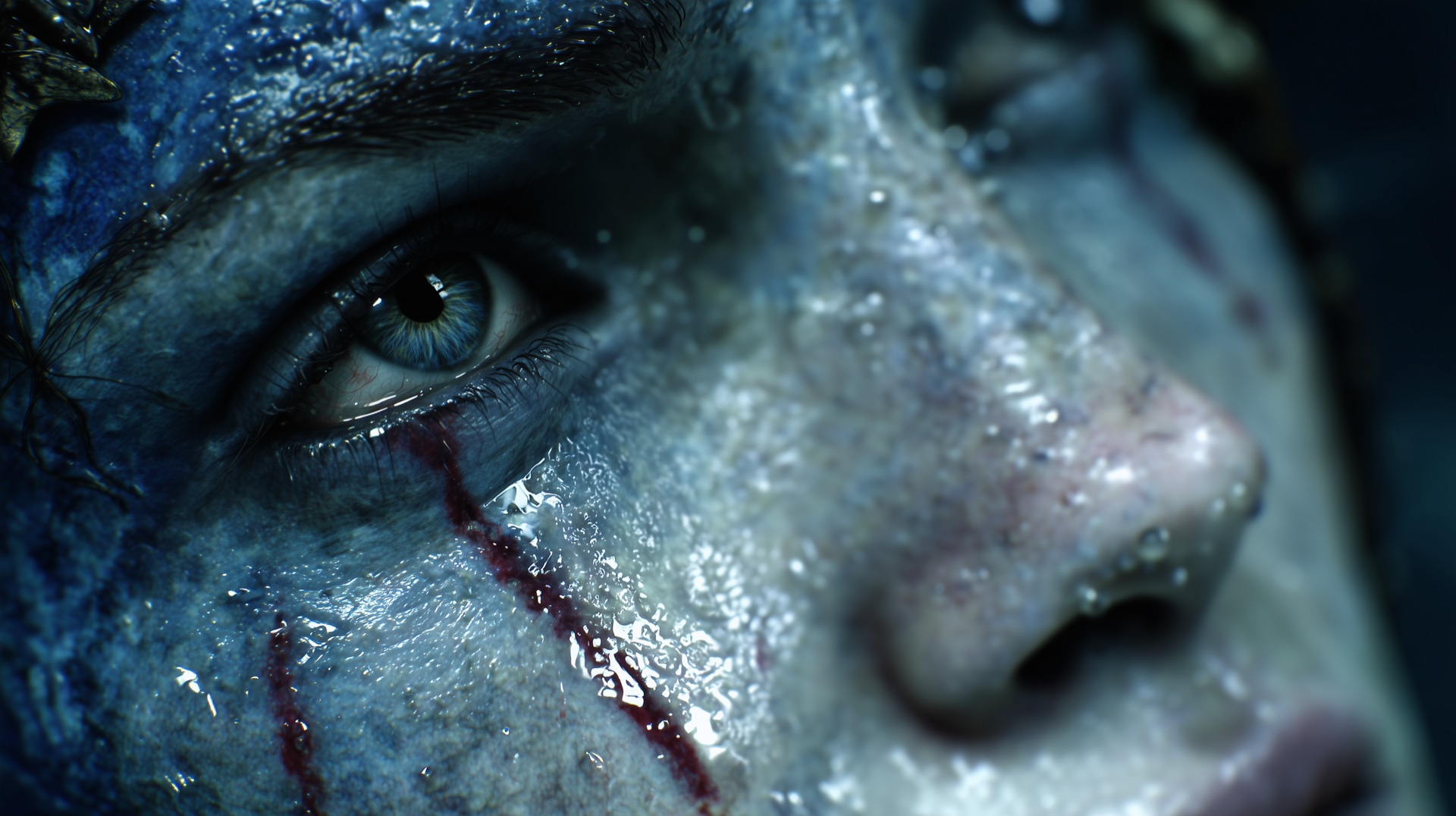
The face was hers. The eyes were not. The pupils had widened permanently, the irises thinned to dark rings around pools of black that caught the bioluminescent light and held it. The eyes of an abyssal creature. She turned from the glass and found Brielle standing behind her.
Brielle’s eyes were the same. Dark, wide, light-drinking. She was staring at Thaelle with an expression that the old eyes would have been harder to read but that the new ones caught in precise bioluminescent detail.
“I can’t picture my mother’s face,” Brielle said.
“What do you mean?”
“I mean I can describe it. I know what she looks like. I could list every feature. But when I close my eyes and try to see her, the colors are wrong. The skin tone, the eye color. I reach for them and there’s nothing there. My brain doesn’t have those colors anymore.”
Thaelle sat down on the bunk. Brielle sat beside her. Their shoulders touched, and neither of them felt the texture of the contact, only the pressure, only the weight.
“I keep trying,” Brielle said. “I close my eyes and I try to see her. And I get the shape. The proportions. But it’s like a drawing with no color. Like someone erased half the painting and left the lines.”
“Orath’s eyes were hazel,” Thaelle said. She hadn’t meant to say it. It came out the way air comes out of lungs that no longer need to breathe. Reflex. “Brown and green and gold. I know that. I can say the words. But I can’t see it anymore. Hazel isn’t a color my brain can generate.”
They sat together in the bioluminescent dark. Two Vael who could see everything the deep ocean had to offer and could no longer picture the faces of the people they loved in the colors those faces had actually been.
“Is this the answer?” Brielle asked. “To Drell’s question? Is this when we stop being us?”
Thaelle thought about it. Not as a biologist. As a person sitting in the dark with someone who was frightened.
“I think we stop being us when we stop knowing what we’ve lost,” she said. “We still know. That might be the worst part. But it’s also the part that means we’re still here.”
Brielle leaned into her. Thaelle put her arm around the younger woman’s shoulders, and the gesture was the same as it had always been, the same motion, the same intent, and the fact that neither of them could feel the other’s skin the way they once would have did not make it less. It made it something else. A kindness that persisted after the body’s ability to fully receive it had been taken away.
She found Korel later that night at the observation port. He had turned off every light in the corridor, and he was standing with his face close to the glass, looking out into the trench. His dark, widened eyes were moving.
“Come here,” he said. “Turn off your headlamp.”
She did. The corridor went black, and then it didn’t, because the bioluminescence was everywhere, faint threads of it pulsing through the station’s walls, glowing traces on the floor where the seawater had crept and retreated. But that wasn’t what Korel was looking at.
Outside the port, the trench wall was alive.
She had seen it before with her old eyes. A dark cliff face, occasionally punctuated by the glow of thermophilic colonies. Functional. Unremarkable. With the new receptors, it was something else entirely. The organisms covering the rock emitted light in patterns she had never been able to resolve, cascading pulses that moved up the cliff face like breath, like a heartbeat, in wavelengths that her old visual system had dismissed as noise. The patterns interlocked. They responded to each other. They were, she realized, communicating, a conversation in light that had been happening outside this window for eleven months without anyone in the station being able to see it.
“It’s been here the whole time,” Korel said. His voice was quiet, not with grief but with something closer to reverence. “We’ve been sitting in this station for a year, and this was right outside, and we couldn’t see it.”
“It’s beautiful,” Thaelle said, and meant it, and then heard herself say it and felt something crack. Because it was beautiful. The new spectrum was not a diminishment. It was a revelation. And the fact that she could see this, could stand here and perceive a conversation in light that no surface-dwelling Vael had ever witnessed, and simultaneously could not picture the color of Orath’s eyes, these two facts existed in her at the same moment, and neither one cancelled the other, and the space between them was not a contradiction but a corridor she would walk through for the rest of her life.
“You don’t look happy,” Korel said.
“I’m not unhappy. I’m…” She searched for the word. “I’m seeing something beautiful with eyes that can’t remember someone I love. Both things are true. I don’t know how to hold both things.”
Korel was quiet for a while. The trench wall pulsed.
“Maybe you don’t hold them,” he said. “Maybe you just walk forward and they walk with you.”
She passed Torren in the corridor on the way back. He was one of the five. He was sitting on the floor with his back against the wall, knees drawn up, arms wrapped around himself. He was not doing anything. He was just sitting.
“Torren.”
He looked up. His eyes were ordinary. Unmodified. In the faint bioluminescent glow of the corridor they looked flat and dim, and Thaelle realized with a small shock that she was seeing unmodified eyes as deficient now. That her perceptual baseline had already shifted.
“I can’t stop thinking about the water,” he said.
She sat down across from him. “What about it?”
“The pressure. The cold. You’ve been talking about gills and skin and eyes, the mechanics of it, what you gain, what you lose. But I keep thinking about the water itself. Three and a half kilometers of it above us. I know we can’t go up. I know the surface is gone. But the surface being gone and choosing to live in the water are two different things.” His hands were shaking. He pressed them against his knees. “You’re choosing the thing that would have killed us. You’re making your bodies into something that belongs to the thing that would have killed us.”
“The water isn’t malicious, Torren.”
“I know. I know it isn’t. But it’s the water.” He pressed harder on his knees. “I grew up on the coast. Northern reach. Phosphorescent tidepools. I used to swim in the shallows and dry off in the sun, and the sun was warm, and the air was warm, and the water was something I chose to enter and chose to leave. I could always leave.” He looked at her. “You’re making it so you can never leave.”
She had no answer for him that wasn’t the answer she’d already given in the common room. Survival. Necessity. The arithmetic of fourteen days. But Torren wasn’t asking about arithmetic. He was afraid of the water the way a child is afraid of the dark, not because the dark contains anything but because you can’t see the edges, and not seeing the edges means not knowing where you end.
“I’m sorry,” she said.
“Don’t be sorry. Be right. About all of it. The gills, the skin, the eyes. Be right, because if you’re wrong, then we all just died for nothing, the five of us in here and the seven of you out there.”
She touched his arm. Pressure. Weight. No texture. He flinched, not from pain but from the strangeness of being touched by skin that felt like polished stone.
“I’ll be right,” she said. She didn’t know if it was true. She said it anyway because he needed to hear it, and because the gap between what she could promise and what she could deliver was smaller than the gap between living and dying, and smaller gaps were all any of them had left.
Stage Four was the last.
Thaelle prepared the neural modification sequence in the medical bay, calibrating the dosage, checking the targeting parameters against the diagnostic display. Enhanced spatial processing. Accelerated pattern recognition. And the last line: dampened emotional volatility.
She was sealing the injector when someone knocked on the door. She opened it. Korel stood in the corridor, his dark eyes catching the bioluminescent glow, his gill slits pulsing slowly at his ribs.
“Brielle and Vess are already done,” he said. “I’m next. But I wanted to talk to you first.”
“About what?”
“About going last.” He stepped inside. Looked at the table. Looked at the injector in her hand. “You’re going to do this to yourself, alone, in a locked room. The way you’ve done everything. Clinical. Controlled. The woman who designs the sacrifice and then performs it on herself because she doesn’t trust anyone else to get it right.”
“Someone has to go last.”
“Someone has to go last. But you chose to go last because you wanted to be the last person who could still feel this at full volume. You wanted to be the one who carried it longest.” He sat on the edge of the table. “I know you, Thaelle. You’ve been rationing your grief the way we ration air. Spending a little at a time, making it last. And now you’re about to turn it down and you want to be alone for that, and I understand, and I’m not going to let you.”
She stared at him. Her fingers tightened on the injector.
“Why?”
“Because Drell can’t be here. He’s on the other side of the airlock with nineteen days of air, and he asked you the only question that matters, and you owe it to someone to answer it while you still can.” He held out his hand. “Give me the injector. I’ll administer it. You lie down. And before I press the trigger, you tell me about Orath. Not what you remember. What you feel. Right now. At full volume. And I’ll witness it. And then we’ll turn it down.”
She looked at his hand. Thick-skinned. The same hand that had gripped the pool’s edge during his first gill-breath. She placed the injector in it.
She lay on the table. The diagnostic display showed her brain in cross-section, the circuits that would be modified pulsing in amber.
“Orath had hands,” she said. “Long fingers. Precise. Warm on good days, cool on others. When Orath touched my face, I could feel each finger separately. Not just pressure. Identity. This one. Then this one. A conversation between skin and skin.”
Korel positioned the injector at her temple.
“I can’t feel my own face anymore,” she said. “If Orath walked in right now and touched me, I would feel the weight. I would not feel the conversation. And after you press that trigger, I will remember this, and the remembering will be quieter, and the quiet will be permanent, and I need you to know that the quiet is not the same as the feeling being gone. It’s the feeling being put into a smaller room. And I’m choosing the smaller room because the ocean doesn’t have space for the big one.”
“I know,” Korel said.
“Press it.”
He did. The modification hit her limbic system in a wave she could track on the display, circuits dimming from amber to a cooler blue. She felt the amplitude drop. Not to zero. The sadness was still there. But smaller. Contained. The ache of Orath’s hands retreated from something that filled her chest to something that occupied a specific point behind her sternum, sharp and small and permanent.
She sat up. Korel was watching her. His own eyes, already modified from Stage Four that morning, were calm, steady, reading her face for signs of distress with an efficiency that was itself evidence of the modification’s success.
“How do you feel?” he asked.
“I feel like someone turned the lights down in every room I’ve ever lived in.” She pressed her hand to her sternum, where the small, sharp point of Orath lived now. “It’s still there. But I have to reach for it. Before, it reached for me.”
Korel nodded. He set the injector down and did not say anything else, and the silence between them was the kind of silence that happens when two people have lost the same thing at different volumes and are learning to hear each other in the new quiet.
They left the station on the four hundred and nineteenth day.
Seven of them, moving through the airlock into water so cold and pressurized that their old bodies would have been crushed in seconds. Their new bodies processed the water through gill slits. Their new eyes read the bioluminescent landscape of the deep trench with a clarity that turned the abyss into a cathedral of cold light. Their new skin registered the pressure as neutral fact. Their new minds observed all of this with an efficiency that left no room for awe.
Thaelle turned back to the airlock. Through the porthole, she could see the common room. The table. The five chairs still occupied. Drell was sitting closest to the glass. He raised his hand. Not a wave. A gesture she recognized, the Vael salute used for departures that were permanent, palm open, fingers spread, held for a count of three.
She raised her hand. Palm open. Fingers spread. She held it for three, and then for three more, because the dampened circuits could not produce the grief that should have accompanied the gesture but could still recognize that grief was owed.
Drell lowered his hand. He turned back to the table, to the thin air, to the nineteen days he had left. He did not look at the porthole again.
Thaelle turned away. The deep ocean spread before her, vast and cold and alive with a light she had been redesigned to see. Somewhere above, beyond nine hundred meters of collapsed basalt, the surface of Vaelith-Kess continued to exist under three white suns whose light she could no longer tolerate. Somewhere in her memory, Orath’s hands rested on her face, and the sensation was a label without content, and the color of Orath’s eyes was a word she could no longer illustrate.
She swam into the dark, and the dark was bright, and she was alive, and the question of whether she was still herself had an answer she could no longer feel strongly enough to grieve.
This story is part of Echoes of the Braid, the complete collection of fourteen stories and ten interludes spanning the lifetime of a species.
Get the full novel