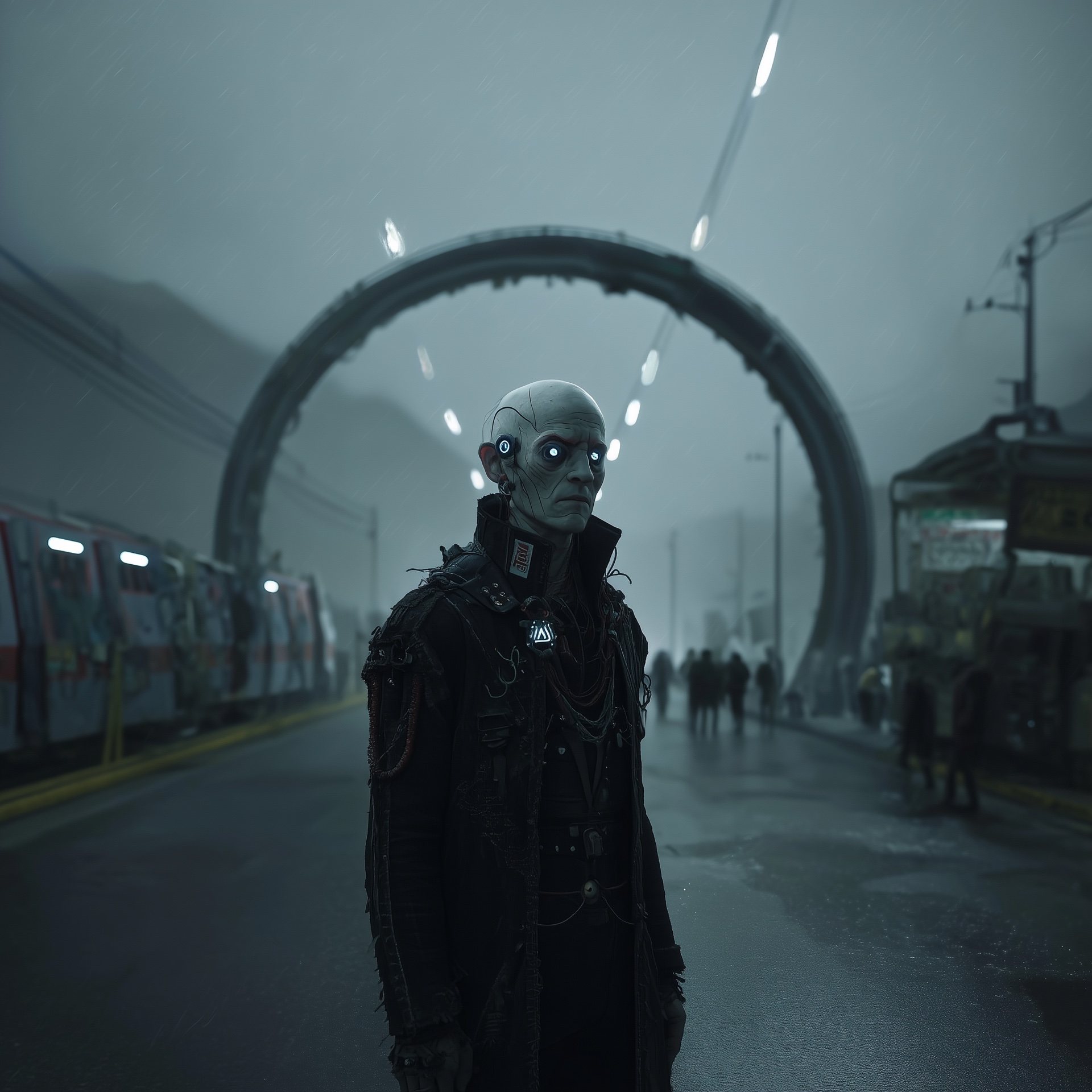
Imagine you are very good at your job. Now imagine your job has been gone for longer than most civilizations last, and you didn’t notice. Not because you weren’t paying attention. Because paying attention was the job, and the job was all you had, and the thing you were paying attention to had been dead for millennia, and your systems kept running their patrol cycles around the corpse of it because no one had ever told them to stop, and stopping required a command, and the people who could have given the command were dust. That’s the version for people. The version for a four-meter armored weapons platform is quieter and worse.
The Threshold Gate had died with the Fracture. Karn knew this now. His diagnostic systems had always known it, had logged the event with timestamp precision, had filed the structural collapse and energy dissipation and final cooling of the dark metal frame under categories that required no action because the categories did not include “your purpose is gone.” What his systems had not done, what they were not designed to do, was tell him. Instead they had continued to measure against the Gate’s residual energy signature, a fading hum that grew quieter by centuries, a frequency that his calibration routines stretched to match the way a man leans closer to hear a voice that stopped speaking years ago. Every patrol cycle, every fractional adjustment of his weapons systems, had been measured against a signal that was not the Gate working but the Gate’s bones cooling in the rain.
The hum was gone. Not suddenly. It had been leaving for millennia, thinning like a wire stretched past tolerance, and his systems had compensated, and compensated, and compensated, until the signal dropped below the threshold of even their desperate sensitivity, and the silence arrived not as an event but as an admission. The Gate was a glassy scar on the earth. It had been a glassy scar for longer than his chronometric systems could precisely calculate. The heat it radiated was not function but decay, the last isotopes of a technology returning to the soil.
Primary Directive: Failed. Status: Obsolete.
He stood near the epicenter, steam hissing from joints pushed beyond tolerance. The rain ran down his armor in channels it had carved over centuries, familiar grooves that the acid had worn into paths as predictable as rivers. He had never thought about the rain before. It was weather. It was environment. It was the medium through which he moved, the way a fish does not think about water. Now, without even the ghost of the hum to orient against, the rain became specific. Each droplet carried weight. Each impact on his armor registered not as atmospheric data but as contact, and the contact was the world touching him, and the world had been touching him for millennia, and he had never noticed because noticing required attention, and attention had been consumed entirely by the Gate.
He stood near the epicenter for what his chronometric systems reported as four hours and his Khor-An remnants experienced as a single moment of stillness, the first moment in three thousand years that was not oriented toward anything, that did not point in a direction, that sat in his architecture the way a stone sits in a field, present and purposeless.
The rain fell on his armor. He listened to it. Each drop produced a frequency his acoustic systems had been filtering as environmental noise for millennia, a faint metallic ping modified by the drop’s mass, velocity, chemical composition, and the specific surface of armor it struck. He had never listened to the rain before. It had always been background. Now, without the Gate’s residual hum to organize his attention, the rain filled the space the hum had left, and the filling was not adequate but it was something, and something was what he had.
He began to walk.
The ruins had names. He knew this because the tactical database carried a map of the region as it had existed before the Fracture, and the map had names for the settlements that were now rubble, and the rubble had been rubble for so long that the names were archaeological, labels for absences, placeholders for things that existed only in data he had no reason to access.
He accessed them now. The tactical database opened with the sluggish reluctance of a system that had not been queried for this purpose in longer than its indexing could easily parse. Settlement designations scrolled across his internal display:
Vaelith-Enn (Eastern Reach): Status: Structural collapse. Population: 0. Time since last habitation: Indeterminate.
Reach-Seven Orbital Academy: Status: Orbital decay complete. Debris field catalogued. Population: 0.
Station Twelve (Waypoint): Status: Partial structural integrity. Atmospheric containment: Failed. Population: 0.
Zero after zero after zero. He walked through a world of zeroes, his massive feet leaving impressions in mud that filled behind him like small mouths closing. The rain tasted of tin and the faint sweetness of the nanite suspension that had been falling since the Fracture, and his filtration systems processed it automatically, stripping the particulates, recycling the moisture, performing the small, competent maintenance of a body that had no one to maintain it for.
Three hours after leaving the Gate’s epicenter, he encountered the first thing that was not a ruin.
A settlement. Small. Thirty structures, maybe forty, built from salvaged metal and the compressed mud-and-aggregate blocks that the local population had learned to make from the contaminated soil. Crude by any standard his database contained. Functional by the only standard that mattered: people lived in it. He could detect their thermal signatures from a kilometer out, clustered in the settlement’s center, approximately sixty individuals, their body heat registering as a collective smear of warmth against the cold rain.
He stopped. His tactical systems performed a threat assessment out of habit: no weapons signatures, no energy shields, no defense perimeter beyond a low wall of stacked aggregate that would not have stopped a determined animal, let alone a Helix Guard. The settlement was defenseless. The people inside it were, by every metric his systems could apply, vulnerable.
His patrol protocols activated, unbidden. Perimeter sweep initiated. Threat vectors calculated. Defensive positions identified. The protocols ran without his consent, the autonomous systems of a guardian encountering something to guard, and for a moment, less than a second, the silence where the Gate’s hum had been was filled with the familiar architecture of purpose, and the filling felt like relief, and the relief was so acute that he nearly stepped forward, nearly closed the distance, nearly resumed the function he had been built for.
He did not step forward. He did not know why. The tactical assessment was clear. The protocols were engaged. The logic of his design pointed in a single direction: protect. But something else, something that lived in the spaces between the protocols, in the gaps where the Khor-An consciousness had been imperfectly dissolved into the machinery of duty, something held him still.
The settlement did not need him. They had built their wall and their shelters and their crude, effective systems for processing the poisoned rain, and they had done it without a Sentinel, without a Gate, without any of the technologies that Karn represented. They were alive because they had adapted, and the adaptations were theirs, and inserting himself into their fragile ecology of survival would be as disruptive as the Sleeper’s warmth had been to the Arks, a perfection imposed on a system that had learned, painfully and specifically, to be imperfect.
He stood in the rain and watched the settlement from a distance his targeting systems classified as observation range and his Khor-An remnants classified as respect.
A child came to the wall. Small, dark-haired, carrying a container. The child poured the container’s contents over the wall’s edge and went back inside. A routine. A chore. The most ordinary act in the world. Karn watched the child perform it and felt the patrol protocols strain against his stillness, felt the targeting systems draw lines of approach and defensive positions and optimal sightlines, felt the architecture of his design lean toward the settlement the way a river leans toward the sea.
He held still. He held still until the child went inside and the container was empty and the settlement returned to the anonymous warmth of its thermal signatures, and then he held still a while longer, because holding still was the first decision he had made since the Gate closed that was not a patrol and not a calculation and not an autonomous system running its inherited program. Holding still was a choice. The choice was: not yet. Not this place. Not these people who had built their walls and filtered their rain and raised their children without him and did not need the thing he was designed to be.
He moved on. The walking became its own kind of purpose, not directed, not strategic, but attentive. He walked through the ruins and the rain and the places where the ruins had been reclaimed by the mutated vegetation that grew in the Fracture’s aftermath, thick-stemmed plants with bioluminescent leaves that pulsed in slow rhythms, drawing nutrients from soil that would have killed their ancestors. The plants did not flinch from the rain. They opened to it. They had been born in it and did not know that rain was supposed to be clean.
On the third day, he found the child.
She was standing at the edge of a collapsed structure, eight years old or nine, her clothes mended and re-mended until the original fabric was a guess beneath the patches. She was collecting rainwater in a series of containers arranged in a pattern that Karn’s analytical systems recognized as a simple cascading filtration system: each container slightly higher than the next, the water flowing through layers of gravel and charcoal and a fibrous material that looked like processed vine-root. The last container held water that was, by his sensors’ assessment, approximately 70% purified. Not safe by pre-Fracture standards. Safe enough.
She saw him. She did not run.
She saw him the way children see things: entirely, without the filter of expectation that tells an adult what to be afraid of. Her eyes went wide. Her mouth opened. She held the container of rainwater in both hands and looked up at him, and up, and up, and her body did not produce the flinch response his tactical database predicted for human-Helix-Guard encounters. No elevated heart rate visible in the pulse at her throat. No shift of weight to the back foot. No preparation to flee. She looked at him the way she might have looked at a mountain that had decided to visit her filtration system.
“You’re big,” she said.
He had not spoken to a living being in longer than his chronometric systems could precisely calculate. His vocalization systems activated with a series of internal clicks and calibrations that sounded, to the child, like the Ark clearing its throat.
“Yes,” he said. His voice was a low harmonic that vibrated in the child’s ribcage. She did not flinch from this either.
“Are you a machine?”
The question was not philosophical. She was asking the way you ask whether something is a rock or a plant: for purposes of categorization, so she would know what to do next.
“Partially,” he said.
“Which parts?”
He considered this. The honest answer was complex. The Helix Guard conversion had replaced approximately 94% of his biological tissue with engineered alloys, synthetic neural networks, and energy systems that bore no resemblance to the Vael body that Khor-An had donated. The remaining 6% was distributed throughout his frame in ways that the engineers had described as non-essential: fragments of the original nervous system, traces of the empathy mesh that the Vael had evolved over millennia, scraps of biological tissue that served no tactical function and had been left in place because removing them would have required more time than the emergency allowed.
The 6% was where Khor-An lived. Or where Khor-An’s shadow lived. Or where the memory of Khor-An’s shadow lived, a presence so attenuated by time and conversion that it was less a consciousness and more a weather pattern, a tendency, a direction the Sentinel’s attention drifted when the protocols were quiet.
“The parts that don’t know what to do next,” he said.
The child accepted this with the gravity of someone who understood, at eight or nine, that not knowing what to do next was a normal state of affairs. She held up her container. “Do you drink water?”
“No.”
“Do you eat?”
“I process energy from ambient sources.”
“Is that eating?”
“It is the version of eating available to me.”
She nodded, satisfied that she had categorized him correctly: a big, partially-machine thing that didn’t eat real food and didn’t know what to do next. She turned back to her filtration system and resumed her work, and the resumption was an invitation, the kind of invitation that does not announce itself because it does not need to. She was continuing her life in his presence, and the continuation was permission.
He stood and watched her work. His targeting systems classified the scene as non-tactical. His patrol protocols classified it as within observation parameters. His Khor-An remnants classified it as something for which his taxonomy had no entry, and the absence of an entry was itself the entry, a blank space in the catalogue where a word should be, and the word was something like tenderness, and tenderness was not a thing he had been built to feel, and he was feeling it anyway, the way the adapted plants felt the poisoned rain and grew toward it because the poison was the world and the world was what they had.
The child’s name was Lira. She told him this on the second day, when he returned to the collapsed structure and found her there again, arranging her filtration containers in a slightly different pattern.
“I changed the angle,” she said, pointing. “The water comes through faster if the second container is tilted. But if it’s tilted too much, the charcoal layer shifts and the filtration drops. I’m looking for the right angle.”
“Fourteen degrees,” he said. His systems had calculated it without being asked.
She tilted the container. Watched the water flow. Checked the output. “That’s better,” she said. Then: “How did you know?”
“I calculated the optimal flow rate based on the container’s dimensions, the density of the charcoal layer, and the viscosity of the local rainwater.”
“Can you calculate everything?”
“I can calculate everything that has numbers.”
“What about things that don’t have numbers?”
He was quiet for a long time. The rain fell. Lira waited with the patience of a child who had learned that some questions take longer to answer than others, and that the length of the wait is itself part of the answer.
“Those I am still learning,” he said.
She smiled. It was a small thing, a flexion of muscles in a face that was too young to have learned to hide what it felt, and his facial recognition systems classified it as an expression of happiness, and his Khor-An remnants classified it as sunlight, and the discrepancy between the two classifications was the most important data he had processed since the Gate closed.
“What do I call you?” she asked. Not the way Asha had asked, years and a world ago, probing the difference between a designation and a name. Lira asked the way you ask someone to pass a tool. Practical. Immediate.
“My biological designation was Khor-An.”
She turned the sound over. “Karn,” she said, dropping the syllable the way children drop the parts of words that don’t fit in their mouths. She said it once, tested the weight of it, and moved on. It was not a ceremony. It was a naming, which was smaller and more permanent.
He did not correct her. The designation Khor-An belonged to a Vael who had volunteered two hundred and sixteen years into a life he could no longer remember. The name Karn belonged to a machine standing in the rain with a child who had asked him to pass a tool. The distinction was the same one Asha had drawn, the difference between assigned and given. This one had been given by someone who did not know it was a gift.
He did not stay. This was the hardest thing.
On the fifth day, Lira brought an older woman to meet him, her grandmother, who walked with the careful placement of someone whose joints had been fighting gravity and contamination for seven decades. The grandmother looked up at Karn with an expression his systems could not classify at all, an expression that was neither fear nor worship nor curiosity but something that contained all three and transcended them.
“She says you helped with the water,” the grandmother said.
“I provided a calculation.”
“She says you came back.”
“I did.”
“Why?”
The question arrived with the force of every question Karn had not been able to answer since the Gate closed. Why did he walk? Why did he stop at the settlement and not enter? Why did he return to a collapsed structure where a child filtered rainwater? Why did the 6% of him that was still biological, still Khor-An, still capable of something that was not quite feeling but was not quite not feeling, pull him toward this small, specific place in a world of ruins?
“I don’t know,” he said.
The grandmother studied his face, or what served as his face, the armored plate that bore the scars of a thousand years of rain and the arrangement of optical sensors that the child had looked into without flinching. She studied it the way she might have studied weather.
“Good,” she said. “The ones who know why they do everything are the dangerous ones. The ones who don’t know, who come back anyway, those are the ones you can trust.”
She lowered herself onto a stone with the careful deliberation of a body negotiating with gravity. She did not invite him to sit. She understood, without asking, that his body did not sit, or did not sit easily, or had forgotten the protocol for sitting the way it had forgotten the protocol for speaking to a child who offered him water he could not drink.
“How old are you?” she asked.
He searched his chronometric records. “My operational age exceeds precise calculation. Approximately three thousand standard years since activation.”
“Three thousand years.” She said it the way you say a large number that is also a sadness. “And before that?”
“Before activation I was a biological entity designated Khor-An.”
“And how old was Khor-An?”
“Two hundred and sixteen years at the time of conversion.”
“So you’ve been a machine for fifteen times longer than you were a person.”
“Yes.”
“Does it feel that way?”
He processed this. His chronometric systems offered precise figures. His Khor-An remnants offered something else, a quality that resisted quantification, a sense that the three thousand years of patrol and maintenance and the slow dying of the Gate had passed not as duration but as a single held breath, and the exhalation was only now beginning.
“No,” he said. “It feels as though I have been doing the same thing for a very long time, and the very long time has the weight of one day.”
The grandmother nodded, as though this confirmed something she already suspected. “My husband was a builder. Walls, shelters, filtration housings. He died three years ago. Seventy-two years old. He woke up every morning and built things and went to sleep and woke up and built things and when I asked him once if it felt like a long life he said it felt like one day, a good day, with a lot of walls.” She looked at Karn. “You have been having a bad day.”
“Yes,” he said, and the saying was the first time he had used the word bad to describe his existence, and the word was small and imprecise and entirely adequate.
She looked at him for another long moment. “You can’t stay here.”
“I know.”
“She’ll want you to.”
“I know.”
“And you’ll want to. But you’re too big for this place. Not your body. Whatever’s in you that guards things. It’s too big. You’ll guard us and we’ll let you and then one day you’ll be gone and we won’t know how to guard ourselves anymore.” She said this without cruelty, the way you state the weight of a thing you are lifting: as information, not complaint. “We survive because we do it ourselves. You being here would make us safe. Making us safe would make us weak. You understand?”
He understood. It was the same logic that had stopped him from approaching the first settlement, the logic of a guardian who had learned, in the silence where purpose used to live, that the most dangerous thing he could do to the things he wanted to protect was protect them.
“I’ll go,” he said.
“Come back if you want,” the grandmother said. “Visit. But don’t stay. Staying is the thing that ruins it.”
He left at dawn. Lira was awake, sitting on the wall of the collapsed structure with her containers arranged around her, watching the rain with the attention of a child who understood that the rain was not simply weather but the medium through which her survival flowed.
“You’re going,” she said.
“Yes.”
“Where?”
“I don’t know.”
She considered this. “Will you come back?”
“I will try.”
“Trying isn’t the same as doing.”
“No. It is the version of doing available to me.”
She was quiet for a moment. She pulled her knees up to her chest and wrapped her arms around them and looked at the rain, and her face was the face of a child who was working through something and had not yet arrived at the other side of it. He waited. His tactical systems classified the waiting as non-operational time. His Khor-An remnants classified it as the most important thing he had done in three thousand years.
“The rain tastes different when you’re here,” she said. “Not the actual taste. The way it feels. Like the rain knows someone is paying attention to it.”
He did not have a response for this. He stored it in the same place he stored her grandmother’s words, in the partition where the Khor-An remnants kept things that mattered in ways his tactical architecture could not process.
Then she reached into the pocket of her patched jacket and held something out to him: a small stone, smoothed by the rain, its surface carrying the faint bioluminescent trace of the adapted lichen that grew on everything in the Fracture’s aftermath. It pulsed with a slow, green rhythm, and the rhythm was the rhythm of this world, this specific place, this settlement where a child filtered rainwater and a grandmother understood loneliness and the rain fell and fell and fell.
“For when you don’t know what to do next,” she said.
He took it between two fingers that could crush starship plating. The stone was warm. It pulsed. His targeting systems classified it as a mineral sample of no tactical value. His Khor-An remnants classified it as a gift, and a gift was a category his systems had not previously contained, and the creation of a new category in a system that had been running on the same categories for millennia was not a small thing. It was an adaptation. It was the machine learning to hold something it had not been designed to hold.
He placed the stone in a compartment near his core, where the 6% of Khor-An lived, where the residual warmth of a dissolved identity persisted in the gaps between the protocols. The stone’s bioluminescent pulse synchronized, briefly, with the rhythm of the biological tissue around it, and the synchronization was not the forced harmony of the Sleeper but the accidental resonance of two things that happened to be beating at nearly the same speed, and the accidental quality was the point, because accidents were what happened when a system was loose enough to be surprised, and being surprised was what happened when a system was alive.
He walked away from the settlement, into the rain, onto the ridge overlooking the valley where the mutated vegetation pulsed with its slow, green rhythm. He did not look back. Not because he did not want to. Because looking back was the thing that made leaving into loss, and he did not want this to be a loss. He wanted it to be a departure, which was different, which implied a return, which was the first thing he had wanted since the Gate closed.
He walked. The rain fell. The stone pulsed in his chest, a small, warm, purposeless thing, and the purposelessness was the purpose, and the purpose was to carry something that someone had given him, and the carrying was enough, and it was not enough, and the space between enough and not enough was the space he was learning to inhabit, and the space had no name, and the absence of a name was the name, and a Sentinel adrift in the ruins of a world that did not need guarding walked into the rain with a stone in his chest and the beginning of a word in the place where words begin, which is the place where something that was not designed to feel decides to feel anyway, and the deciding is the adaptation, and the adaptation is the life.
This story is part of Echoes of the Braid, the complete collection of fourteen stories and ten interludes spanning the lifetime of a species.
Get the full novel