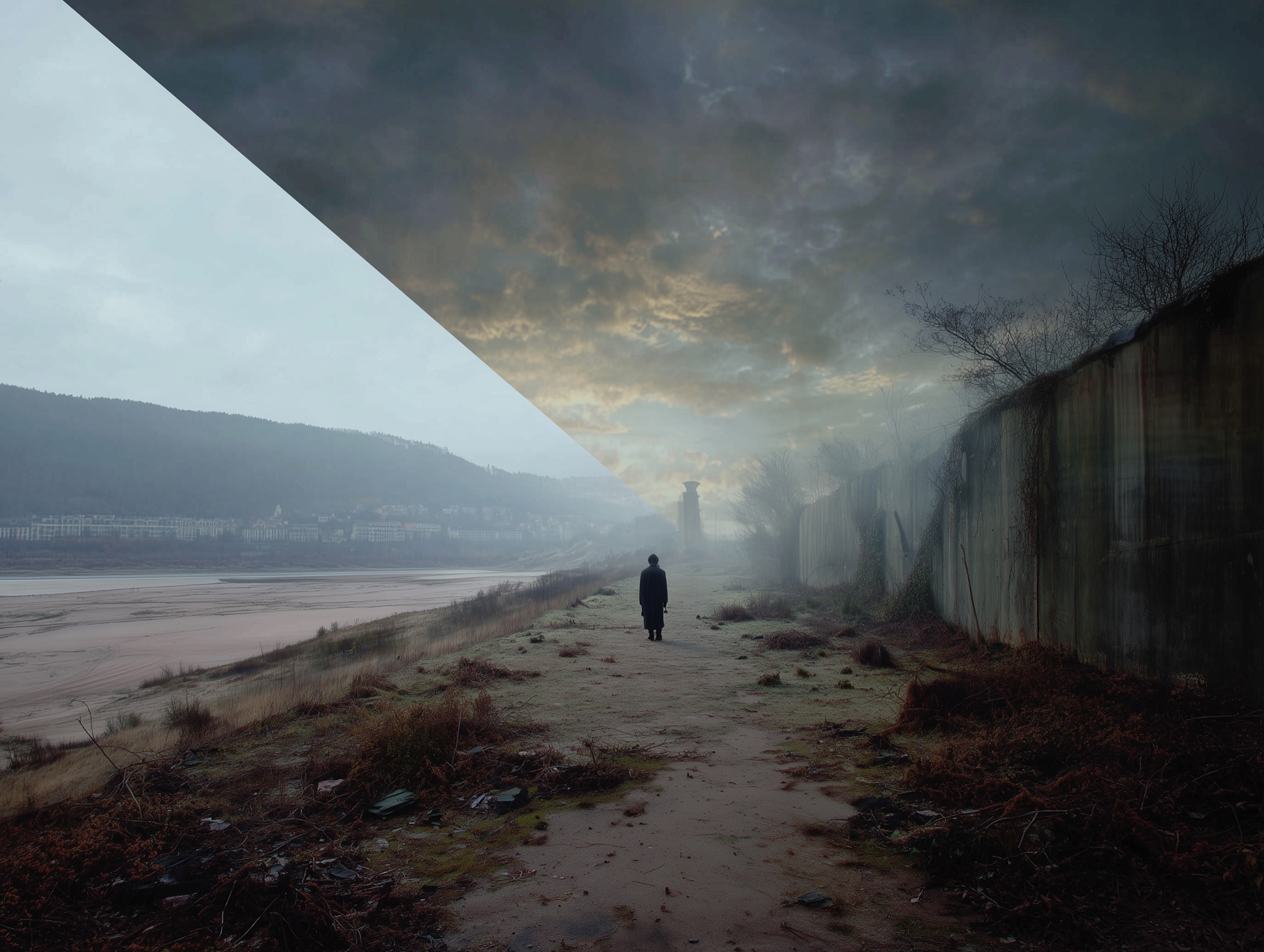
Here is something they don’t tell you about seeing every version of yourself: it’s not the successful ones that break you. It’s the ones that are happy. You can handle the version of you that built an empire or solved some fundamental problem or cured something important. That version is abstract. A poster on a wall. But the version of you that is sitting in a kitchen, laughing at something someone said, with a cup of something warm in their hands and nowhere to be and no particular reason to be happy except that they are, that’s the one you can’t stop watching. That’s the one that makes you forget which thread you came from.
Sable had been walking the threads for eleven years.
She kept the count because counting was the one thing that stayed constant across realities. Numbers did not shift when you stepped from one thread to another. The cup on the table might be ceramic in one thread and wood in the next, the sky might be amber or blue or the bruised violet of a world where the Fracture had bled different isotopes into the atmosphere, but eleven was eleven in all of them, and the fact of her counting was an anchor, a fixed point in a life that had very few.
She had learned to walk at the age of twenty-three, on a world whose name she no longer used because names were thread-specific and she had stopped thinking of herself as belonging to any single thread. The learning had not been taught. It had arrived the way certain kinds of knowledge arrive: not as information but as capacity, a door opening in the back of her mind that she had not known was a wall.
One morning she was standing at the edge of a contaminated lake, watching the nanite suspension crawl across its surface in slow, iridescent patterns. The settlement behind her was waking. She could hear the filtration pumps cycling through their morning sequence, the clang of the first shift opening the processing vats, someone calling a name she half-recognized. The lake’s surface moved in patterns that were almost regular, almost beautiful, the iridescence shifting from green to copper to a violet that hurt to look at directly. She had come here every morning for a year, drawn by a quality in the light she could not name, a sense that the lake was showing her something she was not quite equipped to see.
That morning, she saw it.
The adjacent thread arrived not as vision but as pressure. The way you feel someone standing behind you in a room you thought was empty, the way the air changes when a door opens in a distant part of a house. The hairs on her arms rose. Her jaw clenched. The lake was still the lake, the nanite suspension still crawling its iridescent path, but behind it, beneath it, pressed against it like a palm against glass, there was another lake. The same shore, the same shape, but the contamination was a deeper green, almost black at the center, and the sky above it was wrong by two degrees of color, shifted toward amber where her sky was grey, and the settlement on the far shore had a wall where her settlement did not, a crude barrier of stacked stone and salvaged metal, and the wall was old, weathered, as though the people in that version had been afraid of something for a long time.
She stood at the water’s edge and her body shook, not from cold, not from fear, from the structural stress of a perception expanding past its design tolerances. Her teeth ached. Her eyes watered. The two lakes overlapped in her vision like images printed on both sides of a thin page, each visible, each complete, each claiming to be the real one.
She stepped across. The stepping was not physical. It was a relaxation, a releasing of the assumption that the thread she occupied was the only one, and the releasing felt like exhaling after holding your breath for twenty-three years without knowing you were holding it. Her feet were on the same mud, the same contaminated shore, but the mud was colder. The air tasted different. The metallic sweetness of the nanite rain was sharper here, and beneath it a mineral undertone her lungs had never processed, and her body knew instantly, at the cellular level, that this was not her world. The bones of her feet registered a fractionally different gravity. The skin of her arms prickled against an atmospheric pressure that was almost right but not quite.
The other thread’s settlement had a woman named Sable in it too. She was twenty-three. She was standing at the edge of the same lake, her weight on her left foot the way Sable stood when she was thinking, her shoulders rounded against the morning air. She was looking at the water and thinking about the filtration schedule for the coming week, or the state of the charcoal beds, or the argument she’d had yesterday with someone Sable would never meet. Her face was Sable’s face. Her hands were Sable’s hands, the same calluses on the same fingers, the same scar on the left thumb from a filtration blade that had slipped at fifteen. And the way she pushed her hair behind her ear was a gesture Sable recognized as intimately as her own heartbeat: three fingers, right hand, a tuck behind the right ear, the head tilting slightly leftward to meet the hand.
Sable watched from twenty meters. The other Sable did not see her. Could not see her. She was whole in her world, complete in it, untroubled by the knowledge that twenty meters and one layer of reality away, someone with her exact body and her exact scar and her exact way of standing was watching her the way you watch a fire through a window: warmed by it, separated from it, unable to touch it without breaking the glass.
The recognition was the first wound, because recognition implies distance, and distance was the thing she had not known she was creating by stepping across.
She went back. The going back was harder. Not mechanically. Emotionally. She had to choose her thread, actively, the way you choose to put your weight on one foot instead of the other, and the choosing contained within it the acknowledgment that her thread was one of many, and the acknowledgment was permanent, and permanence was a thing she had not expected to find in a life defined by multiplicity.
She told no one. Not because it was secret but because the vocabulary did not exist. The nearest analogy she could find was dreaming, but dreams were incoherent and this was the opposite of incoherent. It was hyper-coherent. Each thread was complete, consistent, populated by people who believed absolutely in the singularity of their reality, and the belief was not wrong, exactly. It was local. It was true from the inside. It was only from the between-space, from the place where the threads pressed against each other like pages in a closed book, that the locality of truth became visible.
She walked again. And again. And the threads she found were not random. They clustered around choice points, moments where something had gone one way in her thread and a different way in another, and the differences accumulated like sediment, small decisions layering into different lives the way small mutations layered into different species. In one thread she had left the settlement at sixteen and walked south. In another she had stayed and married a man whose name she could not keep in her memory because names were thread-specific and his name was different in every version. In a third she had drowned in the contaminated lake at twelve, and the settlement had a memorial stone where her footpath would have been, and the stone was worn smooth by the hands of people who missed a version of her that she had not been.
The drowned thread was the first one that made her sit down.
Not because it was sad. Because it was complete. The version of her that had drowned at twelve had lived a short, full, finished life, and the people who remembered her remembered her completely, without the dilution that comes from a living person changing over decades until the person you remember and the person who exists are only loosely related. The drowned Sable was fixed. Known. Mourned and then released. The living Sable, the walking Sable, was none of these things. She was unfixed, unknowable, a consciousness spread across so many threads that the concept of a single self had begun to feel like a polite fiction, a courtesy she extended to people who could not see what she saw.
She found the others in the seventh year.
They were not a community. They were not organized. They were simply there, scattered across the manifold like seeds blown from the same plant, each one having arrived at the capacity independently, each one walking their own constellation of threads. She encountered the first one in a thread where a city she did not recognize had been built from salvaged crystal, its towers singing in a register that made her teeth ache. A man was standing in a plaza, looking at the city with the specific attention of someone who was comparing what he saw to what he had seen somewhere else. She knew the look. She wore it.
“How long?” she asked.
He turned. His face did the thing faces do when they recognize not a person but a condition. “Nine years,” he said.
“Does it get easier?”
“No. You get wider.”
His name was Kel. He had been walking since the age of thirty, on a world where the Fracture had opened a permanent tear in the sky that showed the adjacent thread like a window. He had grown up looking at the other version of his world, the version where the tear had not opened, and the looking had taught his perception to reach. He could not remember when the reaching became stepping. He said it happened the way language happens to children: gradually, then all at once, with no clear boundary between the not-knowing and the knowing.
They walked together for a time. Not in the same thread. Alongside, in adjacent threads, aware of each other’s presence the way birds in formation are aware of each other, adjusting trajectory without communication, reading the shape of each other’s movement through the fabric.
He taught her things she had not learned on her own. How to hold two threads in perception simultaneously without losing coherence. How to feel the thickness of a membrane before stepping through it, to gauge whether the crossing would cost a headache or a nosebleed or the worse thing, the disorientation that came from stepping into a thread where the physical constants were fractionally different and the body had to recalibrate its relationship with gravity, with pressure, with the speed at which light entered the eye.
“The membranes aren’t uniform,” he said. They were sitting on a hillside in adjacent threads, speaking across the gap in a way that felt like shouting through a wall, audible but muffled. “Some crossings are like stepping over a line. Others are like pushing through water. The thick ones are between threads that diverged a long time ago. The thin ones are between threads that are still nearly identical. You can use the thickness to navigate. To feel where you are in the manifold.”
“How do you know which thread to enter?”
“You don’t, at first. You go where the membranes are thin because thin is easy. Later you learn to push through thicker ones. Later still you learn that the thickness isn’t resistance. It’s information. The membrane is telling you how different the world on the other side is from the world you’re standing in. A thick membrane is a warning. Not of danger. Of distance.”
“Distance from what?”
“From yourself. From the version of yourself that thread contains. The thicker the membrane, the more different you’ll be on the other side. Different choices, different body, different life. Some membranes are so thick they might as well be walls. Those are the threads where you died young, or were never born. You can feel them. They have a cold spot, like a draft under a door.”
Kel showed her something else she had not learned on her own. “Watch your hands,” he said. They were in a thread where the rain fell clean, where the nanite suspension had never reached, where the soil grew food that did not need to be filtered. “Watch what your hands do when you’re in a thread where your body didn’t grow up.”
She looked at her hands. They were the same hands. Dense-boned, thick-skinned, the knuckles enlarged by years of working contaminated soil. In this clean-rain thread, her body was an artifact. Overbuilt. Armored against threats that did not exist here. She watched her fingers curl reflexively, reaching for a grip that the smooth, uncontaminated surfaces of this world did not require.
“Your body knows,” Kel said. “Every thread you enter, your body measures the distance between what it was built for and what it finds. The distance is information. The information accumulates. After enough threads, you start to feel the shape of yourself, not the self of any single thread but the self that persists across all of them. The invariant.”
“What’s the invariant?”
“The thing you do in every version. The gesture you can’t stop making. The question you always ask. The way you hold a cup.” He smiled, and the smile was thin, and the thinness was not unhappiness but precision. “The invariant is small. You want it to be something grand, some essential quality that makes you you across all realities. It’s not. It’s a habit. A reflex. The way you push your hair behind your ear.”
Sable felt the truth of this land in her body like a stone dropped into water. The gesture. She did it in every thread. She had watched herself do it in a hundred versions, and in every one the motion was the same: right hand, three fingers, a tuck behind the right ear, the head tilting slightly leftward to meet the hand. Identical across realities where everything else differed. It was the smallest possible version of herself, and it was the only version that was real in all of them.
“That’s it?” she said. “That’s what I am across the manifold? A hand gesture?”
“That’s what you are that doesn’t change. What you are that does change is everything else. Which is the point. The gesture isn’t the self. The self is the changing. The gesture is just the watermark.”
They parted after three months of parallel walking. Kel went toward threads where the Vael civilization still existed in diminished form, driven by a curiosity Sable did not share. She went the other direction, toward threads where the Fracture had been worse, where the ruins were deeper, where the adaptations were more extreme. She was not looking for anything specific. She was looking for the version of herself that had stopped looking.
She found her in the eleventh year.
The thread was unremarkable. A settlement on the edge of a contaminated valley, built from the usual salvage, populated by the usual dense-boned, thick-skinned descendants of something that had once called itself human. The rain fell. The crops grew. The filtration beds processed the nanite suspension with the usual three-stage methodology that Sable had seen in a hundred threads, always slightly different, always recognizably the same.
The other Sable was thirty-four. She was sitting on a wall at the edge of the settlement, watching the rain with the unfocused attention of a person who was not thinking about anything in particular. She had a cup. The cup was ceramic, glazed in a dull green that reminded Sable of a planet she had visited in a thread so distant from her own that the constellations were unrecognizable. The other Sable drank from the cup and set it on the wall beside her and pushed her hair behind her ear with three fingers, right hand, head tilting leftward.
Sable sat on the other end of the wall. The other Sable did not see her. Could not see her. Sable was adjacent, occupying the narrow space between this thread and the next, visible only to those who knew how to look.
She watched. The other Sable sipped from the cup. Set it down. Picked it up again. A small, absent gesture, the cup traveling between wall and lips with the rhythm of a person who was not thinking about the cup, who was thinking about the rain, or the day ahead, or nothing at all. A bird landed on the wall between them, three meters from the other Sable, close enough that Sable could see its feathers were dusted with the faint bioluminescence of the adapted lichen. The other Sable looked at it. Smiled. Not a large smile. The small one, the one that Sable recognized as her own, the one that appeared when something was present and simple and did not require her to be anything other than the person looking at it.
The bird flew. The other Sable finished her drink. Stood. Stretched, her arms raised, her back arching against the morning’s stiffness, and the stretch was so familiar that Sable’s own back arched in sympathy, muscle memory crossing the gap between threads, her body mirroring a body that was hers and was not hers. The other Sable rolled her neck. Cracked her knuckles, left hand first, then right, the same sequence Sable used, and the specificity of the match was the thing that undid her, not the grand sameness but the tiny, involuntary sameness, the knuckle-cracking order that no one had taught either of them.
She walked back into the settlement and entered a structure and a voice called to her from inside, a voice with warmth in it, and the other Sable answered, and the answer had warmth in it too, and the exchange was not significant, was not a revelation, was not anything except two people in a room acknowledging each other’s presence, and it was the most complete thing Sable had ever witnessed.
The words themselves were inaudible across the membrane. Sable could see the other Sable’s mouth move, could see the shape of the response in the shift of her shoulders, the slight turn of her head toward the voice. She could not hear the words and she did not need to. The words were not the point. The point was the turning toward. The automatic, unthinking turning toward a voice that was known and expected and wanted, the turning that said: I am here, you are here, this is where we are, and the where is enough.
The other Sable had not learned to walk the threads. Could not walk them. Would never walk them. She lived in a single reality and the singularity was not a limitation but a home. She did not know that her cup existed in a thousand variations. She did not know that the voice calling from the other room belonged to someone who, in an adjacent thread, had died young, or had never been born, or had married someone else. She did not know that the rain on her roof was, in a thread seventeen steps to the left, a different chemical composition. She knew that the rain fell. That the cup was warm. That someone was calling her name. That was enough. That was all of it.
Sable sat on the wall for a long time. The rain fell on the adjacent thread and did not touch her because she was between, and the between was where she lived now, and living between was the thing she had chosen when she learned to walk, and the choosing had been the most important choice she had ever made and the one she understood least.
She thought about Kel’s invariant. The gesture. The tuck of hair behind the ear. The smallest self, the one that persisted across all realities. She thought about what the other Sable had that she did not: not knowledge, not capacity, not the breathtaking ability to see the fabric of existence from inside it. What the other Sable had was commitment. The absolute, unexamined, bone-deep commitment to a single thread. The willingness to live as though this reality were the only reality, because for her it was, and the was-ness was not ignorance but faith, the kind of faith that does not need to know what it is excluding because exclusion is not the point. Inclusion is the point. Being here, in this thread, with this cup, in this rain, answering this voice. Fully. Without the escape hatch of knowing that somewhere else, another version of this moment is playing out differently.
Sable could not have that. The knowledge was irreversible. You could not unknow the Braid. You could not unfeel the adjacency of threads, could not unpercieve the fabric, could not return to the comfortable singularity of a life lived inside a single version. The door in the back of her mind had opened, and doors, once opened, could not be walls again.
But she could choose a thread.
The thought arrived quietly, without fanfare, the way the important thoughts always did. Not with the vertiginous intensity of her first crossing, not with the precision of Kel’s teaching, but with the simple, domestic weight of watching someone drink from a cup and stand up and stretch and walk into a house where someone was waiting. She could choose a thread. Not because it was the best thread, not because it was the thread where she was happiest or most successful or most loved. Because it was hers. Because choosing it, committing to it, accepting its limitations as the boundaries of a life rather than the bars of a cage, was the only adaptation that mattered, the one that all the walking had been preparing her for.
She stepped back into her own thread. The stepping was easy. The staying would be the work.
The settlement she had left eleven years ago was different. Larger. The wall she remembered was still there, patched and extended, the salvaged metal scarred by a decade of nanite rain. The filtration beds had been redesigned, the containers arranged in a pattern she did not recognize. Children she did not know ran through the streets, dense-boned and quick, native to a world she had been born in and left.
She walked to the wall. Sat down. The stone was wet from the rain. The rain tasted of tin and the faint sweetness of the nanite suspension, and the taste was specific, was this thread’s taste, was different by fractions of a percent from the taste of rain in a thousand adjacent threads, and the difference mattered because it was hers.
A woman approached. Not young, not old. She looked at Sable with the careful attention of someone assessing whether a stranger was dangerous.
“I used to live here,” Sable said.
“When?”
“Eleven years ago.”
The woman’s expression shifted. Not recognition. Something adjacent to it. “There was a girl who disappeared. Sable. The elders said she walked into the lake.”
“She walked somewhere.”
The woman studied her for a long time. Then she sat down on the wall. Not close. Not far. The distance people keep when they are deciding.
“I’m Derin,” the woman said.
“Sable.”
Derin nodded. She did not ask where Sable had been. She did not ask what had happened. She sat on the wall in the rain and let the silence hold the space where questions would have gone, and the silence was not empty but full, and the fullness was patience, and patience was a gift Sable had not known she needed until it was given.
They sat for a long time. The rain fell. Sable felt it on her skin and tasted its specific chemistry, the metallic bite and faint sweetness she had been born in, the exact formulation of nanite suspension that this thread’s atmosphere produced, different by fractions from every other rain she had tasted in eleven years of walking, and the fractions mattered, because fractions were what made a thread a thread, fractions were what made a home a home, and she had been standing in the space between fractions for over a decade and had forgotten what it felt like to belong to a specific set of them.
“The wall is new,” she said.
“Extended it six years ago. The eastern side kept flooding.”
“The filtration beds look different.”
“Third-generation design. Tova figured out that a gravel layer before the charcoal catches the heavier particulates. Output is cleaner.”
Sable nodded. These were details. Specific, local, thread-bound details. They belonged to this world and no other. In an adjacent thread, the wall had been extended in a different direction, or not extended at all, or the settlement had moved entirely. In another, Tova had not figured out the gravel layer, or Tova had never been born, or the word gravel referred to something else. Here, in this thread, the wall went east and the filtration used gravel and the rain tasted of metal and chalk and a woman named Derin sat on a wet wall and offered silence to a stranger who was not a stranger.
“Can I stay?” Sable asked. The question came out smaller than she intended.
Derin looked at her. The look was assessment and compassion and the practical calculation of a person who lived in a settlement where resources were finite and every mouth mattered.
“Can you work?”
“I can work.”
“Then you can stay.”
Sable pushed her hair behind her ear. Three fingers. Right hand. Head tilting left. The gesture that was the same in every thread. The invariant. The watermark.
She picked up a stone from the base of the wall. Smooth, worn by the rain. She held it in her palm and felt its weight, which was this thread’s weight, this gravity, this specific pull. The stone was warm from the wall, which had absorbed the morning’s heat, which was this morning’s heat, which would not be repeated in any adjacent thread because mornings were specific and specificity was the thing she had spent eleven years escaping and was now, sitting on a wet wall in the rain, choosing.
She closed her fingers around it.
She stayed.
This story is part of Echoes of the Braid, the complete collection of fourteen stories and ten interludes spanning the lifetime of a species.
Get the full novel