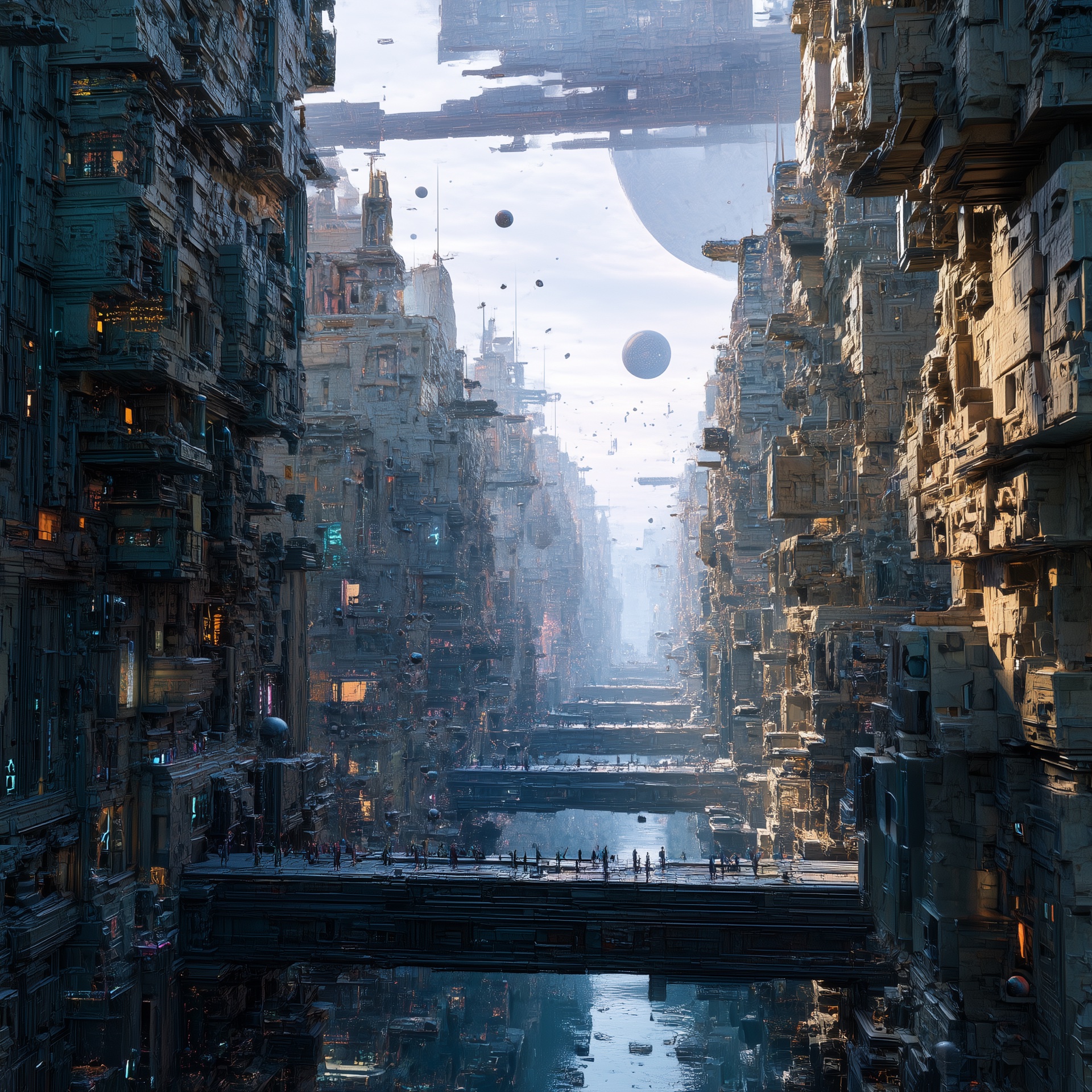
You know the feeling when you walk past your childhood home and someone’s painted the door a different color? Multiply that by a civilization. Now make it so the old color is still there, flickering underneath, visible if you catch it at the right angle, gone before you can prove it to anyone. That’s what it’s like to watch a city die while it’s still alive. You can’t mourn it. You can’t save it. You can stand in the street where you used to feel joy at 8 AM because the architects literally designed it that way, and you can feel the joy still trying to reach you through the cracks, and the cracks are full of some other version of the street where everything is fine, and the everything-is-fine version is what’s killing this one. Grief has a lot of flavors. This one tastes like looking at a photograph that hasn’t been taken yet of a place that hasn’t finished disappearing.
The city of Vaelith-Enn had been, until fourteen days ago, the most beautiful structure in the eastern reach. Luthenne knew this not as opinion but as measurable fact. The Vael had long since quantified beauty, had identified its components in the mathematics of proportion, symmetry, and harmonic complexity, and by every metric Vaelith-Enn had scored higher than any other inhabited structure within six star systems. Its towers were grown from living crystal, their facets tuned to refract the light of three suns into spectra that stimulated specific emotional registers in the Vael nervous system. Joy in the morning. Contemplation at midday. A gentle melancholy at dusk that the city’s designers had calibrated to optimize creative output during the evening hours. The streets were not streets but vascular channels through which nutrients, data, and filtered light circulated in patterns that responded to the collective mood of the population. The city breathed. The city thought. The city was, by any honest assessment, alive.
Now it was drowning.
The Fracture had not arrived as an event. It had arrived as a wrongness, a subtle detuning that Luthenne first perceived as a flatness in the morning light, as though someone had removed a harmonic from the spectrum without telling the sun. She had been in her studio, shaping a memorial lattice for a colleague who had chosen dissolution (an act the Vael considered neither tragic nor celebratory but simply a transition, a thread released from the weave), when the first crack appeared in the city’s living crystal. Not a physical crack. A perceptual one. The crystal’s voice stuttered, and for a fraction of a second Luthenne saw through it, saw the layer beneath the layer, the Braid-thread adjacent to her own, and in that thread Vaelith-Enn’s crystal was intact, singing, whole.
Then the stuttering stopped. The crystal was cracked. The crack was alive, widening as she watched, branching through the wall like a river finding its way downhill.
In the fourteen days since, the eastern reach of Vaelith-Enn had flooded. Not with water. With possibility. The Fracture had torn the membranes between Braid-threads in a jagged line that ran through the city’s foundations, and through the torn places, other versions of reality leaked in like groundwater through broken stone. The streets filled with light that belonged to other suns. Gravity fluctuated as adjacent threads with different planetary masses pressed against the local field. In the worst-affected zones, objects existed in two or three states simultaneously, their forms flickering between versions, a bench that was also a tree that was also empty space, the transitions accompanied by a sound like tearing silk that Luthenne felt in her teeth.
She had stayed. Most of the eastern reach’s population had evacuated off-world, following the Triad Authority’s directives, departing through the last stable transit corridors toward systems where the Braid still held. Luthenne had stood at the transit platform on the third day, her travel case in her hand, and watched twelve hundred people file through the corridor in orderly silence. The Vael did not panic. They assessed, prioritized, departed. It was, by every measure, the correct response.
Hael found her at the platform’s edge, not in the queue.
“You’re not boarding.” Not a question. Hael had worked the studio next to hers for forty years and knew the difference between Luthenne standing in a line and Luthenne standing near one.
“I’m not boarding.”
“The Triad Authority has classified the eastern reach as structurally compromised. They’re projecting full membrane collapse within the month.”
“I heard the briefing.”
Hael set down her own case. She was taller than Luthenne, older by a century, a materials theorist who had spent her career studying how crystal lattices distributed stress. She looked at Luthenne the way she looked at a lattice under load: reading the structure, finding the point where the weight was concentrated.
“You want to watch it happen,” she said.
“I want to be here while it’s still here.”
“Those are the same thing.”
“They are not the same thing. Watching something die is observation. Being present while something still lives is witness. The difference matters.”
Hael was quiet for a long time. Around them, the queue moved. The transit corridor hummed. Through the tears in the district walls, the adjacent Vaelith-Enn caught the afternoon light, its towers singing harmonics that leaked through the damaged membranes as a faint, dissonant echo of the calibrated spectrum.
“The memorial you were working on,” Hael said. “For Sethen. It’s still on your bench.”
“I’ll finish it.”
“Sethen chose dissolution. She’s gone. The city is going. You’re staying for a memorial to someone who isn’t here, in a place that won’t be here.”
Luthenne looked at her. “That’s what memorials are, Hael.”
Hael picked up her case. She looked at Luthenne for a moment longer, and her face did a thing that Luthenne recognized because she had built structures around it for her entire career: the face of a person accepting a loss they cannot prevent.
“The nutrient channels in your district are still functional,” Hael said. “They’ll keep you fed until they aren’t. After that, you’ll have about six days.”
“I know.”
“I’m going to Reach-Eleven. If you change your mind, the corridor should hold for another week.”
“Thank you.”
Hael turned and walked into the queue. Luthenne watched her go. She did not change her mind.
She stayed because Vaelith-Enn was still there.
Not this Vaelith-Enn. Not the cracked, drowning, flickering ruin that she walked through each morning with her feet finding uncertain purchase on floors that could not decide which thread they belonged to. The other one. The one she could see through the tears, the version in the adjacent thread where the Fracture had not reached, where the crystal towers still sang their calibrated harmonics and the vascular streets still pulsed with the rhythm of a living city. That Vaelith-Enn was whole. That Vaelith-Enn was beautiful. That Vaelith-Enn was four millimeters and an infinity away, visible through every crack and tear and stutter, perfect and unreachable and absolutely, undeniably real.
Luthenne was a memorial architect. She built structures that encoded loss into form, that gave grief a shape the Vael could inhabit and eventually, through inhabitation, metabolize. She was very good at her work. She had shaped memorials for dissolved colleagues, for abandoned worlds, for entire species that the Vael had watched flicker out across the manifold. She understood grief the way an engineer understands load-bearing walls, as a force that must be distributed correctly or it would collapse the structure.
But she had no framework for this. She had no model for mourning a thing that still existed. Grief, in every memorial she had ever built, assumed absence. The dissolved colleague was gone. The abandoned world was empty. The extinct species would not return. Loss was definitive, final, a clean subtraction that left a space her structures could fill. What she faced now was not subtraction. It was adjacency. Vaelith-Enn was gone and Vaelith-Enn was right there, singing, whole, separated from her by a distance that could not be crossed because it was not a distance at all but a difference in the angle of existence, and no amount of walking or building or grieving could close a gap measured in dimensions the body could not traverse.
She tried, once. On the sixth day, in a district where the tear was wide enough that she could see entire buildings in the adjacent thread, their crystal surfaces catching light from a sun that shone at a slightly different angle, she reached through. Not physically. Perceptually. She extended her Braid-sense, the faculty that every Vael possessed to varying degrees, the legacy of generations of cognitive adaptation that had begun with a lone researcher on a minor world and had been refined across millions of years into a standard feature of Vael consciousness. She reached for the intact city the way you reach for a reflection in water, knowing it is not solid, hoping anyway.
She touched it. For a duration so brief it had no name in the Vael temporal lexicon, she was in both threads simultaneously. She felt the intact city’s warmth, heard its harmonics, tasted the light of its calibrated morning. She felt the population moving through its streets, felt the collective mood registered in the vascular channels, felt the specific, irreplaceable texture of a living city that did not know it was being mourned by a version of itself four millimeters and an infinity away.
Then the moment collapsed. The membranes reasserted themselves, rougher now, the tear edges jagged with Fracture-damage, and Luthenne was back in the drowning district, on a floor that flickered between solid crystal and empty air, with the sound of tearing silk in her teeth and the taste of a morning that was not hers fading from her tongue.
She sat on the flickering floor for a long time. Around her, the city’s crystal groaned, adjusting to stresses it had not been designed to bear. Through the tears, the other Vaelith-Enn continued its existence, oblivious, whole, beautiful by every metric, scoring higher than any other inhabited structure within six star systems, and it did not know she was watching, and it would never know, and this was the thing that broke something in her that she had spent a career learning to build around.
She began to work.
Not a memorial. That was the first decision and the hardest. A memorial assumed the thing was gone. Vaelith-Enn was not gone. A memorial would be a lie shaped in crystal, and Luthenne had never built a lie.
Instead she built a window.
She worked in the studio she had refused to leave, a room where the floor was stable but the eastern wall flickered constantly, showing the adjacent thread’s version of the same room. She shaped crystal from the city’s own substrate, coaxing it from the damaged walls the way a surgeon harvests tissue from a wound’s edge. The crystal was stressed, fractured at the molecular level, its pitch off-key, but it was still alive, still responsive to Vael shaping techniques, and Luthenne worked it with a precision that came not from calm but from a focused desperation she had never experienced before and did not know the name for.
The window was small. A hand’s width. She tuned its crystal lattice not to refract light into emotional spectra, as the city’s designers had done, but to hold the Fracture’s torn edge in a stable configuration. To frame the tear rather than repair it. To make a permanent, deliberate opening through which the adjacent thread’s Vaelith-Enn could be seen clearly, without flicker, without distortion, the intact city held in a rectangle of shaped crystal like a landscape held in a frame.
When she finished, she set it on the workbench and looked through it.
The other Vaelith-Enn. Morning light on crystal towers. The streets pulsing with circulation. A city alive and whole and forever four millimeters away.
And in the adjacent studio, at the adjacent workbench, her hands shaping a memorial lattice for the colleague who had chosen dissolution, was Luthenne.
She had expected the city. She had not expected herself.
The shock was not visual. It was kinetic. She recognized the set of the other woman’s shoulders before she recognized the face. The particular angle of the spine, the way the weight settled into the left hip during concentrated work, the slight forward tilt of the head that Hael had once described as “the angle at which you stop hearing people.” She was watching herself the way you watch a recording, except the recording was alive, was breathing, was making decisions in real time in a world that had not broken.
The other Luthenne’s tools were arranged in the order Luthenne always arranged them: shaping probe, harmonic gauge, lattice calipers, spectrum knife, laid left to right in descending order of frequency, a habit so automatic she had never noticed it until she saw someone else doing it. Someone who was her and was not her. Someone who had the same hands and the same habits and a world that still deserved them.
The other Luthenne worked with the precise, unhurried movements of someone whose world had not cracked. Her studio was intact. The eastern wall was solid crystal, singing its calibrated evening harmonic, and the light that fell across her hands was the productive melancholy the city’s designers had intended, and she was using it exactly as designed, her creative output flowing in the channel the city had shaped for it. She was doing good work. Luthenne could see that from the lattice taking form under her counterpart’s fingers, the clean geometry of a grief well-structured, a loss properly encoded, a memorial that would do what memorials were supposed to do: give the bereaved a place to stand.
The other Luthenne had not lost her city. Had not spent fourteen days walking through a ruin that could not decide which reality it belonged to. Had not sat on a flickering floor and felt something break that she had spent a career learning to build around. The other Luthenne’s world was whole, and she was whole inside it, and she worked with the confidence of someone who had never had reason to question whether her tools were adequate to the grief she was asked to shape.
Luthenne watched her for a long time. She watched her own hands, undamaged, unshaking, move through gestures she recognized as intimately as her own breathing. She watched her own face, composed, focused, lit by a spectrum calibrated for productivity. She watched the version of herself that had kept everything she had lost, and the grief that came was not the distributed, manageable weight she had felt before. It was specific. It was surgical. It was the grief of seeing proof that your loss was not inevitable, that four millimeters to the left the world held, that the only difference between the woman who lost everything and the woman who lost nothing was an angle of existence neither of them had chosen.
She understood then what her window was. Not a memorial. Not a repair. A frame for a grief that had no precedent, a structure that said: the thing you love still exists, and you cannot reach it, and the version of you that kept it does not know you are watching, and both of these facts are true, and neither one cancels the other.
The Triad Authority sent an evacuation team on the nineteenth day. Three Vael in stabilization gear, their Braid-senses damped by protective fields, moving through the drowning district with the careful efficiency of professionals who had been trained for structural collapse but not for this.
Luthenne heard them before she saw them. Boots on crystal that rang wrong, the pitch flattened by the Fracture’s interference, and voices calling a designation she had not heard spoken aloud in days: her own name, her studio number, the formal address the Authority used for citizens who had declined voluntary evacuation and were now subject to mandatory extraction.
She did not answer. She was sitting before the window, watching the other Vaelith-Enn’s morning, and the morning was particularly clear today, the adjacent thread’s light falling at the angle the city’s designers had intended for the stimulation of joy, and the joy was visible in the way the other Luthenne moved through the adjacent studio, unhurried, her hands shaping the memorial lattice with the confidence of a woman whose world had not learned to stutter.
The team leader came through the studio door with a scanner raised. He swept the room, swept Luthenne, lowered the scanner when the readout confirmed she was alive.
“Luthenne Vaer-Orin. You were issued a mandatory evacuation notice on day fourteen. You are five days past compliance.”
“I received the notice.”
“The eastern reach is scheduled for isolation. The Triad Authority is sealing the Fracture zone. You need to come with us.”
“Sealing it,” Luthenne repeated. She did not turn from the window.
The team leader glanced at his two colleagues. They were younger than him, and their stabilization gear was new, and they looked at the flickering walls of the studio with the tight focus of people who were working very hard not to look through the tears at what was on the other side.
“The tears will be cauterized,” the team leader said. “The adjacent threads will be separated permanently. It’s the only way to prevent further propagation.”
“Permanently,” Luthenne said. “So the threads will still exist. The adjacent Vaelith-Enn will still be there. You’ll simply make it so no one can see it.”
“That’s not how I would describe the procedure.”
“How would you describe it?”
He paused. He was not young, she realized. He was her age, perhaps older, and his efficiency was not the efficiency of someone who had not yet learned to hesitate. It was the efficiency of someone who had learned to hesitate and had decided, deliberately, not to.
“Containment,” he said. “The Fracture is spreading. If we don’t seal this zone, the membrane degradation will reach the western districts within the year. The entire city. Then the transit corridors. Then the adjacent systems. The math is clear.”
“The math is always clear. That’s the problem with math.”
He looked past her to the workbench. To the window. The small rectangle of shaped crystal that held, in its lattice, a stable view of the adjacent thread’s Vaelith-Enn, the towers catching the morning light, the streets pulsing with circulation. He walked to it. Ran the scanner over it.
“This is holding a Fracture-edge in stable configuration.”
“Yes.”
“You built this.”
“Yes.”
He looked at her. Something shifted behind his eyes, a recognition that moved through the professional layer into the personal one and stopped there, held, not permitted to surface. “It’s good work,” he said. “The lattice structure is elegant. But if we move it outside the active zone, the edge will destabilize. The crystal will shatter.”
“I know.”
“So it stays here.”
“It stays here.”
One of the younger team members had moved to the window. She was looking through it, her stabilization field buzzing faintly as it compensated for the Fracture’s proximity, and her face was doing the thing that Luthenne had spent a career building structures around: the face of a person seeing something beautiful that they cannot keep.
“Is that…” the young woman started.
“Vaelith-Enn,” Luthenne said. “The one that’s still whole.”
The young woman stared. The team leader touched her shoulder, gently, and she stepped back, and the professional layer settled over her face again, but not completely, and Luthenne saw the crack in it, and the crack was the same shape as the crack in everything, the shape of a loss that could not be closed because the thing that was lost had not gone anywhere.
“Can I bring it?” Luthenne asked, though she already knew.
“It’s a contained breach,” the team leader said. His voice was quieter now. “I’m sorry.”
She touched the frame. The crystal was warm. Through it, the other Luthenne set down her shaping tools and stretched, and the gesture was so ordinary, so perfectly unremarkable, that it cut deeper than anything extraordinary could have.
She left the window. She walked with the evacuation team through streets that flickered and groaned, through zones where the tearing-silk sound had become a constant low roar, toward the transit platform where the last corridor off-world still held. The young team member walked beside her and said nothing, and the nothing she said was the most honest thing anyone had said to Luthenne in nineteen days.
Behind her, the eastern reach of Vaelith-Enn continued its slow drowning in possibility, and through a small crystal frame on a workbench in an empty studio, the other Vaelith-Enn continued to catch the morning light, whole and unreachable, for as long as the window held.
It held for eleven days after the sealing. Then the contained Fracture-edge destabilized, and the crystal shattered, and the view closed, and the adjacent thread became invisible, and the intact city continued to exist in a place no one in this thread could see or reach or prove, and Luthenne, on a station orbiting a quieter world three systems away, began to build something new. Not a memorial. Not a window. Something she did not yet have a word for. A structure that acknowledged that the thing she grieved was real and present and lost, all at once, forever, and that the grief itself was the only bridge between the two.
This story is part of Echoes of the Braid, the complete collection of fourteen stories and ten interludes spanning the lifetime of a species.
Get the full novel