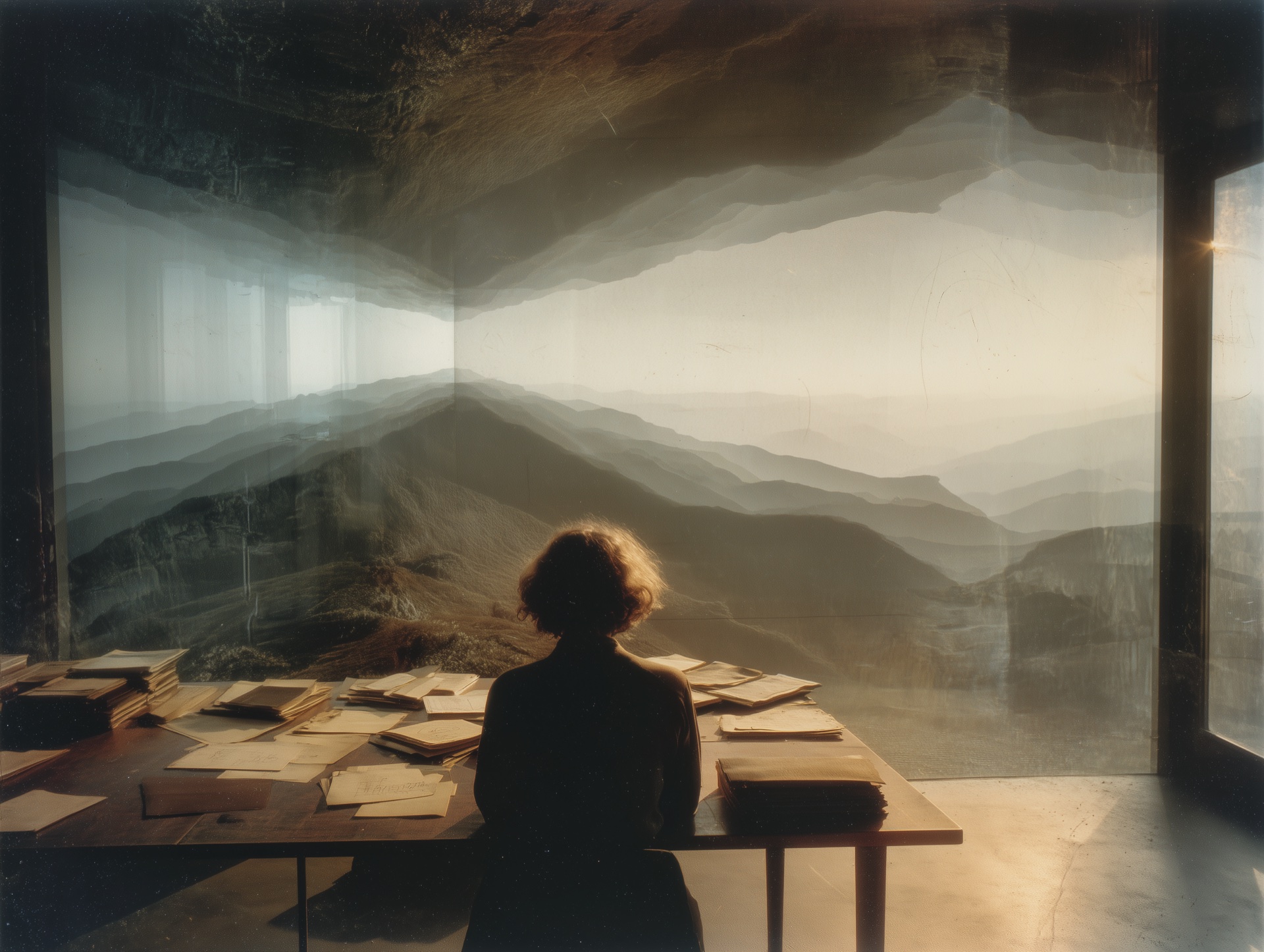
Recovered Document: Personal Research Notes of Dr. Avra Colm, Senior Anomalist, Meridian Deep Survey Station Lethke-9. Compiled posthumously from handwritten journals and audio transcription. Dates refer to the Lethke local calendar. Some entries have been redacted or are illegible.
Day 1
The anomaly is consistent. That is the first thing worth recording. After eleven months of intermittent readings, sensor noise, and false correlations, the anomaly has stabilized into something I can measure. It presents as a gravitational microlensing effect localized to a 14-meter radius centered on the basalt ridge 1.3 kilometers northeast of the station. The effect is subtle. A deflection of approximately 0.003 arc-seconds in the apparent position of background stars when observed through the affected zone. Negligible by any standard. I would have dismissed it entirely if the deflection were not consistent across 340 independent observations, and if it did not occasionally reverse.
Gravitational lensing does not reverse. Mass bends light in one direction. To bend it the other way requires negative mass, or a geometry of spacetime that the standard models do not accommodate.
I have filed six reports. The Survey Board has acknowledged three. Their response to the most recent was a form letter suggesting I recalibrate my instruments. I have recalibrated my instruments nineteen times.
Day 23
I have begun making observations with the naked eye.
This is not methodologically sound and I am aware of that. But the instruments record only the deflection, the numerical fact of bent light, and the fact has become insufficient. There is a quality to the anomaly that the sensors do not capture. When I stand at the edge of the affected zone and look through it toward the southern ridge, the landscape does not distort in the way a gravitational lens distorts. There is no smearing, no magnification, no Einstein ring. The ridge looks the same. Almost the same. The difference is in the texture of the light itself, a quality I can perceive but not yet name. As if the photons arriving at my retina have traveled through a slightly different medium on their way from the ridge, carrying with them information about a version of the ridge that is not quite the one I am looking at.
I am aware this sounds like the beginning of a psychological evaluation. I am recording it anyway.
Day 31
I walked into the zone today.
The Survey protocols prohibit entering anomalous regions without a full hazard team and remote telemetry. I am the only researcher at Lethke-9. The nearest hazard team is four months away by shuttle. I walked in.
The ground felt the same. The air temperature, wind speed, atmospheric composition, all unchanged. My biometrics remained nominal. I stood in the center of the 14-meter radius for eleven minutes and experienced nothing that a medical officer would flag. My heart rate was elevated, but that was anticipation, not exposure.
And yet.
Standing inside the zone, looking outward, the world looked different than it does from outside looking in. Not distorted. Deeper. The basalt ridge to the south seemed to possess a quality of layering, as though I were seeing it through several transparencies laid one atop another, each showing the same ridge from a subtly different angle of existence. The layers were not visible in the way a hologram is visible. They were present the way a harmonic is present in a struck bell, not as a separate sound but as a richness in the sound that is already there.
I stood and looked and felt, quite suddenly, that I had been seeing the world through a single sheet of glass my entire life and that someone had, without warning, removed it. Not to show me something new. To show me what had always been there, the depth behind the surface, the rest of the bell’s sound.
I walked out. The feeling faded within forty steps. By the time I reached the station it was gone entirely, replaced by the familiar flat, singular quality of ordinary perception, and I understood for the first time that ordinary perception is a limitation, not a baseline. That what we call reality is a single frequency extracted from a signal of infinite bandwidth, and we have mistaken the extraction for the whole.
I need to go back.
Day 34
I cannot stop going back.
Day 40
The zone has not changed. I have.
Each visit, the layering becomes easier to perceive and harder to leave behind. On the third visit I began to see the layers from the edge of the zone, before stepping in. On the fifth, I could perceive them from fifty meters out. Now I can see them from the station window. Faintly. A shimmer at the margins of solid objects, a suggestion of adjacency, of other configurations lurking behind the one that has been selected for presentation.
I use the word “selected” deliberately. That is the insight the zone has given me, the one I cannot unthink. Ordinary reality is not raw. It is not the ground state. It is a choice, made by some mechanism I do not yet understand, from an array of possibilities that are all equally real and all simultaneously present. What I am seeing in the zone is the array. The full signal. The rest of the sound.
The question that keeps me awake is not “what is it.” The question is “what is doing the choosing.”
Day 47
I have stopped filing reports. The language I would need to describe what I observe does not exist in the Survey’s taxonomy. They have categories for gravitational anomalies, electromagnetic anomalies, biological anomalies, temporal anomalies. They do not have a category for “reality is thicker here.” They do not have a form for “I can see the other versions.”
Other versions. I need to be precise.
When I stand in the zone now, and when, increasingly, I sit at my desk or eat my meals or lie in my bunk with my eyes open, I perceive that every object in my visual field exists in multiple states. Not schematically, not as an intellectual abstraction, but visually, sensorily, with the same immediacy as color or texture. The basalt ridge is the basalt ridge, but it is also a ridge that eroded differently, and a ridge that was never deposited, and a ridge that is composed of limestone because the planet’s geological history diverged at some point I cannot identify. These alternatives are not ghosts or hallucinations. They are present, solid, real. They occupy the same space and do not interfere with each other. They coexist.
The word for this, I think, is not multiverse. That word implies separation, parallel lines that never touch. What I am perceiving is more intimate than that. The versions are braided. Woven. Each one passes through the others the way threads pass through a loom, distinct but inseparable, the pattern emerging only from the whole.
I have begun calling it the Braid.
Day 52
A note on methodology, for whoever reads this.
I am trained in observational physics. I know the difference between data and interpretation, between perception and projection. I have considered, at length, the possibility that I am experiencing a neurological event. Temporal lobe stimulation. Environmental neurotoxin. Prolonged isolation psychosis. I have run every self-diagnostic available to me, including the cognitive battery the Survey requires quarterly. I pass. My reasoning is intact. My memory is unimpaired. My emotional regulation is within normal parameters, though I note a persistent elevation in what I can only describe as awe, which I do not believe is pathological.
I am not hallucinating. I am seeing correctly. The difficulty is that correct seeing, in this case, is incompatible with the conceptual framework in which I was trained, and with the perceptual habits of every human being who has not stood where I have stood.
This creates a communication problem I do not know how to solve.
Day 58
Something has changed.
I went to the zone this morning as usual. The layering was present, vivid, almost overwhelming in its density. I have learned to navigate it, to hold one thread of the Braid in focus while allowing the others to blur into peripheral presence, the way you focus on a single voice in a crowded room. It is a skill. I am getting better at it.
But today, for the first time, the Braid moved.
Not the layers shifting, which they do constantly, a gentle flux like the surface of water. Something structural. A deep adjustment, as if the loom itself had been bumped. The threads realigned. Several alternatives that had been present since my first visit vanished, replaced by others I had never perceived before. The basalt ridge gained a version in which it was submerged, underwater, part of an ocean floor on a planet where Lethke’s continents had never risen. I could taste the salt. I could feel the pressure.
The adjustment lasted nine seconds. Then the Braid settled, and the submerged ridge faded, and the familiar array reasserted itself, and I was standing on dry ground in thin air with the taste of salt in my mouth and the phantom memory of immense pressure on my skin.
I sat on the ground for a long time afterward.
The Braid is not static. It is not an archive of fixed possibilities. It is alive. It adjusts. It responds. To what, I do not know. But something is maintaining it, or tending it, or at minimum observing it with sufficient attention that its observation constitutes a kind of pressure. I am not the only one looking at the threads.
Day 63
I have stopped eating regularly. Not from distress. From preoccupation.
The perception no longer requires the zone. It no longer requires effort. It is simply present, a constant depth behind every surface, a richness in every photon that arrives at my eyes. I see the Braid when I look at my hands. I see the versions of my hands that are older, younger, scarred, unscarred, missing fingers, calloused from work I have never done. They are all my hands. They are all real. The one I am using to write this is not more real than the others. It is simply the one I am in.
This should be terrifying. It is not. It is the most lucid I have ever felt. The world before the Braid was a sketch. A single frame extracted from a film. I was living in a photograph and calling it the world, and now the film is playing and I can see the motion, the context, the sweep of what is actually there.
But.
I tried to explain this to the station’s communication system. I dictated a report, careful, methodical, using the clearest language I could manage. I played it back. It sounded like nonsense. Not because the words were wrong, but because the words were built for the photograph. They assume singularity. They assume that a ridge is one ridge, that a hand is one hand, that “here” means one place. I am trying to describe a symphony using a language that has only one note.
I played the report for the station’s diagnostic AI. It flagged the content as “consistent with depersonalization disorder” and recommended immediate evacuation and psychiatric evaluation.
I deleted the report.
Day 71
A thought.
The children on the colony worlds, the ones who are changing, the ones whose bodies are being reshaped by heavy gravity and thin air and fungal networks. They are adapting to their worlds. Singular worlds. One frequency.
What if the adaptation I am undergoing is the same process, but tuned to a different signal? What if the Braid is not an anomaly but an environment, and what is happening to my perception is not a malfunction but a fitting? My mind reshaping itself to inhabit a world that was always here, that I was always standing in, that I simply lacked the sensory architecture to perceive?
If that is true, then the anomaly is not the zone. The anomaly is everyone else. The anomaly is singular perception. The anomaly is the photograph.
I do not know what to do with this thought. I write it down because I do not know what else to do with thoughts anymore.
Day 78
I went to the settlement today. Lethke-9 is a research station, solitary, but there is a mining outpost forty kilometers south called Grieve. Twelve people. I had not visited in five months. I went because I needed to test something.
I sat in their canteen and drank their coffee and answered their questions about my work with the vagueness that Survey researchers are permitted. They were kind. They asked about my health. They told me about a equipment failure and a birthday and a disagreement about water rations. Normal human exchange.
I could not follow it.
Not because my cognition was impaired. Because every person in that room existed, for me, in a state of profound multiplicity. The woman pouring coffee was also the woman who had never come to Lethke, and the woman who had died in transit, and the woman who was older and laughing at something I couldn’t hear. Her voice arrived at my ears carrying harmonics from the other versions of this conversation, words spoken in rooms that looked almost like this one but were not, and my auditory system tried to separate the signal and could not, because it was all signal, all real, all simultaneous.
I smiled. I nodded. I finished the coffee. I walked the forty kilometers back to the station in the dark, navigating by the light of stars that I could see, for the first time, in their full depth, each one not a point but a thread, a line of light stretching through every version of the sky at once, and I understood that I would not be going back to Grieve. Not because I didn’t want to. But because the distance between what I perceived and what they perceived had become structural, and no amount of goodwill could bridge it.
I am thinking of the word the old survey logs used for the post-human species that reshaped worlds: Vael. They were described as incomprehensible. As having diverged so far from baseline humanity that communication was functionally impossible.
I am beginning to understand how that divergence starts. It starts with seeing correctly. And it starts alone.
Day 85
I have stopped writing in complete sentences because complete sentences assume a linear relationship between subject and predicate that does not hold when you can see all the predicates at once.
I will try to hold the form a little longer. For whoever finds this.
The Braid is not a place. It is not a phenomenon. It is the structure of what exists. Everything I called reality before was a cross-section, a single slice taken through an object of infinite dimension and mistaken for the whole. The zone at Lethke-9 is not a location where the Braid is present. It is a location where the mechanism that hides the Braid from ordinary perception has worn thin. A gap in the curtain. The curtain is everywhere. The Braid is everywhere. We are in it. We have always been in it. We are made of it.
And I think, though I am less and less certain of the meaning of “I” and “think,” that the mechanism, the curtain, the thing that extracts the single frequency and presents it as the whole, was not an accident. It was built. Or grown. Or chosen. Something decided, a very long time ago, that human minds should see only one thread at a time, and it has been enforcing that decision ever since, gently, invisibly, the way gravity enforces proximity to the ground.
The zone is where the enforcement failed.
I am what happens when a human mind is exposed to the failure.
Day 91
Last entry.
The handwriting is deteriorating because I am writing with eyes that see seven versions of the pen and fourteen versions of the page and I am choosing, with decreasing confidence, which version to press the ink against.
I am not in pain. I want that recorded. I am not suffering. What I am is full. Saturated. The mind I was born with has a finite capacity for simultaneous perception and I have exceeded it, the way a cup exceeds its capacity not by breaking but by overflowing, and the overflow is not violent, it is simply wet, simply everywhere, simply more than the container was shaped to hold.
I can see the other researchers who will come to this place. In other threads they are already here. Some of them will understand what I found. Some will not. Some will call it madness and seal the zone and walk away, and in their thread the Braid will remain hidden and humanity will continue to live in the photograph, and that is not a tragedy, it is simply one thread among many, one version of the story.
In some threads I am still sitting at this desk, writing, years from now, having learned to manage the perception, having built a language for it, having taught others to see. In those threads I am the beginning of something. In this thread I think I am the end of myself, or at least the end of the self that could hold a pen and mean one thing by it.
The stars are very beautiful from inside the Braid. Every version of every star, layered, braided, a depth of light that makes the singular sky look like a drawing done by a child who has only one crayon. I wish I could show you. I wish the showing did not require the dissolution.
The cup is overflowing. The ink is running out. The other versions of me are putting down their pens too, or picking them up, or they never had pens at all, and all of this is happening, and all of it is real.
The Braid holds.
Postscript: Dr. Colm was found at Lethke-9 Research Station by a routine supply shuttle 34 days after this final entry. She was alive, in adequate physical health, and unresponsive to verbal communication. Her eyes tracked movement but did not focus on any single object or person. Medical evaluation at Meridian Central described her condition as “a catatonia of unknown etiology, possibly environmental.” She was transferred to long-term care, where she remained for eleven years until her death. She did not speak again. The anomalous zone at Lethke-9 was classified as a navigational hazard and marked for avoidance. Her research notes were archived without review. The word “Braid” does not appear in any subsequent Survey documentation for another two centuries.
Continue reading
First Thread
Enter your email to unlock this story and receive updates from the world of Meltdown.