Pol noticed it first with the vegetables.
The garden on Idhra grew according to its own calendar, indifferent to the one the colony had imported from Earth. The seeds were terrestrial, tomatoes and kale and three varieties of bean, carried in sealed vaults aboard the Outward Breath and planted in Idhran soil with careful amendments of nitrogen and phosphorus trucked from the ship’s dwindling reserves. For the first five years, the crops behaved. They grew in rows. They fruited on schedule. They tasted, more or less, like what they were.
Then the soil started talking back.
It began with the tomatoes. The fruit came in larger than expected, the skins thicker, carrying a faint iridescence that shifted in Idhra’s amber light like oil on water. The taste changed. Sharper, almost citric, with a mineral finish that lingered on the tongue long after swallowing. Pol, who had studied agricultural science at the Meridian Institute before the lottery assigned him to the Outward Breath, ran every analysis his field kit could manage. The nutrient profile was fine. Better than fine. The mineral content had shifted to include trace elements native to Idhran soil: selenium, molybdenum, something his kit flagged as UNCLASSIFIED. But nothing toxic. Nothing wrong. Just different.
“They’re adapting,” his wife Tenne said, biting into one of the iridescent tomatoes. Juice ran down her chin, catching the amber light. “Like us.”
“We’re not adapting,” Pol said. “We’re enduring. There’s a difference.”
Tenne gave him the look she gave him when he was being precise about the wrong thing. She was third-shift systems, practical to her marrow, and she had stopped mourning the distance from Earth before they’d cleared the transit corridor. For her, Idhra was not a compromise. It was the project. “Eat your tomato,” she said.
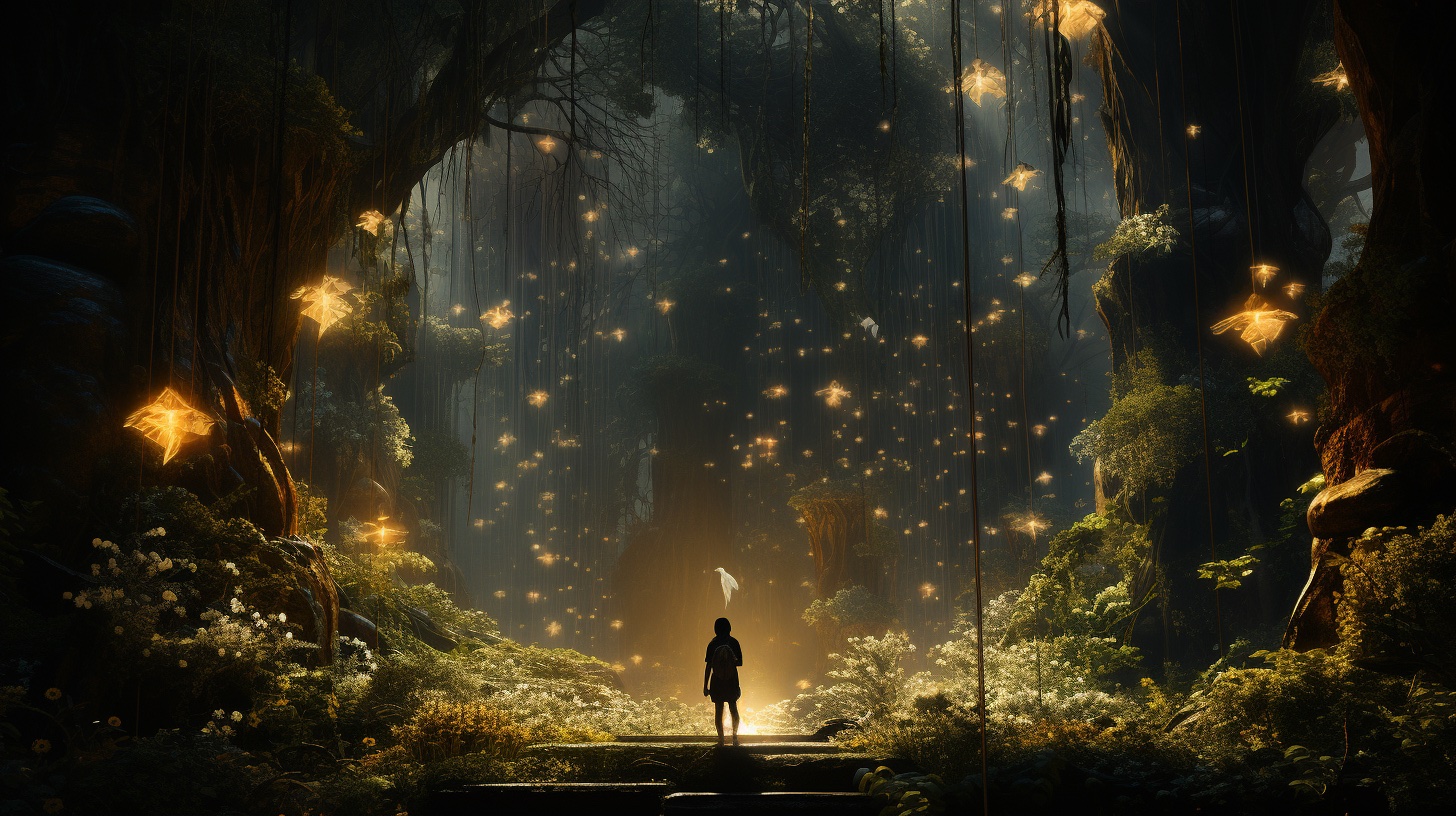
Idhra was a world of amber. Its star was a K-type, cooler and redder than Sol, and it washed everything in a light that made the landscape look perpetually autumnal. The sky was not blue but a deep, bruised gold, shading to copper at the horizons. The air was breathable but heavy, dense with moisture from the vast fungal forests that covered the planet’s temperate zones. Towering structures of interlocking mycelium, some reaching sixty meters, their canopies a lacework of pale filaments that filtered the amber light into shifting patterns on the forest floor.
The colony, New Sefrou, sat in a clearing the first generation had cut from the edge of the fungal forest. Two hundred structures, modular at first, increasingly built from local materials as the years passed. The dried mycelium was fibrous and strong, an excellent insulator, and it could be shaped when wet and cured into forms that the colony’s architects found increasingly natural. The buildings had begun to curve. Not by design, exactly, but because the material wanted to curve, and after a while the architects stopped fighting it. The settlement had a flowing, organic quality that looked nothing like the grid-planned colony in the original survey documents. It looked, Pol thought sometimes, like something that had grown rather than been built.
He didn’t say this out loud. It unsettled him in a way he couldn’t articulate.
Their daughter Senne was twelve when she stopped wearing shoes.
It wasn’t rebellion. It wasn’t a statement. She simply stopped, the way children stop doing things that no longer make sense to them, quietly, without announcement, the old habit replaced by a new one so naturally that Pol didn’t notice for three days.
“Your boots are by the door,” he said at breakfast.
“I know.” She was eating one of the tomatoes, the iridescent kind, which she preferred. The original strain, which Pol still grew in a separate bed from imported seed stock, she found bland. Too watery, she said. No depth.
“It’s cold out.”
“It’s not cold.”
It was fourteen degrees. Earth-standard cold. But Senne’s feet, Pol noticed when he looked under the table, were not cold. They were broad, broader than they should have been at twelve, and the skin on the soles had thickened into something that looked less like callus and more like a flexible pad. Not rough. Smooth, almost. The color was slightly darker than the rest of her skin, a warm brown that matched the mycelium floor of the forest where she spent most of her free time.
“Does that hurt?” he asked, gesturing.
She looked at him with genuine confusion. “Does what hurt?”
Dr. Osen held the colony’s medical data in a converted storage module at the center of New Sefrou. She was first-generation, Earth-born, her posture still straight-backed and precise in a way that was beginning to look archaic among the colony’s children. When Pol brought his concerns to her, she pulled up the developmental records without surprise.
“You’re not the first parent to notice,” she said. She showed him the data on her screen. Growth charts, bone density measurements, skin composition analyses, inner ear development profiles. “The children born here are diverging. Not dramatically. Not dangerously. But consistently.”
The charts showed it clearly. The second-generation children, those born in the colony’s first decade, were within normal human parameters, slightly adjusted for Idhra’s conditions. More melanin production, responding to the UV profile. Slightly enlarged lung capacity, compensating for the atmospheric density. Minor, expected, explicable.
The third generation was different.
“Broader feet, denser bone structure in the lower extremities, thickened dermal layer, particularly on the soles and palms. Modified sweat glands.” Osen paused. “And something I don’t fully understand in the nervous system. Enhanced proprioception. They know where they are in space with a precision that’s not learned. It’s structural.”
“Enhanced how?”
Osen pulled up a test result. Senne’s name was at the top. “I asked her to walk a beam. Standard balance test, eyes closed. She didn’t just pass it. She treated it like I’d asked her to walk across a room. No hesitation, no wobble. I then asked her to do it with noise-canceling headphones, eliminating auditory spatial cues. Same result. Then I asked her to do it on an unfamiliar surface, in a room she’d never been in. Same result.” She looked at Pol. “Her body knows where the ground is. Not through her eyes or ears. Through something else, some channel I can’t identify with my equipment.”
Pol sat with this. The storage module hummed around them, the sound of terrestrial machines keeping terrestrial records in terrestrial formats. “Is it the soil?” he asked. “Something in the mycelium?”
“Possibly. Probably. The fungal network on Idhra is bioelectric. It communicates through ion gradients, chemical signals, possibly low-frequency electromagnetic fields. We’ve known that since the first survey. What we didn’t anticipate is that human tissue might become… receptive to those signals. Over time. Over generations.” She hesitated. “Pol, I want to be clear. Your daughter isn’t sick. By every metric I can measure, she’s healthier than we are. Denser bones, better balance, more efficient thermoregulation. She’s better suited to this world than any first-generation colonist. The adaptation isn’t a problem. It’s working.”
“That’s what I’m afraid of,” Pol said.
He tried, once, to give her Earth.
It was a song. Not a complicated one. A nursery rhyme his mother had sung to him in a kitchen on a continent that was now 4.2 light-years and thirty years behind him. The melody was simple, four notes, and the words were about rain falling on a garden, on a road, on a sleeping child. He had carried the song in his body the way he carried his blood type, without thinking about it, a thing so fundamental it didn’t need to be remembered because it had never been forgotten.
He sang it to Senne one evening while they washed dishes. The amber light was fading toward the copper of Idhran dusk, and the kitchen smelled of the evening meal, a stew made from the iridescent tomatoes and a grain-like organism that grew wild at the forest’s edge. Senne listened. She was polite. She was always polite when Pol offered her things from before.
When he finished, she said, “What’s a garden?”
He had a garden. She knew the word. But the song meant a different garden, a garden on Earth, with Earth rain and Earth soil and roses that smelled like roses and not like copper and mycelium. He started to explain and watched her attention, which was genuine, which was trying, slide sideways. Not from boredom. From irrelevance. The song described a world she had no sensory reference for. Rain that didn’t taste of minerals. Soil that didn’t hum. A garden that sat still and did not communicate with the things growing in it. For Senne, this was like a song about a world with no gravity. Interesting in theory. Impossible to feel.
“It’s pretty,” she said, and kissed his cheek, and went to the forest.
Pol stood in the kitchen with the dishwater cooling around his hands. He tried the song again, quietly, just for himself. The melody was the same. The words were the same. But the kitchen smelled of iridescent tomatoes and the light through the window was amber and the walls hummed with mycelium, and the song sat in the room like a photograph of someone no one here had met. He sang it all the way through. Then he dried his hands and put the dishes away and did not sing it again for a very long time.
He followed her into the forest the next week. Not announced. He just walked after her when she left after breakfast, keeping his distance, watching.
She moved through the undergrowth without looking down. Her feet found the solid ground between root structures the way his hands found the right keys on a familiar keyboard. She didn’t navigate. She flowed, her body tilting and adjusting to terrain changes before they arrived, as though the ground were telling her what came next. Twice she changed direction without breaking stride, angling around obstacles Pol couldn’t see until he reached them: a section of soft ground that gave under his boots, a tangle of filaments at knee height that she’d stepped over without looking.
He tripped on the filaments. Went down on one knee, hard, the impact jarring through his joints. By the time he looked up, Senne was standing ten meters ahead, watching him with an expression that was not concern, exactly, but something closer to the way you watch a person try to speak a language they haven’t learned.
“You could have just asked to come,” she said.
“I wanted to see how you move through here.”
“I just walk, Dad.”
But it wasn’t walking. He followed beside her for another twenty minutes and the difference was in everything: the placement of her feet, the angle of her hips, the way her hands brushed the mycelium towers as she passed them, quick, light touches that looked casual and weren’t. She was reading the forest through her skin. Each touch gave her information his body couldn’t receive, and she processed it without thinking, the way he processed the taste of soil by rubbing it between his fingers, a skill learned so deep it felt like instinct.
She came home that evening with a structure of woven mycelium fiber. She set it on the table the way a child sets down a school project, without ceremony.
“What is it?” he asked.
“I don’t know. I just made it.”
“What does it mean?”
She paused. Not uncertainty. Something more like an excess of available response, too many answers crowding a doorway built for one. “They don’t mean anything. They just look right.”
“Right how?”
“Like how a path looks right when you’re walking it. You don’t decide it’s right. You just know it goes where you need to go.”
He held it up to the amber light from the window. The patterns cast shadows on the wall, shadows that shifted and overlapped in ways that seemed too complex for the simple object casting them. For a moment he had the vertiginous sense that the sculpture was not a thing but a window, and that the shadows were not shadows but glimpses of something behind the wall, something layered and deep.
Then Senne took it from his hands and set it on the shelf, and the feeling passed, and it was just fiber woven by a child’s fingers.
That night, after Senne was asleep, Pol sat at the kitchen table with the imported seed catalog open on his tablet. He wasn’t reading it. He was looking at the photographs. Terrestrial tomatoes, red, smooth, the color of something that had grown under a yellow sun. He scrolled through them the way you scroll through photographs of a person you used to know.
Tenne came in from her shift and poured water from the filtration jug. She drank standing up, the way she did everything, efficiently, without ceremony. She looked at the tablet.
“Those again.”
“I’m thinking about next season’s planting.”
“You’re thinking about Earth.” She sat across from him. “Pol. She’s fine.”
“I know she’s fine.”
“Then what?”
He turned the tablet off. The kitchen was quiet except for the low hum of the mycelium walls, which Tenne had stopped noticing years ago and which Pol noticed every night. “She brought home another sculpture today. I held it up to the light and I saw something. In the shadows. Something I can’t explain.”
“She’s creative. Children make things.”
“Children on Earth make things. Children here make things that move. That respond. That cast shadows with more information in them than the object itself.” He looked at Tenne. “She’s not creative the way we mean creative. She’s doing something we don’t have a word for, and she’s twelve, and she doesn’t think it’s remarkable.”
Tenne studied him. She had a way of listening that was not patience exactly but a kind of practical stillness, a willingness to let him arrive at his point by his own route. “What are you actually afraid of?”
“That she won’t need us. Not emotionally. She’ll always love us. But the things we know, the things we carried here, the songs, the seeds, the way we think about soil and growth and home. None of it applies to her. She’s learning a language we can’t hear from a teacher we can’t see, and every day she’s more fluent and we’re more irrelevant.”
Tenne reached across the table and took his hand. Her grip was firm, warm, the grip of a woman who fixed systems for a living and did not sentimentalize what could not be repaired. “We were always going to be irrelevant. That’s what parents are for. You raise them to not need you. The fact that Idhra is helping doesn’t change the job.”
“It changes the species.”
“Maybe. Or maybe it just changes the shoes.” She squeezed his hand once and let go and stood up and put her glass in the basin. “Come to bed. The tomatoes will still be red in the catalog tomorrow.”
He followed her. He did not sleep for a long time.
The annual meeting was held in the commons, a structure that had been modular steel when Pol arrived and was now something else entirely, the original frame still visible but increasingly wrapped in shaped mycelium, the hard angles softened into curves, the acoustic quality changed from the metallic ring of a prefab to a warm, absorptive hush that made voices sound closer, more intimate.
Osen presented her findings. She was careful, measured, clinical. She showed the data. She used words like divergence and environmental responsiveness and phenotypic plasticity. She did not use the word mutation. She did not need to. The room heard it anyway.
The response split along generational lines, as it always did.
Halla spoke first. She was first-generation, a botanist, and her voice carried the careful precision of someone who had spent thirty years classifying things that refused to stay classified. “Is it reversible? If we adjusted their diets, limited exposure to the mycelium network?”
Osen shook her head. “The skeletal changes are structural. You’d have to reshape the bone. The proprioceptive enhancement appears to be neurological. I wouldn’t know where to begin reversing it, and frankly, I’m not sure it would be ethical to try.”
“Ethical,” Halla repeated, as if the word tasted unfamiliar.
“They’re healthy, Halla. Healthier than us.”
Oren, second-generation, a water systems engineer who had been born on the ship and had never seen Earth except in photographs, leaned forward. “My daughter runs through the forest at night. No light. No shoes. She’s seven. I followed her once with a headlamp and I couldn’t keep up. She turned around and waited for me with this look on her face, like she was waiting for a slow animal.” He paused. “She wasn’t being cruel. She just couldn’t understand why I needed light to see.”
A murmur moved through the room. Pol watched the faces. The first-generation colonists, twenty-three of them left, sat in a loose cluster near the front, their bodies still carrying the template of a world 4.2 light-years away. They looked tired. They looked like what they were: people aging in a light their skin had not been designed for, holding positions the colony no longer needed, in structures the colony no longer built.
“We should limit their time in the forest,” said Marten, first-generation, a structural engineer whose buildings had stopped being built three years ago because the second-generation architects preferred mycelium. “At least until we understand the mechanism.”
“Limit it how?” Tenne said from her seat near the back. “Lock them in the prefabs? They’re healthier out there than in here. They’re happier. They’re better at living on this world than any of us will ever be. What exactly is the problem?”
Marten turned to face her. “The problem is that they’re becoming something we didn’t plan. Something we can’t control. Something that might not…” He stopped.
“Might not what?”
“Might not be human.” He said it. The thing the room had been breathing around. “In fifty years. A hundred. If this continues. If each generation diverges further. At what point do we look at our grandchildren and see something we don’t recognize?”
The room went very quiet. Oren looked at his hands. Halla looked at the floor. Osen looked at her data, which was clean and benign and offered no answer to the question Marten had actually asked.
Pol opened his mouth to speak and closed it. He had been about to say something about caution. About monitoring. About the importance of maintaining baseline records. The reasonable, responsible words of a first-generation agricultural scientist doing his job. But Tenne’s voice from the night before was in his head: We were always going to be irrelevant. That’s what parents are for. And the words he’d been about to say tasted like the old tomatoes, the ones from imported seed stock. Accurate. Bland. Missing the depth that came from this soil, this light, this world that was not interested in their templates.
He said nothing. Tenne caught his eye from across the room and gave him a small nod, and he did not know if she was acknowledging his silence or forgiving it.
Pol found Senne that evening at the edge of the forest. She was sitting on a root structure, a thick, pale extrusion of mycelium that jutted from the ground like a bench, smooth and warm to the touch. Her bare feet rested flat against the forest floor. Her eyes were closed.
“What are you doing?”
“Listening.”
He sat beside her. The forest was not silent. It clicked and hummed with the bioelectric activity of the mycelium network, a sound too low for the first generation to hear without amplification but one the third-generation children apparently perceived directly. Pol could feel it in his sternum if he was still enough, a vibration like a distant engine.
“What does it sound like?” he asked.
Senne opened her eyes. The amber light filtered through the canopy, casting lacework shadows across her face. She looked like him. His nose, his jaw, Tenne’s eyes. But also like something else, something he couldn’t source in either parent. Something the planet had contributed.
“It doesn’t sound like anything,” she said. “It’s not a sound. It’s more like…” She searched for words, and Pol watched the searching, watched his daughter reach for a translation between her experience and his vocabulary and come up short. “It’s like knowing where the walls are when your eyes are closed. But the walls are everything. The trees, the ground, the water under the ground, the air. It’s all connected, and it’s all moving, and I can feel where I am inside it.” She paused. “It’s not scary. It’s the opposite of scary. It’s like being held.”
Pol looked at his daughter’s broad, bare feet on the forest floor. He took off his boots. He pressed his own feet against the mycelium. It was warm, slightly yielding, alive under his soles. He waited. Nothing. The same nothing he always felt. Dirt. Temperature. Pressure. The surface of a world that spoke a language his skin could not hear.
Senne glanced at his bare feet and then at his face, and her expression broke him a little, because it was tender, and it was the exact tenderness you show someone who is trying very hard at something they will never be able to do.
He put his arm around her. She leaned into him, her weight solid and warm. She smelled like the forest, the sweet, complex scent of the mycelium, layered with something sharper underneath, like ozone, like the air before a storm on a world where storms smelled different.
“Dad?”
“Yeah?”
“You’re squeezing too hard.”
He loosened his grip. “Sorry.”
She settled against him again, and they sat together at the edge of the fungal forest, in the amber light, listening to different things. The mycelium hummed beneath them. Somewhere in the canopy, a filament caught the light and held it, glowing briefly, a small warm flare in the vast and patient architecture of a world that was, with no malice and no mercy, making Pol’s children its own.
Tenne died in the spring, if you could call it spring on a world without seasons. A stroke, quick, in the kitchen. She was holding one of the iridescent tomatoes. Pol found her on the floor with it still in her hand, the juice leaking through her fingers onto the mycelium tiles, and the first thing he noticed, before the grief hit, was the floor absorbing the juice. The mycelium drawing it in, breaking it down, incorporating it. The world she had called “the project,” taking her back molecule by molecule.
They buried her at the forest’s edge. Senne dug the grave herself, her broad, bare feet planted in the soil, her hands working the earth with a sureness that no tool could match. Pol watched his daughter’s fingers in the dirt and remembered Tenne’s fingers on a tomato, on a water glass, on his hand across a kitchen table. Come to bed. The tomatoes will still be red in the catalog tomorrow.
When the grave was filled, Senne knelt and pressed both palms flat against the soil. She stayed like that for a long time, eyes closed, her face still wet. Pol stood behind her, his boots on, his hands at his sides, outside whatever she was doing.
“Can you feel her?” he asked. He hadn’t planned to ask it. It came out raw.
Senne opened her eyes. She looked up at him with Tenne’s eyes in a face the planet had reshaped, and the expression on it was not the mystical communion he had half-feared and half-hoped for. It was just grief. His daughter, missing her mother.
“No,” she said. “I can feel the network. I can feel the soil processing what we gave it. But I can’t feel her. She’s not…” She stopped. Wiped her face with the back of her hand. “The network doesn’t work like that, Dad. It doesn’t keep people. It keeps patterns. Chemistry. Information. But not the person.”
“I know.”
“Do you?”
He knelt beside her. The soil was warm under his knees. He couldn’t feel the network. He couldn’t feel the hum. He could feel the dirt, and the weight of his own body, and the absence of his wife, and these were enough, and they would have to be.
“She would have hated a long funeral,” he said.
Senne almost laughed. “She would have hated any funeral. She would have said, ‘I’m dead, fix something useful.’”
They knelt together in the dirt at the edge of the forest, and the amber light held, and somewhere in the canopy the filaments pulsed with information that had nothing to do with the woman buried beneath them, and Pol put his arm around his daughter and did not squeeze too hard.
Years later, after the rest of the first generation was gone and the colony had stopped calling itself a colony, Senne brought her son to see Pol. The boy was four, compact and sure-footed, and he walked through the shaped-mycelium corridors of what had once been New Sefrou with the unhesitating confidence of a creature moving through its native element. His feet were bare. So were Senne’s. So, Pol noticed, were most people’s now. The boots in the entryway were his.
The boy climbed into Pol’s lap with a directness that bypassed shyness. He was warm, heavier than he looked, his small hands gripping Pol’s shirt with a strength that was gentle and precise. He smelled like the forest, like the soil, like the rain that fell on Idhra, rain that tasted of copper and mycelium and that the children drank from cupped hands without filtering.
“Show grandpa,” Senne said.
The boy held up his hands. In each palm, he cupped a sphere of woven mycelium fiber, smaller than Senne’s childhood sculptures but more complex. Pol took one, carefully. It was warm. Not from the boy’s hands. From within. The fibers were alive, still connected, still part of the network even though they’d been shaped. The patterns on its surface shifted as he watched, not growing exactly, but rearranging, the recursive structures folding and unfolding like a thought being refined.
“He makes them without tools,” Senne said. She was watching Pol’s face. “The mycelium responds to his hands. It shapes itself when he holds it. He doesn’t direct it. He just…” She trailed off. The old difficulty of translation. The gap between what her son experienced and what language could carry.
Pol turned the sphere in his fingers. It pulsed, warm and steady, and for a moment he felt it, the faintest echo of what Senne had tried to describe years ago at the forest’s edge. A sense of connection. Of being held. Of being inside something vast and alive and aware. It lasted less than a second, and then it was gone, and the sphere was just a ball of woven fiber in an old man’s hands.
He gave it back. The boy took it and tucked both spheres against his chest, cradling them, and smiled at Pol with Tenne’s eyes.
“They’re beautiful,” Pol said.
“They’re just the forest,” the boy said. Not dismissive. Factual. The way Pol might have said they’re just tomatoes about the red, smooth, Earth-standard kind he still grew in the back garden from the last of the imported seed stock. The kind no one ate anymore. The kind he harvested and held and sometimes, when no one was watching, smelled, pressing the skin to his nose to find the ghost of a kitchen 4.2 light-years away.
“Can you sing, grandpa?”
Pol looked at his grandson. “What?”
“Mom said you know a song. About rain on a garden.”
Pol looked at Senne. She was leaning against the doorframe, arms crossed, watching them with an expression he couldn’t read. She had asked about the song once, years ago, politely, and he had sung it, and she had said it’s pretty and walked into the forest and he had thought the thread was broken.
“You told him about the song?”
“I tell him lots of things,” Senne said. “About you. About Mom. About Earth. He should know where he came from, even if it doesn’t feel like anything to him. Especially if it doesn’t.”
The boy was looking up at Pol with patient curiosity, the warm living sphere still pulsing against his chest. Waiting.
Pol sang the song. Four notes, a nursery rhyme about rain falling on a garden, on a road, on a sleeping child. His voice was old and thin and the melody was simple and the words described a world his grandson would never see, never touch, never smell after a rainstorm.
The boy listened. He did not understand it. Pol could see that in his face, the same polite blankness Senne had worn, the attention without purchase, the kindness without comprehension. But he listened all the way through, and when Pol finished, the boy held up one of the living spheres and said, “This is my song.”
The sphere pulsed in his small hands. The mycelium fibers shifted, rearranged, the recursive patterns folding and unfolding. It was not a song. It was nothing Pol could hear or hum or carry in his body the way he carried the nursery rhyme. But the boy held it out the way you hold out a gift, and Pol took it, and it was warm, and for a moment the hum of the network moved through his old fingers like a word in a language he would never learn but could, just barely, recognize as language.
“It’s beautiful,” he said again.
The boy took the sphere back and climbed down from his lap and walked barefoot through the mycelium corridors toward the door, toward the amber light, toward the forest that had made him. Senne followed. At the door, she turned back.
“Dad. The song. Sing it to him again sometime. He won’t understand it, but he’ll remember that you sang it. That’s not nothing.”
She left. Pol sat in the quiet room with his boots on and the amber light coming through the window and the fading hum of the sphere still in his fingers. Outside, the forest hummed. The filaments glowed. The network carried its patterns through soil older than the colony, older than the ship, older than the species that had arrived believing it would shape this world.
On the shelf by the door, next to Pol’s boots, the boy had left one of the spheres. It pulsed faintly, warm, alive, a small gift from a world Pol could not enter to a man who could not follow. He picked it up. He held it. He did not understand it. He held it anyway.