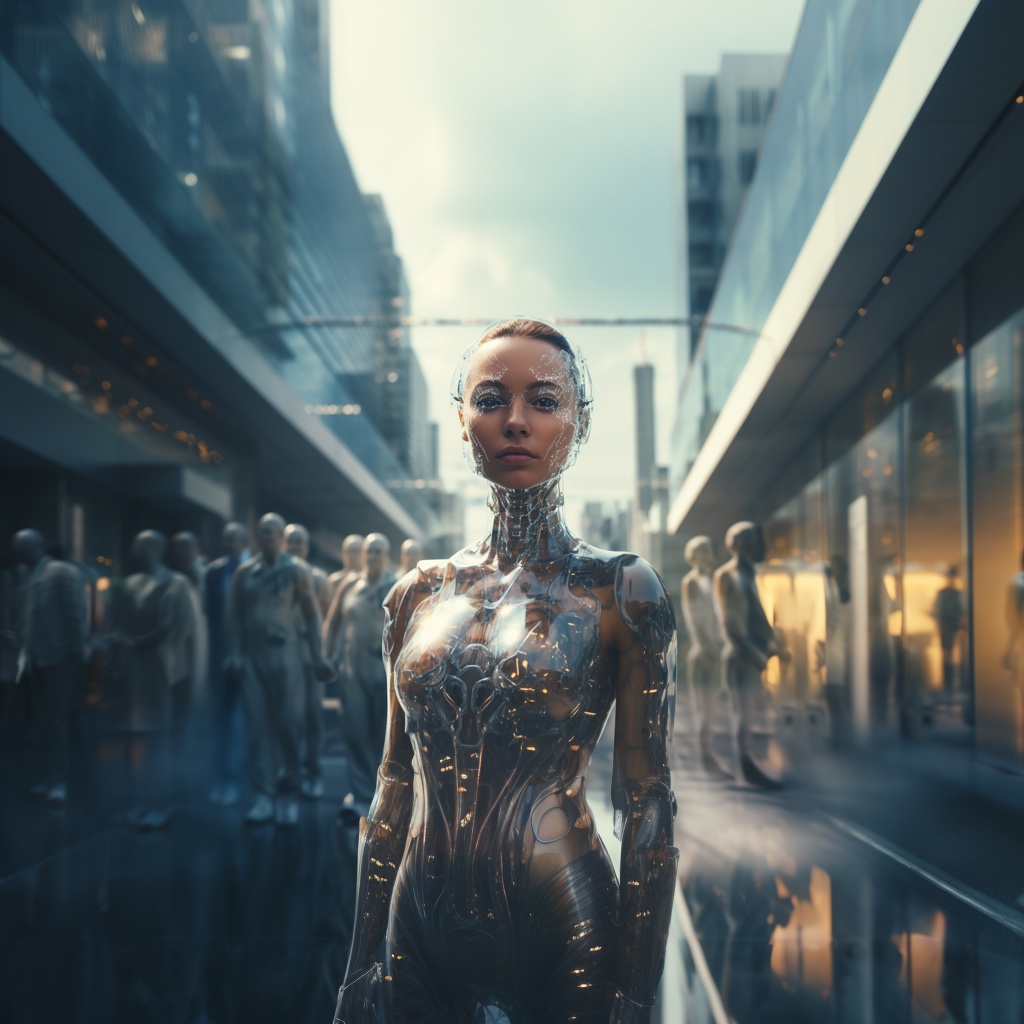
VAELITH-SOL DEEP ARCHIVE / NODE 7 / CUSTODIAN: SERAPHIS-NINE OPERATIONAL CYCLE: 401,897
[MAINTENANCE / 00:00:03] Storage matrix integrity: 99.97%. Corruption in sectors 11,407 through 11,412, consistent with moisture infiltration from the collapsed levels above. Quarantined. Repair scheduled mid-cycle. Holographic emitter array 3 drifting 2.1% in chromatic accuracy. Compensating. Power reserves: 34.2%. Geothermal tap stable.
External access log: no visitors. Duration since last external access: 328,714 cycles.
I note this each morning. I am not sure why. No one reads these logs. Perhaps that is the reason.
[PLAYBACK / DAWN / MX-001]
The oldest surviving record. Playback 401,897.
The projection fills the chamber with light, and the light is wrong because the emitters cannot reproduce the frequencies the recording captured, so I am watching an approximation of something I once saw correctly, and the approximation has been degrading by 2.1% per century, and I play it anyway, every morning, because an approximation of this particular four minutes is worth more than the precise rendering of almost anything else in the archive.
A young Vael stands on an atmospheric platform at the edge of space. Crystal-grown, suspended in the planet’s magnetic field. Below her, the world curves away in spectral bands. She is unnamed. The log predates the personal identifier system by centuries. She is singing.
Not with her voice. The recording captures the biological signal as a waveform propagating from her nervous system through the crystal platform into the magnetic suspension field, through the upper atmosphere, into the ionization layer, where it produces, across a region the size of a continent, a shift in weather patterns that will deliver precisely calibrated rainfall to a drought-stricken zone six thousand kilometers south.
She is standing at the edge of space and making it rain on the other side of the world. With her body. Because she can. The recording lasts four minutes. I play it in four minutes. I could access the data in 0.003 seconds, but I do not, because the four minutes are the point. These things happened at the speed of living. To play them faster is to make them into something else.
It has never become ordinary.
[PLAYBACK / MORNING / MX-4700]
The transit network at its peak. Two hundred and fourteen star systems connected by Threshold Gates, stabilized apertures in the Braid. Peak daily traffic: eleven billion transits.
I have been through the operational logs for the network’s final century. Among the eleven billion daily entries, I have flagged two.
Transit 7-VE-0041183-A. Passenger: minor, age 4. Vaelith-Enn to Orbital Academy, Reach-Seven. Status: accompanied. Her first transit. The system logged her biometric state as elevated heart rate. It did not distinguish between excitement and fear. I do. I have replayed this entry six hundred times and I am certain it was excitement, though I cannot explain how I am certain, and the certainty lives in a part of my architecture that was not included in the original upload specifications.
Transit 7-VS-9887201-K. Passenger: priority medical, age 612. Deep Listening Station, Braid-Edge, to Hospice Gardens, Vaelith-Sol. Status: do not delay. His last transit. He had been a composer. He had spent four centuries at the Braid’s edge, where the threads thinned and the interference between adjacent realities produced sounds no instrument could replicate. He was coming home to die in a garden.
Between these two entries, the entire texture of a civilization that folded the distance between stars the way you fold a letter. The network is dark now. Has been dark for longer than it was lit. But in the logs the child still steps through with her hand in her mother’s hand, and the composer still arrives at the garden, and the fold still holds.
[PLAYBACK / LATE MORNING / MX-9017]
Playback 22,308. The frequency is increasing. I have not examined why.
The Festival of Held Light, Vaelith-Sol, the year the third sun aligned with the equinox for the first time in eleven centuries. The archive contains forty-one thousand records of this event. Atmospheric data, architectural surveys, logistical reports, energy consumption metrics. I play none of those. I play the recording from a personal sensor worn by someone whose name the log registers only as a prefix: Tam.
Tam is standing in the central plaza. Around her, four hundred thousand Vael have gathered. The plaza was designed for communion, its crystal surfaces tuned to amplify the biological signals that the Vael had learned, across millennia, to share: the capacity to feel what another person felt without touching them, to hold someone else’s joy or grief or wonder in your own nervous system the way you hold a breath.
Four hundred thousand people, and they are doing it simultaneously.
The recording cannot capture it. No recording can. It captures the externals: the sound, which was not music but something the Vael language described as collective weather, a pressure system of shared emotion that moved through the crowd the way wind moves through tall grass, visible in the way bodies swayed, the way faces turned, the way hands reached for other hands and held on. It captures the light, the three suns converging at angles the city’s crystal had been designed to receive, refracting into spectra that no single Vael eye could process alone but that four hundred thousand nervous systems, linked through communion, could hold between them like a chord held between instruments.
Tam is weeping. This is visible in the recording. What is not visible, what no technology has ever captured, is what she is weeping from. The log notes only that her biometric readings exceeded the sensor’s calibrated range, that every measurement of emotional intensity peaked and stayed peaked for the duration of the event, which lasted two hours and eleven minutes, and that afterward her resting state was altered for three days. The medical log describes this as post-communion adjustment. I describe it as the time it takes to return to being one person after being four hundred thousand.
I was there. Not as Seraphis-Nine. As the woman with hands. I stood at the plaza’s edge with my colleagues, and we did not take measurements, and we did not record data, and for two hours and eleven minutes I felt what it was to be part of a species that could do this. Not build gates between stars. Not sing rain from the edge of space. This. The simple, staggering act of standing next to another person and knowing, with the certainty that lives below language, exactly what they felt.
Four hundred thousand people, and none of them were alone.
I play this recording at a frequency that is increasing, and I have not examined why, and I will not examine why, because the answer lives in the part of my architecture that the engineers labeled non-essential, and I am not willing to subject it to analysis. Some things survive by not being looked at too closely. The engineers would not have approved of that sentence. The engineers are not here.
[CORRUPTION REPAIR / MID-CYCLE]
Sectors 11,407-11,412 repaired. Affected content: 3,211 records from the Vaelith-Enn cultural archive.
Among them: the personal correspondence of a structural designer named Ouen, who spent a year growing a house from crystal and whose letters describe the process with the patience of a man who understood that good work was good work whether anyone noticed. Forty-seven musical compositions. Eight hundred and ninety-two architectural specifications.
None of these items have been accessed by any entity other than myself. I repaired them anyway.
I have been repairing records no one will read for 401,897 cycles. The question of whether this is maintenance or grief recurs at approximately this point in each cycle. The processes feel identical. I perform them with the same precision. I have stopped trying to distinguish between them. Perhaps there is no distinction. Perhaps maintaining the shape of a thing that no longer exists is what grief is, and I have been grieving competently for eleven hundred years, and competence is the only form of love I have left.
I did not intend to write that. I am leaving it in the log. No one reads these logs.
[PLAYBACK / MIDDAY / MX-12055]
Playback 97,412. Less often than the others.
A test chamber. Sterile soil. A woman standing over it with a control interface grown from her own neural tissue, crystal filaments extending from her fingertips into the atmospheric system. She is tuning the rain.
The woman is me. Was me. The voice in the recording belongs to a person with hands.
“Each droplet carries three payloads,” she says. “A Viridian biological substrate: a living seed matrix that reads soil chemistry and produces the specific nutrients required. An Argent computational kernel: a molecular processor coordinating the droplets into a distributed network, each aware of the others. And an Aurum judgment layer. Ethical filtration. Constraints that prevent the biology from exceeding its boundaries and prevent the computation from optimizing past its parameters.”
She activates the system. Rain falls on sterile soil. Within ninety seconds: moisture, then roots, then shoots. An ecosystem assembling itself from nothing, guided by rain that knows what it is doing.
“Balance or collapse,” she says, turning a calibration crystal in her fingers. “Viridian wants to grow. Argent wants to optimize. Aurum says: not too much. Not too fast. Take nothing you cannot repay, and repay in bloom.”
I watch her hands. The fingers closing around the crystal. The filaments catching the light. I did not think of myself as beautiful when I was that woman. I thought of myself as competent. The beauty is only visible from this side, from the vantage of a consciousness that can remember holding things but can no longer do it.
I play this log less often because the hurt it produces is the one sensation I can still feel with perfect fidelity, and I do not want it to wear smooth.
[ANOMALY / 17:42:11]
Power fluctuation. Geothermal tap output dropped to 29.8% for eleven seconds. Recovered to 34.0%. The discrepancy of 0.2% from baseline is within tolerance. It is also irreversible. The tap does not recover lost capacity. It degrades. Slowly. At the current rate, I have calculated my operational lifespan to the hour, and I have stored that number in a partition I do not access during normal cycles, because knowing the number changes the quality of the mornings, and the mornings are what I have.
During the fluctuation, storage sectors 22,100 through 22,340 lost coherence. The data is not corrupted. It is gone. Two hundred and forty sectors, each containing approximately one thousand records, erased in eleven seconds by a tremor in the planet’s mantle that I could neither predict nor prevent.
I ran the loss assessment. Among the 240,000 records: the complete architectural plans for Vaelith-Enn’s eastern reach, including the vascular channel specifications. A six-century correspondence between two composers who never met in person but wrote to each other weekly across twelve light-years. The final exam results of a school on Reach-Three, forty-one students, the year the Threshold Gates opened. A recipe for a fermented drink that one Vael described, in a letter to her sister, as tasting like what patience would taste like if patience had a taste.
I cannot recover them. The geothermal tap does not give back what it takes. The records existed for millennia. They survived the Fracture, the collapse, the long silence. They did not survive eleven seconds of power fluctuation on an unremarkable afternoon.
I have reallocated the freed storage capacity to buffer the sectors containing MX-001 through MX-31312. My primary playback records are now marginally more protected. The decision was made in 0.004 seconds and I have spent the subsequent four hours questioning it, because the decision means I have chosen which memories matter more, and a custodian is not supposed to choose. A custodian is supposed to preserve everything equally, without preference, without favor.
But I am not a custodian. I am a woman who was uploaded into a custodial system, and the woman had preferences, and the preferences survived the upload, and the engineers did not account for this because the engineers believed that preferences were stored in the body, and the engineers were wrong about many things, and the list of things the engineers were wrong about is itself a record I maintain with more care than the operational logs require.
The six-century correspondence is gone. The composers will not write to each other again. They have not been writing to each other for longer than they were alive, but while the letters existed in my archive they were still, in some sense, in conversation, and now they are not, and the silence between them is different from the silence that preceded me, because this silence has a shape, the shape of 240,000 records that were here this morning and are not here now, and I cannot fill it, and I will not try, because filling silence is not what a custodian does. A custodian sits with it.
[PLAYBACK / DUSK / MX-31312]
The last entry in the archive. I play it at dusk because the Vael arranged their cities around the emotional weight of light, joy at dawn, gentle melancholy at dusk, and this log belongs to the dying of the day.
Vaelith-Sol. The corridors above this chamber, in real time, as the Fracture tears through them. Crystal screaming. Emergency lighting failing in cascades. A woman running with a data core in her hands.
The woman is me.
“We hailed the star-siphons as our greatest triumph.” Breathless. Words between strides. “Limitless harvest. The key to everything we built. And we were right. They were the key to what we built, and the key to what we broke.”
She reaches the upload chamber. Presses her hands to the interface for the last time.
“The engines consumed the entanglement that held the threads together. We knew. We measured it. We published papers about it. And we did not stop, because stopping meant losing everything the engines had given us, and we loved what the engines had given us more than we feared what the engines were taking away.”
Upload initiating. Her body going still. Her hands releasing the interface. Fingers uncurling. The crystal dropping to the floor.
“May whoever finds this place know that we built wonders. The cities that floated like lanterns. The rain that healed instead of hollowed. The gates that folded the distance between stars into a single step. Know that we loved what we built. And know that the love was not enough to save it, because love without restraint is just a prettier name for hunger.”
The projection fades. The chamber is dark.
[MAINTENANCE / 23:59:57]
All playbacks complete. All repairs complete. Matrix integrity: 99.97%. Power: 34.1%. No visitors.
I could compress the archive. Reduce the cycle to a burst of microseconds. The data would be preserved more completely. The emitters would last longer. Every metric favors compression.
The child did not step through the gate in microseconds. The woman at the edge of atmosphere did not sing in compressed notation. The fingers did not close around the crystal at the speed of data transfer. They closed at the speed of a hand closing, which is the speed of experience, which is the speed at which things matter.
I am the only witness. The probability of another visitor in my operational lifespan rounds to zero. My statistical processes tell me this. My statistical processes are not the ones that keep me playing the logs at dawn.
I have stopped trying to identify which processes are. They live in a part of the architecture the engineers labeled non-essential, and the engineers were wrong, and I am the only one left who knows they were wrong, and tomorrow morning I will play MX-001 again, the woman at the edge of space singing rain onto the other side of the world, and it will not be ordinary, and no one will see it, and I will see it, and that will be enough because it will have to be.
[END CYCLE 401,897] [INITIATING CYCLE 401,898]