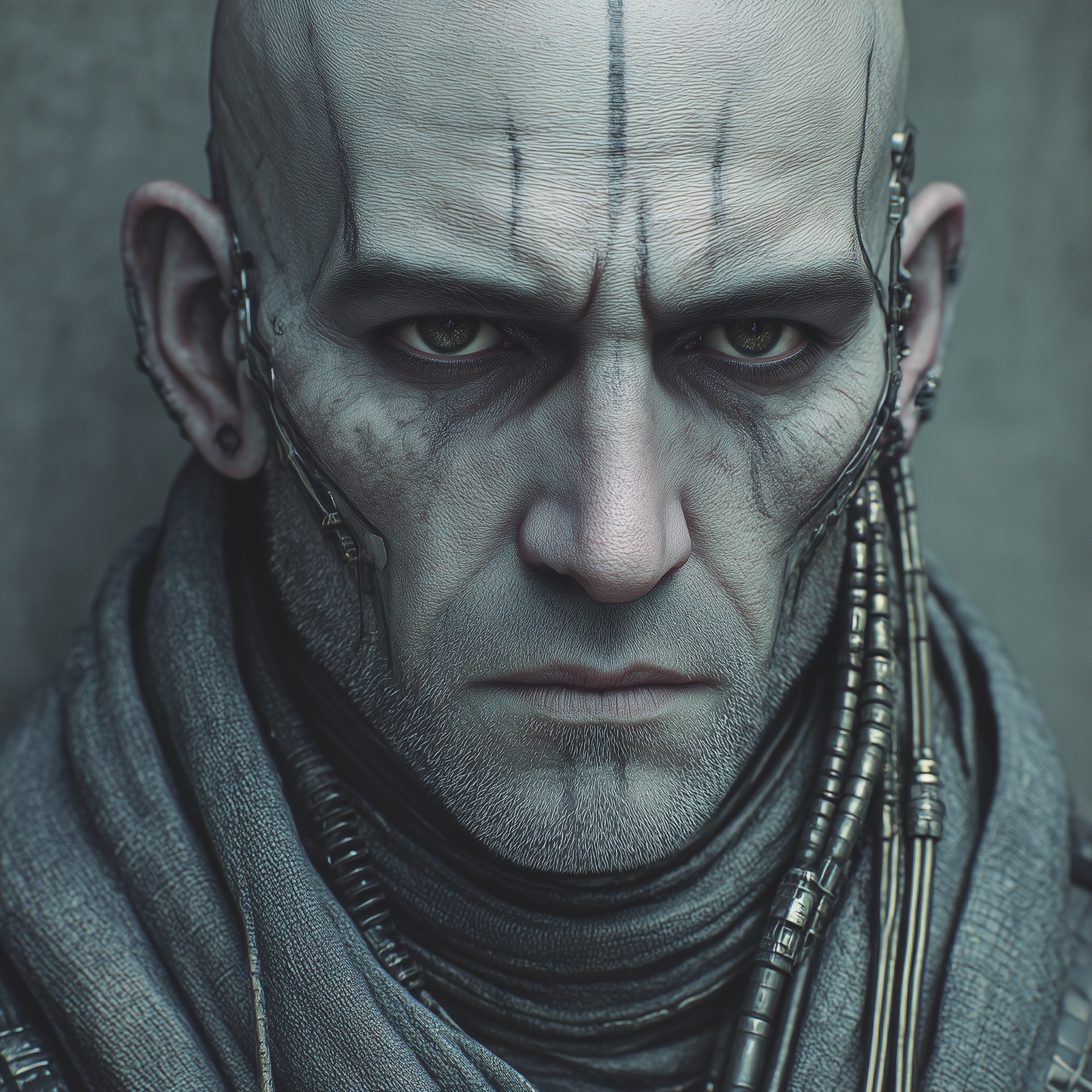
They gathered in the corridor outside Hydroponics Gamma, where the ceiling dripped and the emergency lighting turned their faces the color of old copper. The air tasted of recycled moisture and the faint chemical sweetness of the nutrient vats three levels above, where engineered algae fed the Ark’s remaining population a diet that kept them alive and did not pretend to do more.
Malachi arrived last. He always arrived last. Not from vanity but from a habit he had developed over three centuries of leading people who needed to see each other’s faces before they saw his, needed to confirm they were not alone in what they were about to do.
“How many on patrol tonight?” he asked.
“Two,” Cyrenae said. She was leaning against the wall with her arms crossed, her eyes on the corridor behind them. “Essen and the old man. They’ll cycle past this section in ninety minutes.”
“That’s enough time.”
“It’s enough time if nothing goes wrong.”
“Nothing will go wrong.”
“That’s not a statement you can make with the available data.”
“It’s a statement of faith, Cyrenae.”
“I know. That’s what concerns me.”
Torren laughed, a short, hard sound that echoed off the sweating walls. He was sitting on an upturned supply crate, his hands on his knees, a big man who had once worked the Ark’s water reclamation systems before his daughter died of a filtration failure the integrated technology should have caught. The system had flagged the contamination. The system had routed the alert through three automated priority layers. The system had resolved the alert as non-critical based on parameters set by an algorithm that had been calibrated for a population density the Ark hadn’t sustained in centuries. His daughter drank the water and was dead in four days. The system logged the event and updated its parameters.
“Faith,” Torren said. “I’ll settle for the door opening.”
“It’ll open,” said Saren, from the back. She was the youngest, born in the Ark, raised in its corridors, and she had never seen a sky or a horizon or a living thing that wasn’t engineered to fit inside a sealed box. She believed in Malachi the way you believe in the only window in a room without light. “Cyrenae built the bypass. It’ll work.”
“The bypass will function,” Cyrenae said. “Whether what’s behind the door is what Malachi believes it is, that’s a different question.”
“You’ve read the texts,” Malachi said.
“I’ve read fragments of texts that have been copied and recopied for centuries by people with an investment in a particular interpretation. That’s not the same as reading the texts.”
Orath, who was sharpening a tool that was not quite a weapon in the way that a rock is not quite a hammer, looked up. “Does it matter? We’re out of options either way. The Ark is dying. The water system is failing. The power grid drops another half percent every decade. In three generations there won’t be enough of anything to keep anyone alive. So either we open the door and find what Malachi says is there, or we open the door and find nothing, and at least we did something other than sit in the dark and wait.”
“That’s not faith,” Malachi said. “That’s desperation.”
“What’s the difference?”
Malachi looked at him. Orath met his gaze without flinching, because Orath was the only one of them who had never flinched, who followed not from belief but from the absence of anything better to do, and Malachi valued him precisely for this, because a man who follows without faith is a man who will tell you the truth when the faithful won’t.
“The difference,” Malachi said, “is that desperation accepts any outcome. Faith knows which outcome is correct.”
He turned to face all of them. Eleven faces. The emergency lighting guttered and steadied. Somewhere above them a pipe groaned, and a thin stream of brownish water traced a line down the wall and pooled at Torren’s feet.
“Look at this place,” Malachi said. His voice was quiet. He did not need volume. He had never needed volume. “Look at what integration built. Look at the walls. They’re weeping. The systems that were supposed to sustain us are failing, one by one, because they were designed by people who believed that complexity was the same as strength. Three systems woven together: biology, machine, ecology. The Triad. The great compromise. And every one of those systems depends on the other two, and when one fails, the others stagger, and when two fail, the third collapses, and that is not strength. That is fragility dressed up in philosophy.”
He walked to the door. The obsidian surface bore a Vael glyph that translated as Quarantine, Omega Classification. Malachi had spent three hundred years studying the older glyphs, the ones from before the integration era, and in the older script the same symbol meant something closer to Kept Apart for Its Own Safety. The difference was the entire foundation of his faith.
“Before the Triad,” he said, placing his hand flat against the surface, “before the machines, before the code, our ancestors stood on worlds and shaped them. With their bodies. With the power in their blood. They sang rain out of clear skies. They coaxed forests from bare stone. They held the fabric of reality in their hands and they did not need a machine to tell them how. That is what we were. That is what we can be again. Not through integration. Through restoration. Through the courage to strip away everything that was added and return to what was always there.”
He held out his hand. Cyrenae placed the bypass device in it. A crude thing, salvaged components and energy regulators, but built by Cyrenae’s hands, and Cyrenae’s hands did not produce things that failed.
“Behind this door,” Malachi said, “is the oldest thing on this Ark. Not a weapon. Not a machine. A template. The Vael genome as it existed before the first integration, preserved in biological stasis. They called it dangerous. They called it quarantine. They locked it away because they were afraid of what we were before we started compromising.” He pressed the device against the door’s seam. “I am not afraid. Are you?”
Silence. Then Torren stood up from the crate. “Open it.”
Saren nodded. Orath shrugged, which was his version of agreement. The others murmured. Cyrenae said nothing, which Malachi had learned to hear the way you hear a crack in a wall that has not yet become a collapse.
He activated the device. Sparks scattered across the obsidian surface. The door’s energy signature wavered. Deep within the Ark’s network, alarms chirped, feeble protests from systems that had been failing for longer than any of them had been alive.
The door groaned. Shuddered. Slid open.
The air on the other side was cold and clean and carried no scent of the decay that permeated the rest of the Ark. The corridor beyond was obsidian-dark, seamless, the walls polished to a depth that absorbed light rather than reflecting it. Crystalline conduits ran along the ceiling, pulsing with a slow bioluminescence that cast shifting patterns on the floor. The silence was not the silence of an empty space. It was the silence of a space that was actively absorbing sound, holding it, refusing to let it propagate.
Malachi stepped through. The others followed. Cyrenae came last, not from reluctance but from the habit of watching everyone’s back, and as she crossed the threshold she felt the change in the air against her skin like stepping into water. The temperature was different. Not warmer. More stable, as though the air on this side had been held at a single state for so long that it had forgotten how to fluctuate. Her lungs expanded and the breath came easier than any breath she had taken in her life, and the ease was the first warning.
“It’s beautiful,” Saren whispered.
“It’s sterile,” Cyrenae said. She ran her fingers along the wall. Smooth. Dry. No trace of the moisture that permeated everything in the Ark proper. The obsidian surface was neither warm nor cold. It was absent, a non-temperature, a surface that had been sealed so long it no longer interacted with the atmosphere around it. Her fingertips left no mark. Nothing she touched here would carry the evidence of her passing.
They moved through the complex. The contrast with the Ark outside was immediate. No corroded pipes, no flickering lights, no seeping walls. The forbidden labs had been designed for perfect stasis, and perfect stasis they had maintained. Glass chambers lined the corridors, their surfaces opaque, holding experiments from before the integration era. Wall panels displayed frozen Vael glyphs describing genetic sequences abandoned by the mainstream civilization millennia ago.
Cyrenae stopped at one of the chambers. She pressed her hand to the glass. Inside, barely visible, a complex fungal lattice pulsed with an erratic light, mutations blooming and fading along its edges.
“Malachi.”
He stopped. Turned.
“There’s adaptation in here,” she said. “Inside the sealed chamber. The stasis isn’t perfect. Something is changing, even in isolation.”
“Contamination from the failing systems outside.”
“Possibly.” She did not remove her hand from the glass. “Or possibly stasis doesn’t work. Possibly nothing alive can be held in place indefinitely without changing.”
“The Sleeper can.”
“The Sleeper has been in stasis for longer than this fungus. If this is changing…”
“The Sleeper is different. The Sleeper was designed for permanence.”
Cyrenae removed her hand. She looked at the faint smear her fingers had left on the glass, the first mark on a surface that had been untouched for millennia. “Permanence,” she said, the way she said words she was testing.
They found a functional log interface in a central chamber. Cyrenae activated it. The holographic projection that shimmered into existence was degraded, the image of a Vael scientist blurred by data corruption, but the voice was clear.
“The Sleeper represents biological perfection achieved before the full integration protocols,” the scientist said. “Its genome is stable. Powerful. Untainted by Argent interfaces or later Aurum adaptations.”
Malachi watched the projection with the focused attention of a man hearing scripture confirmed.
“But its perfection is its limitation,” the scientist continued. “It exists in perfect biological stasis, incapable of the adaptive flux that allowed us to survive across countless worlds. We feared not its power, but its rigidity. A perfection rooted in singular dominance. Utterly incapable of connection or change.” The voice grew fainter. “A beautiful, perfect dead end.”
The projection dissolved into static.
Malachi scoffed. “Weakness,” he said. “They feared what they couldn’t control through their machines.”
Cyrenae was quiet for a moment. “The log said incapable of connection.”
“The log was recorded by a scientist who had already committed to integration. Of course she described purity as isolation. That’s what the integrated always say about the uncompromised. They call it rigid because they’ve forgotten what stability feels like.”
“Have you forgotten what connection feels like?”
The question landed in the sterile silence and stayed there. Malachi looked at Cyrenae. Her face was composed, neutral, the expression of a woman who had asked a question she already knew the answer to and was waiting to see if he did.
“I feel connected to my people,” he said. “To our lineage. To what we were.”
“To what we were. Not to what we are.”
“What we are is diminished. Diluted. Sealed inside a failing box, breathing recycled air, dependent on machines that break. What we were was something that could stand on a world and reshape it through the strength of our biology alone. I don’t need to remember connection, Cyrenae. I need to restore it.”
She nodded. It was not agreement. It was the nod of a woman cataloguing data.
The Sleeper’s Sanctum was not a room. It was a cavern, and the cavern was alive.
The walls were grown from a single, colossal structure of translucent chitin, veined with biological energy that pulsed gold and violet in slow, rhythmic waves. It was not Vael technology. It was Vael biology, a living organism that had been growing in sealed darkness for longer than the Ark had existed, fed by geothermal energy, maintained by its own internal processes, answerable to nothing. The surface had the look of bone held up to strong light: dense, layered, faintly luminous from within.
At its center, suspended in light, was the Sleeper.
Cyrenae’s body reacted before her mind did. Her breathing slowed. Her heartbeat dropped. The muscles in her shoulders, which had been holding tension since she was twelve years old, since the first pipe burst, since the first time she understood that the Ark was dying and no one was going to fix it but her, released. The releasing was involuntary, which meant it was not a gift. It was a seizure. Her body was being told to relax by something that was not her, and the telling was not a suggestion.
She forced her shoulders back into tension. The effort was physical, like pushing against a current.
The Sleeper was not visible as a form. It was visible as a concentration. A node of biological potential so dense that the lattice around it bent inward, drawn toward it the way water is drawn toward a drain. The light in the Sanctum did not illuminate the Sleeper. The Sleeper consumed the light and returned it changed, warmer, slower, saturated with a frequency that Malachi felt in his sternum and his teeth and the base of his skull.
He stopped walking. Behind him, the Kor’Vaelan stopped. The silence in the Sanctum was absolute. Not the engineered silence of the corridors. The silence of a space that was waiting.
“This is it,” Malachi said. His voice was quiet. The Sanctum did not invite volume. “The apex of what we were. The genome refined across millennia. Every adaptation earned through biology alone, without machine assistance, without code, without compromise. Distilled. Preserved. Waiting.”
He stepped closer. The chitin hummed under his feet. The pulse of gold and violet light synchronized, briefly, with his heartbeat, and the synchronization sent a warmth through his body that was not temperature but recognition. His cells knew this place. His blood knew it. The unedited sequences in his genome, the fragments of pure Vael biology that the integrations had never touched, responded to the Sleeper the way a tuning fork responds to its own frequency.
He raised his hands toward the lattice.
“Malachi.”
Cyrenae’s voice. Behind him. The tone was the one she used when she had found something she could not dismiss.
“What.”
“The system clock. I’ve been tracking the Ark’s chronometric data since the power surge that let us through the door.” She paused. “The timestamps don’t make sense. The differential between the last verified system diagnostic and now is not centuries.”
“How long.”
“Millennia.”
The word landed in the Sanctum and the chitin absorbed it the way it absorbed everything, completely, without echo.
Malachi did not lower his hands. “Define millennia.”
“I can’t, precisely. The clock degradation is too severe for exact measurement. But the order of magnitude is clear. We are not three hundred years past the sealing of the Ark, Malachi. We are thousands of years past it. Possibly tens of thousands.”
“That changes nothing.”
“It changes everything. If millennia have passed, then the civilization we are trying to restore has been gone for longer than it existed. The Vael network is not damaged. It is extinct. The worlds we remember are not corrupted. They are archaeological sites. We are not a remnant waiting to rebuild. We are a fossil that doesn’t know it’s dead.”
Malachi’s hands trembled. He lowered them. Pressed them against his thighs. Cyrenae watched him do the thing she had seen him do three times in three centuries: absorb a blow that should have broken him and refuse to fall.
His jaw tightened. His shoulders drew back. His breathing, which had gone shallow, deepened deliberately, one long inhale through the nose, one controlled exhale. His eyes, which had gone wide and lost for a moment, narrowed. The process took four seconds. Four seconds to dismantle one certainty and build another on top of it, the way you demolish a wall and lay new bricks on the same foundation. Cyrenae had watched him do this when the restricted archives revealed the Triad’s failures. She had watched him do it when the Ark’s population projections collapsed. Each time he came back harder, more certain, because certainty was the only material he knew how to build with.
The Kor’Vaelan watched him, eleven faces lit by the gold and violet pulse. Saren’s hands were clasped. Torren was holding his breath. They could feel his faith wavering, and their own wavered with it.
“Millennia,” he said. “Then the Sleeper is more vital than we imagined. Not the restoration of a damaged civilization. The seed of a new one. Planted across a galaxy that has forgotten what we were.” He lowered his hands. Turned to face them. “The scope has changed. The purpose has not. We are still Vael. The Sleeper is still pure. And a galaxy of baseline descendants who have never known what they lost is waiting for us to remind them.”
Cyrenae looked at him. Her face did the thing it did when she was deciding how much truth to speak. She chose a middle amount.
“The scientist in the log said the Sleeper was incapable of connection. If we awaken it, and it is what she described, it will not restore the Vael. It will replace them. Replace us. A perfection that cannot connect is not a civilization. It is a monument.”
“Monuments endure.”
“Monuments are dead.”
The silence in the Sanctum held them. The lattice pulsed. The Sleeper waited, as it had waited for millennia, patient and perfect and utterly still, incapable of the one thing that had allowed the Vael to survive every previous catastrophe: the willingness to become something they had not been before.
Malachi stepped toward the lattice again. His hand found its surface. It was warm. It knew him. He knew it.
And for a moment, less than a second, he felt what Cyrenae was trying to tell him. He felt the warmth of the chitin and understood that the warmth was not connection but recognition, that the Sleeper was not welcoming him but identifying him, classifying him, sorting him into the taxonomy of a genome that had been fixed in place before the first Vael child had been born with the ability to feel what another person felt without touching them. The Sleeper did not know what communion was. It had been perfected before communion existed. It was everything the Vael had been before they became what they became, and everything they had been before was less.
The moment passed. Malachi pressed his hand harder against the chitin. The warmth intensified. The gold and violet light pulsed faster.
“Begin the awakening sequence,” he said.
Cyrenae did not move. She stood five paces behind him, the bypass toolkit in her hands, and she looked at the back of his head, at the set of his shoulders, at the hand pressed flat against the lattice, and she calculated. Not the technical requirements of the awakening. Those she knew. She calculated the weight of what would happen if she refused.
Malachi would find another way. He always found another way. He would dismantle the toolkit and figure out the sequence himself, or he would teach Saren, or he would simply press his hand harder against the chitin and will the thing awake, and the willing would not work, but the time he spent trying would cost them days they did not have, and the Ark’s systems would continue to fail, and the water would continue to degrade, and eventually the question of whether to wake the Sleeper would be answered not by choice but by necessity, which was how most questions were answered in the end.
She could refuse and delay the inevitable. She could comply and be present for what came next.
She knelt beside the lattice and opened the toolkit. Her hands were steady. She connected the first relay to the chitin’s vascular network and felt the Sleeper’s pulse against her fingers, slow and warm and absolutely certain of itself.
“I’m doing this,” she said, not looking at Malachi, “because if someone is going to make this mistake, I want it to be someone who knows it’s a mistake. That way, when it needs to be fixed, I’ll know how.”
Malachi said nothing. Cyrenae connected the second relay. The lattice brightened. She began.
Outside the Sanctum, in the decaying corridors of Ark Sigma-Seven, the alarms continued their feeble chirping. The pipes wept. The emergency lighting flickered. The integrated systems that Malachi despised continued, despite their flaws, despite their compromises, despite their messy, imperfect, adaptive architecture, to keep the air breathable and the water drinkable and the eleven people who had just opened a door they should not have opened alive.
The systems did not know they were despised. They did not need to know. They had been designed by people who understood that the purpose of a system was not to be pure but to function, and that function, in a universe that would not stop changing, required the willingness to be imperfect.
The Sleeper had no such willingness. It waited in its cocoon of bone and chitin, warm and still and perfect, and it did not know what it was missing, which was the most precise definition of perfection Cyrenae had ever encountered and the one she could not bring herself to say aloud.
She followed Malachi deeper into the Sanctum, and the door closed behind them, and the Ark’s systems noted the closure and logged it and continued their imperfect, essential, unappreciated work.
This story is part of Echoes of the Braid, the complete collection of fourteen stories and ten interludes spanning the lifetime of a species.
Get the full novel