Here is something no one tells you about leaving your home planet: you don’t notice what you’ve lost until your body starts compensating for its absence. You don’t grieve the sky. You grieve the specific way your knees used to bend when gravity was a suggestion instead of a demand. You grieve the taste of air that didn’t sting. You grieve in your bones, literally, because your bones are changing, and the old shape is being pressed out of them by a world that doesn’t care what you looked like when you arrived.
The last person on Crae who had been born on Earth was a woman named Yuna, and she was dying in the way that old people die on heavy worlds. Slowly, pressed into herself, her skeleton a map of concessions to the gravity that had claimed her fifty years ago.
Her granddaughter Liel brought her water. The cup was ceramic, local clay fired in a kiln Liel’s mother had built from stones pulled out of the eastern ridge. The glaze was a dull green, nothing like the cobalt Yuna sometimes described from a place she called Arita, a word that meant nothing to anyone on Crae except Yuna herself. Liel held the cup to the old woman’s lips and watched her drink, the tendons in her throat working visibly, the effort of swallowing a small, private labor.
“The light’s wrong today,” Yuna said, setting the cup down with both hands.
Liel looked toward the window. Crae’s sun, which they called the Nail because of the way it pinned its white light to the sky without warmth, hung at its usual midday angle. The light looked the way it always looked. Flat, shadowless, vaguely surgical. “Wrong how?”
“Too even.” Yuna closed her eyes. “On Earth the light moved. Clouds. You don’t know clouds. The real kind. They made the light a living thing, it would slide across a hillside like a hand across a face, warm and then cool and then warm again, all in a moment.” She paused, and Liel could hear the faint wheeze of lungs that had never fully reconciled with Crae’s thin, alkaline air. “Everything here is constant. The light. The wind. That sound.”
The sound was the drone of Crae’s iron-rich crust, a low harmonic that vibrated through the ground and into the walls and into the bones of everyone who lived there. Liel had never known its absence. To her it was silence, the baseline hum beneath all other sound, as fundamental as her own pulse. She could not imagine a world without it, any more than she could imagine a world where the light moved of its own accord.
“I’ll open the vent,” she said, because there was nothing else to offer.
Crae had been settled forty-seven years ago by the third wave of the Meridian Dispersal. 1,400 people packed into a colony ship called the Invariant, a name chosen, Liel assumed, by someone with either a dry sense of humor or no sense at all. Nothing about the colony was invariant. The first generation had arrived upright and strong-boned, accustomed to the easy gravity of Earth and the transit stations. Within a decade, Crae had begun to press them into new shapes. The gravity was 1.6 standard. Not crushing, but relentless, a constant tax on every movement, every breath, every heartbeat. The body paid and paid and paid, and eventually it began to negotiate.
Liel’s mother, Cade, had been born on the Invariant during transit but raised on Crae from the age of three. She stood a full head shorter than Yuna and twice as broad across the shoulders, her frame thickened and lowered by decades of the planet’s patient insistence. Her gait was different too. Not the upright stride of the Earth-born but a rolling, grounded movement, weight shifting low, knees always slightly bent. Efficient. Adapted. She could work a twelve-hour shift at the smelting yard and walk home without visible fatigue, her body an instrument tuned to Crae’s frequency in ways that Yuna’s never would be.
Liel herself was something further along. She had never stood fully upright in the way old photographs showed Earth people standing. Her spine curved forward at the thoracic, a gentle bow that distributed the load of gravity across her broadened hips and shortened femurs. The colony doctor, Dr. Azenka, herself second-generation, broad and close to the ground, said it wasn’t pathology. It was architecture. The body solving a problem the mind hadn’t consciously posed.
Three generations. Three different skeletons walking the same corridors, sitting at the same table, calling the same settlement home. But Liel had begun to notice that the word home meant something different in each of their mouths.
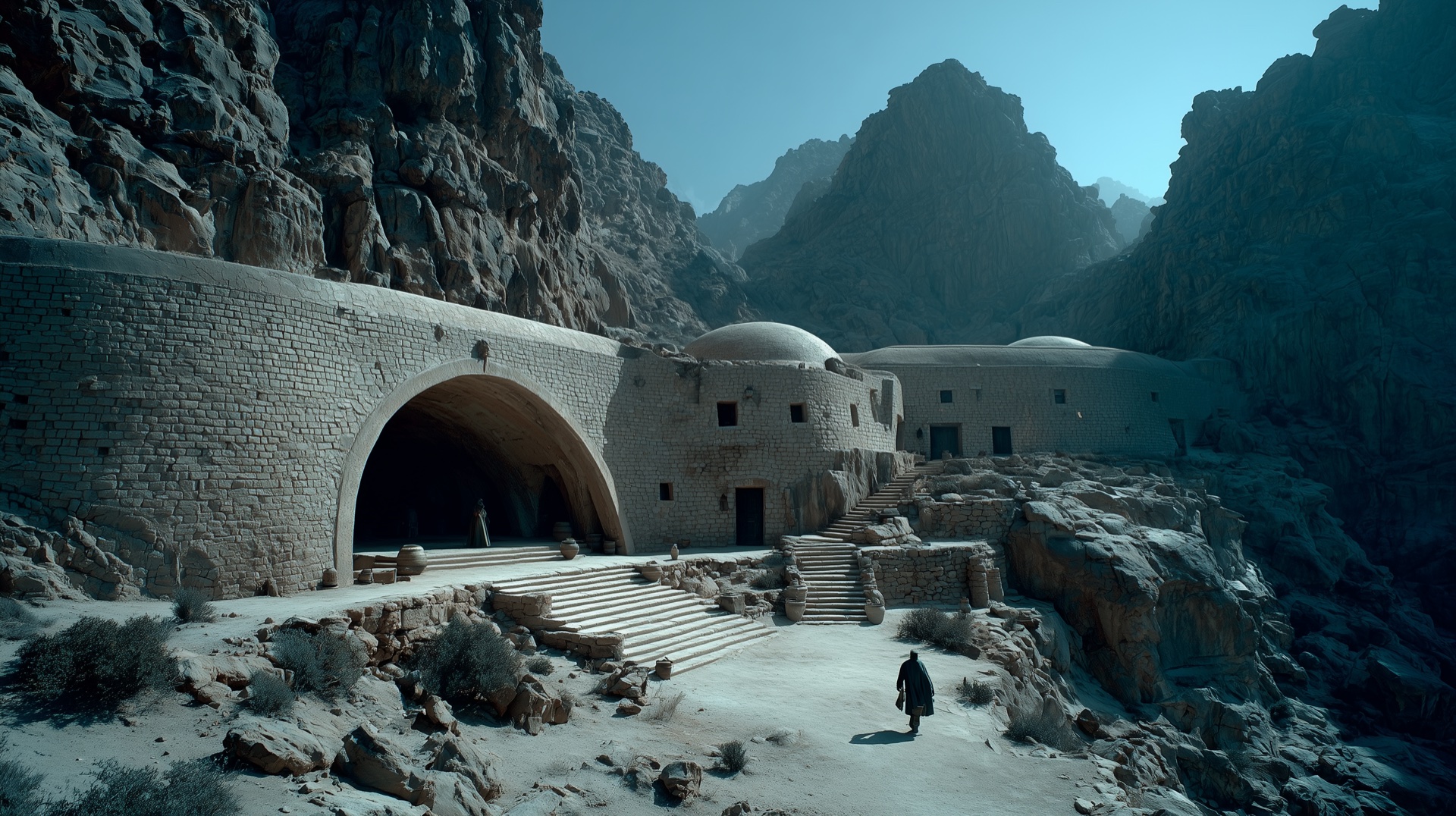
The settlement was called Threshold, which Liel thought was either aspirational or accidental. It sat in a shallow basin between two ridges of the iron-black rock that comprised most of Crae’s visible surface. Seventy structures, none taller than two stories because the gravity made height expensive and dangerous. The buildings were squat, thick-walled, hunched against the wind that blew constant and cold from the northern steppe. Everything was built from local materials: the dark stone, the copper-green clay, the fibrous stalks of a native plant they called razorgrass that could be woven into insulation dense enough to hold heat through the fourteen-hour nights.
Nothing about Threshold resembled anything from the image archives Yuna kept on her personal terminal, the only piece of Earth technology she had carried across the void and refused to let anyone repair or upgrade when its display began to flicker. The images showed structures of glass and white stone, slender towers, arched bridges over water that caught light and threw it back in colors Liel had no referent for. Trees. She knew the word, could identify them in the images, but the concept of a living thing that grew ten meters tall and swayed in wind without breaking felt implausible, a mild hallucination. On Crae, nothing grew taller than knee-height. The razorgrass clung to the ground in dense, low mats, and the fungal blooms that spread across the rock faces after the rare rains were flat, furred things that shrank from even the modest wind.
Yuna cycled through these images in the evenings, her fingers moving across the cracked display with a tenderness that made Liel uncomfortable. Not because it was sad (Liel understood sadness) but because it revealed a loyalty to something she could not verify. The images could have been fabricated, could have been another world entirely, could have been a shared dream that the first generation maintained by consensus. Earth was a word. A set of images on a dying screen. A quality of light that Liel had never seen and would never see. She felt no grief about this. What troubled her was that she was supposed to.
The funeral customs had drifted. Yuna told Liel once that on Earth the dead were buried in soil or burned to ash, and that both methods had deep roots in beliefs about return, the body given back to the world that made it. On Crae, there was no soil. The ground was rock and mineral dust, and digging a grave in 1.6 gravity was an extravagance of effort no one could justify. The colony’s dead were carried to the ridge and laid out under the Nail’s white light, and the wind and the alkaline air did the rest. Within weeks, the body was powder. Within months, indistinguishable from the dust that covered everything.
Yuna found this obscene. “They become the planet,” she had said, her voice carrying a revulsion that Liel recognized but did not share. “Not Earth. Not home. This place eats them and calls it burial.”
But Liel had watched her mother’s face when old Petros died last year and was carried to the ridge. Cade had stood in the wind, her broad frame solid and unmoved, and watched the body laid on the dark stone without flinching. When Liel asked her afterward if she thought it was wrong, Cade had looked at her with genuine puzzlement. “Wrong how? Where else would he go?”
Where else would he go. The question assumed Crae. Only Crae. The planet was not a compromise or a refuge or a second choice. It was the world. Liel saw this in her mother and recognized it in herself, and understood that Yuna was the last person alive for whom this recognition was a wound.
Yuna died on a still day, which on Crae meant the wind had dropped from its usual forty kilometers per hour to something closer to twenty. The hum of the crust seemed louder without the wind’s counterpoint, a deep, steady tone that Liel felt in her jaw and her sternum. She sat with the body for an hour, as custom dictated, though the custom was only thirty years old and had been invented by the second generation to fill a gap where older customs could not survive transplantation.
She looked at Yuna’s hands. They were long-fingered, delicate, the bones visible beneath skin that had thinned to translucence in her final years. Earth hands. Liel placed her own beside them. Shorter, broader, the knuckles thickened, the skin rougher, a faint mineral discoloration at the nail beds from years of handling Crae’s iron-rich clay. The two hands side by side told the whole story. No one needed to say the word adaptation. The evidence was structural, skeletal, written in the architecture of tendon and bone.
Cade came in and stood behind her. “We should take her up before dark.”
“She wanted to be buried,” Liel said. “In the ground. She told me.”
A long silence. The drone hummed through the floor. Finally, Cade said, “There is no ground, Liel. Not the kind she meant.”
They carried her to the ridge at dusk. It took four of them, because gravity made even a small woman heavy, and they laid her on the dark stone facing the sky, because Yuna had once said that on Earth the dead faced upward, toward something. Liel did not know what the something was. She suspected Yuna hadn’t either, not really, not after fifty years on a world that offered nothing above but the Nail and the flat white light and the thin, alkaline dark.
The wind picked up as they walked back. Behind them, the dust was already beginning its work.
Yuna’s terminal passed to Liel. No one else wanted it. Cade had no use for images of a world she couldn’t remember, and the younger members of the settlement, the fourth-generation children, born low and dense-boned, their eyes already developing the narrowed squint that filtered Crae’s unforgiving light, regarded the device with the polite disinterest of people shown artifacts from someone else’s religion.
Liel set it on the shelf beside the window in her quarters. For three days she didn’t touch it. She told herself she was busy. The eastern kiln needed relining, the razorgrass harvest was coming, there were always things to do in a settlement where survival was the baseline occupation and everything above it was luxury. But she knew the real reason. She was afraid of what she would feel. Or, more precisely, afraid of what she wouldn’t.
On the fourth night, after her daughter Maret had fallen asleep, eight years old, already so close to the ground she seemed to crouch even when standing, Liel powered on the terminal. The display flickered, stabilized, flickered again. The colors were wrong, shifted toward the yellow end of the spectrum by whatever degradation had crept into the screen’s aging elements. Earth, as rendered by the dying display, looked like something seen through old glass or through water, present but distorted, a place viewed at a remove that was more than distance.
She scrolled through the images. She had seen them all before, over Yuna’s shoulder, accompanied by narration so practiced it had become liturgy. This is the coast at Busan. This is my mother’s kitchen. This is rain on a window. Liel knew the words. She did not know the things. The coast was a concept, a place where land met water, but the scale of it, the sheer volume of water implied by that single image, was beyond her experience. Crae had water, pulled from deep aquifers and recycled with obsessive efficiency, but it was a resource, measured in liters, never something that could stretch to a horizon and move of its own volition.
She stopped on an image Yuna had rarely shown. Two people standing in a field of something green, not razorgrass green, not the dull sage of Crae’s fungal blooms, but a green so saturated it looked invented. The people were tall, straight-backed, their arms bare, their skin a color Liel had no word for because no one on Crae had skin like that. Unweathered. Uncompressed. They were smiling. Behind them, the sky was a blue that Liel understood intellectually but could not feel. She stared at the image for a long time, waiting for something to happen inside her. Grief. Longing. The ache of exile that had carved Yuna’s face into a mask of permanent, quiet loss.
Nothing came. The people in the image were strangers. The green field was an abstraction. The blue sky was a technical specification. She felt the same mild interest she felt looking at diagrams of the colony ship’s engine, an acknowledgment that this was real, or had been real, combined with a complete absence of personal connection. She was three generations and forty-seven years removed from that field, and the distance was not measurable in light-years. It was skeletal. Cellular. The body that sat on this stool in this squat stone room under this white sun was not the same kind of body that had stood in that green field under that blue sky. The adaptation was too complete. There was nothing left to grieve with.
She powered off the terminal and sat in the dark, listening to the drone of the crust and the wind scraping the walls, and understood that this was not a failure of feeling. It was the feeling itself. The absence was the message. You cannot mourn what you never had. You can only note, with a precision that is its own kind of sorrow, the place where the mourning was supposed to be.
Maret was the reason Liel began to pay attention to the shape of things.
Her daughter moved differently. Not just the low center of gravity, the broad stance, the rolling gait that all Crae-born shared. Something else. Maret navigated spaces with an efficiency that seemed almost precognitive, ducking through doorways a half-second before she could have seen the lintel, stepping around obstacles in the dark, placing her feet on stable ground with a certainty that had nothing to do with sight. Dr. Azenka, examining her during a routine check, noted that Maret’s inner ear structure had shifted. The semicircular canals were larger, more complex, adapted to process Crae’s gravitational field with a fidelity that the second and third generations hadn’t achieved.
“She doesn’t fight the gravity,” Azenka said, reviewing the scans. “You and I compensate for it. Our bodies are Earth-derived, adapted but always working against the baseline. Maret’s body doesn’t have a baseline. Crae is the baseline. She’s not adapted to this world. She’s native to it.”
Liel watched her daughter climb the ridge path that afternoon, scrambling over the black rock with a fluid sureness that looked nothing like the careful, deliberate movements Liel made on the same path. Maret didn’t grip the rock. She flowed over it, her weight distributed instinctively, her hands touching stone only for guidance, never for support. She looked like something that had grown here. Like the razorgrass, like the flat fungal blooms, like the wind-carved pillars of iron-rich stone that lined the northern steppe. She looked like Crae.
And she would never know what she had cost. That was the thing that lodged in Liel’s chest and would not dissolve. Maret would never stand in front of Yuna’s flickering terminal and feel the absence where grief should be, because for Maret there was no absence. There was no ghost of an upright skeleton haunting her posture, no phantom memory of a blue sky she’d never seen encoded in her visual cortex. She was clean. Complete. Unburdened by the transitional architecture that Liel carried, the body that was neither Earth nor fully Crae, the mind that could still recognize the distance between the two.
Liel was the hinge. She could see both sides. Behind her, Yuna’s world. Vertical, fragile, lit by moving light. Ahead, Maret’s world. Low, dense, humming with the iron drone of a planet that had finally finished the argument. After Liel, no one would stand in the middle. No one would feel the turn.
There was a night, three months after Yuna’s death, when Liel saw something she could not explain.
She was on the ridge, alone. She went there sometimes after dark, not to visit Yuna (the wind had long since erased any trace) but because the ridge was the highest point near Threshold, and from it you could see the steppe stretching north under the Nail’s residual glow, a vast and featureless dark broken only by the faint luminescence of fungal blooms on distant rock faces.
The Nail had set. The sky was black, thick with unfamiliar constellations. Crae’s sky, nothing like the star charts from Earth that Yuna had once tried to teach her. Liel sat on the dark stone and felt the drone through her bones and watched the nothing, which was her preferred form of thinking.
Then the light changed.
It was subtle. Not a flash, not a flare, but a shift in quality. As if the darkness itself had acquired a texture, a depth it hadn’t had a moment before. The stars didn’t move, but they seemed to recede, to layer themselves at different distances in a way that Liel’s eyes had never registered. For a moment, a fraction of a moment, briefer than a blink, she had the sensation that the sky was not a surface but a stack. That behind each star was another star, and behind that another, and that each layer was not distant but adjacent, occupying the same space at a slightly different angle of existence.
Her inner ear lurched. The drone of the crust shifted pitch, or she imagined it shifted, dropping into a register so low it was less a sound than a pressure, a feeling of depth beneath depth, the planet itself revealing that it was not one thing but many things pressed together.
Then it was over. The stars were stars. The sky was a surface. The drone returned to its familiar frequency. Liel sat very still, her heart beating hard, her broadened hands pressed flat against the rock as if to confirm its solidity. She breathed Crae’s thin air and tasted the alkaline bite of it and felt the gravity holding her exactly where she was, and she told herself it was fatigue, or altitude, or the residual grief that Dr. Azenka said sometimes manifested as sensory anomalies.
She did not tell anyone. There was no one to tell. Yuna might have understood. Might have said, yes, the light does that sometimes, the world is not as settled as it seems. But Yuna was dust on the ridge, becoming Crae, and Cade would have frowned and suggested she sleep more, and Maret would have looked at her with the cheerful incomprehension of a child who had never needed to question the ground beneath her feet.
Years passed. Maret grew. The settlement expanded, slowly, cautiously, in the way that things grew on heavy worlds, spreading outward rather than upward, close to the ground. New kilns. A second smelting yard. A school where the children learned geology and atmospheric chemistry and the practical mechanics of survival, and where the word Earth appeared in the curriculum as a historical note, a point of origin no different from the name of the colony ship or the designation of the star.
Liel taught at the school for a time. She taught material science. The properties of Crae’s iron-rich stone, the tensile strength of razorgrass fiber, the chemistry of the alkaline soil. Practical knowledge. The kind of knowledge that kept you alive. She did not teach history. The history teacher was a fourth-generation woman named Solenne who had never seen Yuna’s terminal and who taught the founding of Threshold the way one teaches the formation of a river, as a natural event, inevitable, requiring no particular mourning or celebration.
Liel attended one of Solenne’s classes once, standing in the back, listening. Solenne described the arrival of the Invariant in clear, unadorned language. She mentioned Earth as the point of departure. She did not describe it. A child raised her hand and asked what Earth was like, and Solenne said, “It was a world with lighter gravity and a different atmosphere. The colonists had to adapt when they arrived here.” That was all. No images of green fields or blue skies or arched bridges over moving water. No sense of loss. No sense that anything had been left behind that mattered more than what had been found.
Liel left the classroom and stood in the wind outside, and for the second time in her life she felt the flicker, the layering, the stacking, the momentary sense that the world she stood on was one page in a book of infinite pages, each one almost the same but tilted at a slightly different angle. It lasted longer this time. Two breaths. Three. She felt, with a clarity that frightened her, that somewhere in the stack was a version of this moment where she had never left Earth, where Yuna had never boarded the Invariant, where the green field in the photograph was not an image but a daily view from a kitchen window. That version of her was standing in moving light, under a sky full of clouds, in a body that had never bent beneath heavy gravity. And that version could not see her either.
The flicker passed. Liel stood in the constant light of the Nail, in the wind, on the dark stone, in the body Crae had built for her, and she let it go. Not because it wasn’t real. But because it didn’t matter. That other Liel, in that other light, was not more real. She was just different. Another page. Another pressing of the same clay into a different mould.
Maret had a daughter. They named her Yuna, at Liel’s request, though Liel knew the name would mean nothing to the child, would be only a sound, emptied of its cargo, a word that had once pointed toward Earth and now pointed at a small, dense-boned girl who would never stand fully upright and who would hear the drone of Crae’s crust the way a fish hears water: as the medium of existence itself, invisible, total, unquestioned.
Liel held the baby. She was heavy, heavier than a baby should be by Earth standards, though there were no Earth standards anymore, not here, not in the bodies of these people. The baby’s hands were broad, the fingers short and thick, the grip startlingly strong. Liel looked at those hands and thought of Yuna’s hands, the first Yuna, the Earth Yuna, translucent and long-fingered, reaching for a cracked display that showed a world of moving light. The distance between those hands and these hands was forty-seven years and 1.6 gravities and the entire width of what a species could become when it stopped holding still.
She carried the baby to the window. Outside, Threshold lay in its basin under the Nail’s white light, low and solid and permanent, built from the bones of the planet itself. Children ran in the streets, if you could call them streets, their movements quick and sure, close to the ground, native. The wind blew from the north, carrying dust and the faint mineral scent of the steppe. The drone hummed through the floor, through the walls, through Liel’s skeleton and into the baby’s, two instruments tuned to the same frequency, the older one still carrying the faint echo of a different pitch.
She did not show the baby Yuna’s terminal. It sat on the shelf, powered off, its screen dark. One day it would stop working entirely, and no one would repair it, and the images of Earth would join Earth itself. A thing that had happened, that had mattered, that had produced everything that came after, and that was no longer needed.
Liel pressed her lips to the baby’s forehead, feeling the warmth of it, the solidity, the untroubled weight of a creature perfectly suited to the world it had been born into. This was what adaptation looked like from the inside. Not loss. Not surrender. Not survival. Something harder to name. The thing that remained when everything else had been given over to the gravity and the wind and the slow, patient insistence of a world that would accept you only on its own terms.
Outside, the light held steady. The wind did not stop. The dust settled on every surface, fine as powdered bone, covering the new and the old alike in the same thin, mineral layer, until you could not tell where one ended and the other began.